

What you'll learn
- How to turn a real situation into a probability model.
- How assumptions such as independence and equal likelihood affect calculations.
- How to criticise assumptions rather than simply accepting them.
- How more realistic assumptions are likely to change a model's predictions.
Probability prerequisites
Before building models, you need a few basic probability ideas.
Events and outcomes
An outcome is one possible result of a process. For example, rolling a 4 is an outcome when a die is rolled.
An event is a set of one or more outcomes. For example, “rolling an even number” is the event containing 2, 4 and 6.
A probability lies between 0 and 1:
0≤P(A)≤10 \le P(A) \le 10≤P(A)≤1The probabilities of all mutually exclusive outcomes in a complete model must add to 1.
Mutually exclusive events
Events are mutually exclusive if they cannot occur at the same time. For mutually exclusive events AAA and BBB,
P(A∪B)=P(A)+P(B)P(A \cup B)=P(A)+P(B)P(A∪B)=P(A)+P(B)Independent events
Events AAA and BBB are independent if the occurrence of one does not change the probability of the other. In that case,
P(A∩B)=P(A)P(B)P(A \cap B)=P(A)P(B)P(A∩B)=P(A)P(B)Independent does not mean mutually exclusive
Independent events can occur together. Mutually exclusive events cannot. Two events with positive probabilities cannot be both independent and mutually exclusive.
What is a probability model?
A probability model is a mathematical description of a situation involving uncertainty. It specifies the possible outcomes and assigns probabilities to them.
The real world is usually too complicated to describe completely, so a model deliberately simplifies it. These simplifications are called assumptions.
Assumption
An assumption is a condition treated as true when constructing a model, even though it may only be approximately true in reality.
For example, a model of traffic accidents might assume that accidents occur independently and that the accident rate is constant throughout the day. These assumptions make calculation possible, but they may not be realistic during rush hour or poor weather.
A model is not reality
A probability model is useful when its assumptions are reasonable enough for its purpose. A model can be mathematically correct but still produce poor predictions because its assumptions do not match the situation.
Constructing a probability model
A sensible modelling process has four broad stages:
- Identify the uncertain quantity or event of interest.
- Choose possible outcomes and assign probabilities using data, theory or judgement.
- Calculate the model's prediction.
- Compare the prediction with reality and refine the assumptions if necessary.
Theoretical and experimental probabilities
A theoretical probability is found from the structure of an idealised situation. For a fair die,
P(rolling a 6)=16.P(\text{rolling a 6})=\frac{1}{6}.P(rolling a 6)=61.An experimental probability, also called a relative frequency, is estimated from observations:
relative frequency=number of times the event occursnumber of trials.\text{relative frequency}=\frac{\text{number of times the event occurs}}{\text{number of trials}}.relative frequency=number of trialsnumber of times the event occurs.Estimating a cancellation probability
A train company records 18 cancellations among 1200 scheduled trains. Estimate the probability that its next train is cancelled.
-
Treat the recorded trains as representative trials and define CCC as the event that a train is cancelled.
-
Use relative frequency:
P(C)≈181200=0.015.P(C)\approx\frac{18}{1200}=0.015.P(C)≈120018=0.015. -
The model therefore estimates a cancellation probability of 0.015, or 1.5%. This relies on future conditions being similar to those during the data collection period.
Treating an estimate as exact
A probability calculated from data is an estimate. A different sample will usually give a different relative frequency, especially when the sample is small.
Common modelling assumptions
Equally likely outcomes
Outcomes are equally likely when each has the same probability. This is reasonable for an ideal fair die, but not automatically for every physical object or human choice.
If there are nnn equally likely outcomes and an event contains rrr of them, then
P(A)=rn.P(A)=\frac{r}{n}.P(A)=nr.Questioning equal likelihood
A café models each of four sandwich choices as equally likely. It therefore predicts that 50 of its next 200 customers will choose each sandwich.
-
Equal likelihood gives each sandwich probability 14\frac1441, so the predicted number choosing one sandwich is
200×14=50.200\times\frac14=50.200×41=50. -
This assumes customers have no preference and that price, availability and time of day have no effect.
-
If sales data show that one sandwich is more popular, a more realistic model would assign it a probability greater than 14\frac1441. Its predicted sales would rise above 50, while the predictions for at least some other sandwiches would fall.
Independence
Assuming independence allows probabilities along separate stages to be multiplied. However, repeated real-world events are often connected.
Drawing counters with replacement makes successive draws independent because the bag returns to its original composition. Drawing without replacement makes them dependent because the first draw changes the second probability.
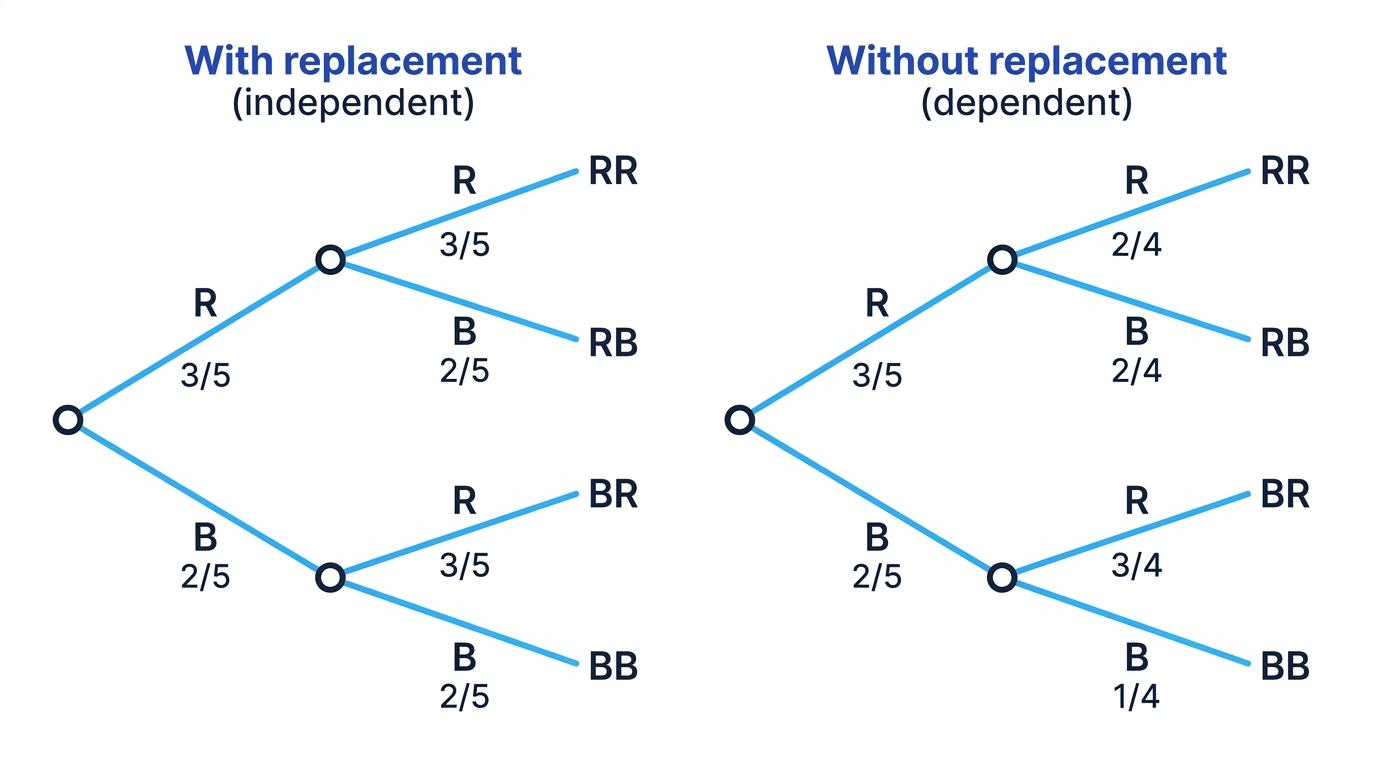
Comparing independent and dependent draws
A bag contains 3 red and 2 blue counters. Two counters are drawn. Compare the probability of two red counters with and without replacement.
-
With replacement, the probability of red remains 35\frac3553 on each draw:
P(RR)=35×35=925.P(RR)=\frac35\times\frac35=\frac{9}{25}.P(RR)=53×53=259. -
Without replacement, after one red counter is drawn there are 2 red counters among 4 remaining counters:
P(RR)=35×24=310.P(RR)=\frac35\times\frac24=\frac{3}{10}.P(RR)=53×42=103. -
The independent model gives 925=0.36\frac{9}{25}=0.36259=0.36, while the dependent model gives 0.30. Assuming replacement therefore overestimates the chance of two reds in this situation.
A constant probability
Repeated-trial models often assume that the probability of success, ppp, stays constant.
For example, a model might assume that every component has the same probability of being defective. In reality, the probability could change if a machine warms up, materials vary or equipment begins to wear out.
A fixed number of trials
A model may assume that the number of trials, nnn, is fixed in advance. This is required for a binomial model.
Binomial model
A random variable XXX can be modelled using a binomial distribution, written X∼B(n,p)X\sim B(n,p)X∼B(n,p), when there is a fixed number nnn of independent trials, each trial has two possible outcomes, and the probability of success ppp is constant.
Using and criticising a binomial model
A website estimates that each visitor independently has probability 0.04 of making a purchase. It receives 20 visitors. Find the probability of exactly two purchases.
-
Let XXX be the number of purchases. Under the stated assumptions,
X∼B(20,0.04).X\sim B(20,0.04).X∼B(20,0.04). -
Choose which two visitors make purchases and multiply by the appropriate success and failure probabilities:
P(X=2)=(202)(0.04)2(0.96)18≈0.146.P(X=2)=\binom{20}{2}(0.04)^2(0.96)^{18}\approx0.146.P(X=2)=(220)(0.04)2(0.96)18≈0.146. -
Independence may be unrealistic if visitors influence one another through shared recommendations. A constant value of ppp may also be unrealistic if visitors arrive from different advertising campaigns. If one campaign attracts more likely buyers, the model may underestimate the variation in purchase numbers.
Critiquing assumptions
To critique an assumption means to judge whether it is reasonable and explain how any weakness could affect the model.
A strong critique has three parts:
- Name the assumption.
- Explain why it may fail in context.
- State the likely direction or nature of the effect on the prediction.
It is not enough to write “the model is unrealistic”. You must identify what is unrealistic.
Critiquing an accident model
A factory models each worker as having an independent probability of 0.01 of suffering an accident during a year.
- The model assumes that all workers have the same accident probability. This may fail because jobs, experience and working hours differ.
- It also assumes independence. This may fail because several workers could be affected by the same equipment fault or unsafe conditions.
- Shared risks make accidents more likely to occur in clusters. An independent model may therefore underestimate the probability of several accidents occurring in the same year, even if its prediction for the average number is reasonable.
State the direction of the effect
Useful conclusions include “the model is likely to overestimate”, “the model is likely to underestimate” and “the outcomes will be more clustered or more variable than predicted”. Only claim a direction when the context supports it.
Making assumptions more realistic
A more realistic model may:
- use different probabilities for different groups;
- allow probabilities to vary over time;
- include dependence between events;
- use data from a more representative time period;
- include additional outcomes or explanatory factors.
Greater realism is not always automatically better. A more detailed model requires more data, introduces more parameters and may be harder to interpret.
Balance accuracy and simplicity
The best model is not necessarily the most complicated one. It should be detailed enough to answer the question reliably while remaining practical to use.
In the exam
- Translate every assumption into context: identify what independence, equal likelihood or constant probability means in the situation.
- When criticising, give a specific reason the assumption may fail and explain the likely effect on the result.
- Keep exact values during calculations, then round only at the end and state that data-based probabilities are estimates.
Check yourself
- What conditions must hold before a binomial model is appropriate?
- Why does drawing without replacement usually destroy independence?
- How would you improve a model that assumes every customer has the same purchase probability?
