

What you'll learn
- How to describe an object's position and displacement relative to a chosen origin.
- The difference between distance travelled and displacement.
- The difference between speed and velocity.
- How acceleration describes a change in velocity.
Describing motion
Kinematics is the study of how objects move, without considering the forces causing the motion.
In mechanics, an object is often modelled as a particle. This means its size and shape are ignored, so its entire mass can be treated as being concentrated at a single point.
Before describing motion along a straight line, you must choose:
- a fixed origin, such as the point labelled OOO;
- a positive direction, such as motion to the right.
The opposite direction is then negative.
Direction matters
A positive value means “in the chosen positive direction”, while a negative value means “in the opposite direction”. The signs do not automatically mean forwards and backwards: that depends on the direction chosen in the question.
Scalars and vectors
Kinematic quantities can be either scalars or vectors.
Scalar
A scalar quantity has magnitude, meaning size, but no direction. Distance and speed are scalars.
Vector
A vector quantity has both magnitude and direction. Displacement, velocity and acceleration are vectors.
For one-dimensional motion, direction can be represented using a positive or negative sign. For example, if right is positive, a velocity of −4 m s⁻¹ means a velocity of magnitude 4 m s⁻¹ to the left.
Position
The position of a particle tells you where it is relative to the chosen origin. For motion along a straight line, position is commonly represented by the coordinate xxx.
For example:
- x=7x=7x=7 m means the particle is 7 m in the positive direction from the origin;
- x=−3x=-3x=−3 m means the particle is 3 m in the negative direction from the origin.
Position can be positive, negative or zero. A negative position does not mean that the particle is moving in the negative direction; it only tells you which side of the origin it occupies.
Confusing position with direction of motion
The sign of a particle's position does not tell you its direction of travel. A particle at x=−3x=-3x=−3 m could be moving in either direction.
Displacement
Displacement
The displacement of a particle is its change in position. It is a vector, so it includes direction.
If a particle moves from initial position x1x_1x1 to final position x2x_2x2, then
displacement=x2−x1.\text{displacement}=x_2-x_1.displacement=x2−x1.Displacement depends only on the initial and final positions. The route taken between those positions does not affect it.
Finding displacement from two positions
A particle moves from x=−4x=-4x=−4 m to x=7x=7x=7 m. Find its displacement.
-
Identify the initial and final positions: x1=−4x_1=-4x1=−4 m and x2=7x_2=7x2=7 m.
-
Subtract the initial position from the final position:
displacement=7−(−4)=11 m.\text{displacement}=7-(-4)=11\text{ m}.displacement=7−(−4)=11 m. -
The displacement is 11 m in the positive direction.
Distance travelled
Distance travelled
The distance travelled is the total length of the route followed by a particle. It is a scalar, so it has no direction and cannot be negative.
If a particle changes direction, you add the length of every part of its journey. By contrast, its displacement still depends only on where it starts and finishes.
Comparing distance and displacement
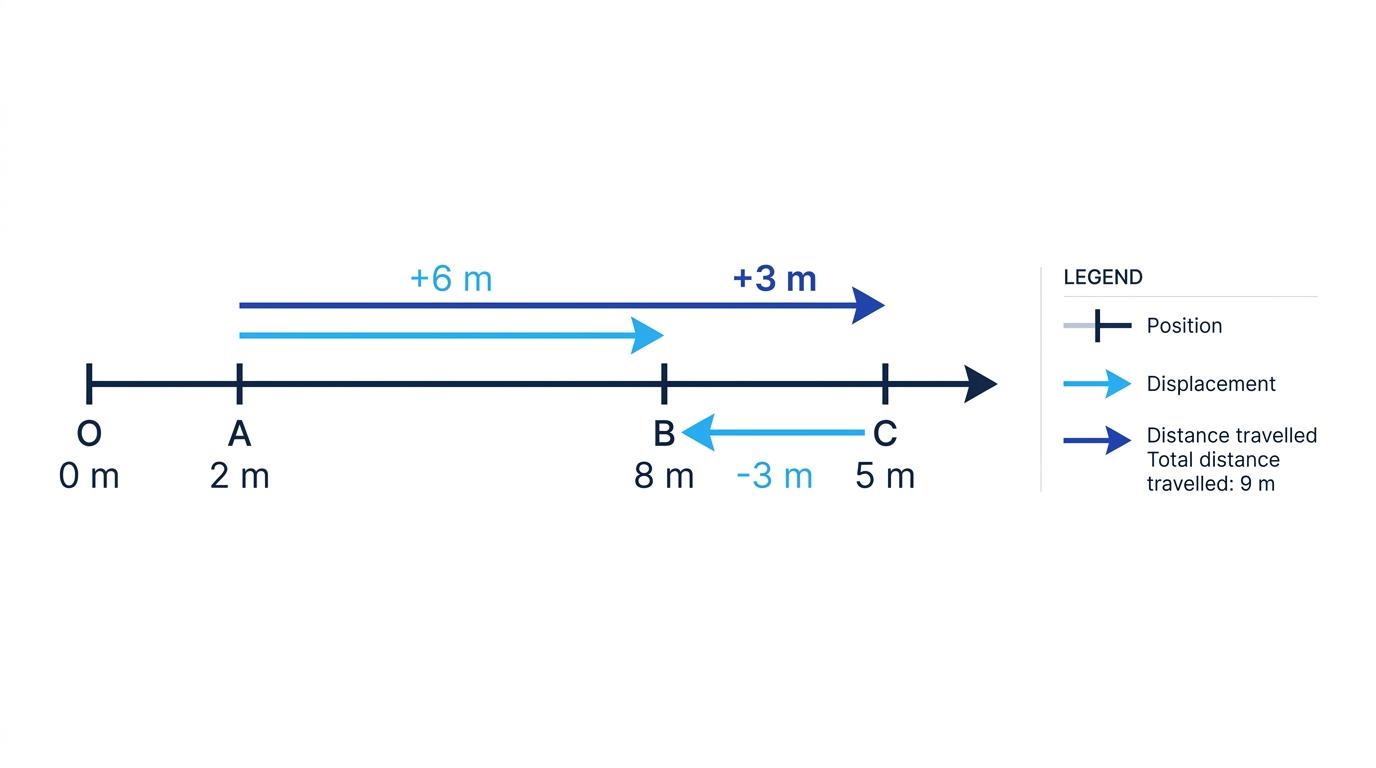
A particle begins at x=2x=2x=2 m, moves to x=8x=8x=8 m, and then returns to x=5x=5x=5 m. Find its distance travelled and displacement.
-
The first part of the journey has length 8−2=68-2=68−2=6 m, and the return journey has length 8−5=38-5=38−5=3 m.
-
Add the lengths to find the total distance:
distance travelled=6+3=9 m.\text{distance travelled}=6+3=9\text{ m}.distance travelled=6+3=9 m. -
Use only the initial and final positions for displacement:
displacement=5−2=3 m.\text{displacement}=5-2=3\text{ m}.displacement=5−2=3 m. -
Therefore, the distance travelled is 9 m, while the displacement is 3 m in the positive direction.
A useful check
The magnitude of displacement can never be greater than the distance travelled. They are equal only when the particle travels directly without reversing direction.
Speed
Speed
Speed is the rate at which distance is travelled. It is a scalar and is measured in metres per second, m s⁻¹.
The average speed over a complete journey is
average speed=total distance travelledtotal time taken.\text{average speed}=\frac{\text{total distance travelled}}{\text{total time taken}}.average speed=total time takentotal distance travelled.Average speed does not show changes during the journey. A particle might sometimes travel faster and sometimes slower while still having a particular average speed.
Velocity
Velocity
Velocity is the rate of change of displacement. It is a vector and is measured in metres per second, m s⁻¹.
The average velocity over a time interval is
average velocity=displacementtime taken.\text{average velocity}=\frac{\text{displacement}}{\text{time taken}}.average velocity=time takendisplacement.Because displacement has direction, velocity also has direction. In one dimension:
- positive velocity means motion in the positive direction;
- negative velocity means motion in the negative direction;
- zero velocity means the position is not changing at that instant.
The instantaneous velocity is the velocity at one particular instant. Similarly, instantaneous speed is the speed at that instant.
Speed is the magnitude of velocity
For motion along a straight line, speed is the magnitude of velocity. If v=−6v=-6v=−6 m s⁻¹, the velocity is in the negative direction but the speed is 6 m s⁻¹.
Comparing average speed and average velocity
A particle travels 30 m east and then 10 m west in a total time of 8 s. Take east as positive.
-
Add the route lengths to obtain the distance travelled: 30+10=4030+10=4030+10=40 m.
-
Include direction when calculating displacement: 30−10=2030-10=2030−10=20 m east.
-
Divide distance by time:
average speed=408=5 m s−1.\text{average speed}=\frac{40}{8}=5\text{ m s}^{-1}.average speed=840=5 m s−1. -
Divide displacement by time:
average velocity=208=2.5 m s−1.\text{average velocity}=\frac{20}{8}=2.5\text{ m s}^{-1}.average velocity=820=2.5 m s−1. -
The average speed is 5 m s⁻¹, while the average velocity is 2.5 m s⁻¹ east.
Using displacement to calculate average speed
Average speed uses total distance travelled, whereas average velocity uses displacement. These can give very different answers if the particle changes direction.
Acceleration
Acceleration
Acceleration is the rate of change of velocity. It is a vector and is measured in metres per second squared, m s⁻².
If the velocity changes from uuu to vvv in time ttt, the average acceleration is
a=v−ut,a=\frac{v-u}{t},a=tv−u,where:
- uuu is the initial velocity;
- vvv is the final velocity;
- aaa is the acceleration;
- ttt is the time taken.
Acceleration can be caused by a change in speed, a change in direction, or both.
Calculating average acceleration
A particle's velocity changes from −3 m s⁻¹ to 7 m s⁻¹ in 5 s. Find its average acceleration.
-
Keep the signs of both velocities because velocity is a vector: u=−3u=-3u=−3 m s⁻¹ and v=7v=7v=7 m s⁻¹.
-
Calculate the change in velocity:
v−u=7−(−3)=10 m s−1.v-u=7-(-3)=10\text{ m s}^{-1}.v−u=7−(−3)=10 m s−1. -
Divide by the time taken:
a=105=2 m s−2.a=\frac{10}{5}=2\text{ m s}^{-2}.a=510=2 m s−2. -
The average acceleration is 2 m s⁻² in the positive direction.
Negative acceleration and slowing down
A negative acceleration means that the acceleration acts in the chosen negative direction. It does not necessarily mean that the particle is slowing down.
A particle slows down when its acceleration and velocity have opposite signs:
- positive velocity with negative acceleration means slowing down;
- negative velocity with positive acceleration means slowing down.
If velocity and acceleration have the same sign, the particle's speed increases.
Assuming negative acceleration means deceleration
Negative acceleration describes direction, not automatically a decrease in speed. Always compare the signs of velocity and acceleration.
Deciding whether a particle is speeding up
A particle has velocity −5 m s⁻¹ and acceleration −2 m s⁻².
- The negative velocity shows that the particle is moving in the negative direction.
- The acceleration is also in the negative direction, so velocity and acceleration have the same sign.
- The magnitude of the velocity therefore increases, meaning the particle is speeding up.
In the exam
- Choose a positive direction and keep that convention throughout your working.
- Use final position minus initial position for displacement, but add every section of the route for distance.
- Keep signs when working with velocity and acceleration, and carry the correct SI units through each calculation.
- Check whether the question asks for a scalar, such as speed, or a vector, such as velocity.
- To decide whether a particle is speeding up or slowing down, compare the signs of its velocity and acceleration.
Check yourself
- A particle moves from x=−2x=-2x=−2 m to x=6x=6x=6 m and then returns to x=1x=1x=1 m. What are its distance travelled and displacement?
- Why can a particle have a non-zero average speed but zero average velocity?
- Is a particle with negative acceleration always slowing down? Explain using the signs of velocity and acceleration.
