

What you'll learn
- How rectangles can approximate the area under a curve.
- How to write these approximations using sigma notation.
- Why taking a limit gives the exact value of a definite integral.
- How to evaluate and recognise limits of sums in exam questions.
Prerequisites
Definite integrals
A definite integral gives the signed area between a graph and the horizontal axis over a specified interval.
If f(x)≥0f(x)\geq 0f(x)≥0 between x=ax=ax=a and x=bx=bx=b, then
∫abf(x) dx\int_a^b f(x)\,dx∫abf(x)dxis the area under the curve y=f(x)y=f(x)y=f(x) from x=ax=ax=a to x=bx=bx=b.
You already know that this can be evaluated using an antiderivative:
∫abf(x) dx=[F(x)]ab=F(b)−F(a),\int_a^b f(x)\,dx=[F(x)]_a^b=F(b)-F(a),∫abf(x)dx=[F(x)]ab=F(b)−F(a),where F′(x)=f(x)F'(x)=f(x)F′(x)=f(x).
In this topic, you will see where this integral comes from.
Sigma notation
The Greek capital letter ∑\sum∑, read as “sum”, is used to add a sequence of terms.
For example,
∑r=1nr=1+2+3+⋯+n.\sum_{r=1}^{n}r=1+2+3+\cdots+n.r=1∑nr=1+2+3+⋯+n.Here, rrr is the index: it changes from its starting value to its finishing value.
You should know these standard results:
∑r=1n1=n,\sum_{r=1}^{n}1=n,r=1∑n1=n, ∑r=1nr=n(n+1)2,\sum_{r=1}^{n}r=\frac{n(n+1)}{2},r=1∑nr=2n(n+1), ∑r=1nr2=n(n+1)(2n+1)6,\sum_{r=1}^{n}r^2=\frac{n(n+1)(2n+1)}{6},r=1∑nr2=6n(n+1)(2n+1),and, when required,
∑r=1nr3=(n(n+1)2)2.\sum_{r=1}^{n}r^3=\left(\frac{n(n+1)}{2}\right)^2.r=1∑nr3=(2n(n+1))2.Evaluating a sum of squares
Evaluate ∑r=1n(3r2+2r)\displaystyle \sum_{r=1}^{n}(3r^2+2r)r=1∑n(3r2+2r).
-
Split the sum using the fact that sums are linear:
∑r=1n(3r2+2r)=3∑r=1nr2+2∑r=1nr.\sum_{r=1}^{n}(3r^2+2r) =3\sum_{r=1}^{n}r^2+2\sum_{r=1}^{n}r.r=1∑n(3r2+2r)=3r=1∑nr2+2r=1∑nr. -
Substitute the standard formulae:
=3(n(n+1)(2n+1)6)+2(n(n+1)2).=3\left(\frac{n(n+1)(2n+1)}{6}\right) +2\left(\frac{n(n+1)}{2}\right).=3(6n(n+1)(2n+1))+2(2n(n+1)). -
Simplify:
=n(n+1)(2n+1)2+n(n+1)=n(n+1)(2n+3)2.\begin{aligned} &=\frac{n(n+1)(2n+1)}{2}+n(n+1)\\ &=\frac{n(n+1)(2n+3)}{2}. \end{aligned}=2n(n+1)(2n+1)+n(n+1)=2n(n+1)(2n+3).
Approximating an area with rectangles
Suppose you want the area under y=f(x)y=f(x)y=f(x) from x=ax=ax=a to x=bx=bx=b.
Divide the interval into nnn equal strips. The width of each strip is
Δx=b−an.\Delta x=\frac{b-a}{n}.Δx=nb−a.The symbol Δx\Delta xΔx means “change in xxx”.
If the height of each rectangle is taken at the right-hand end of its strip, the right endpoint of strip rrr is
xr=a+rΔx=a+r(b−a)n.x_r=a+r\Delta x =a+\frac{r(b-a)}{n}.xr=a+rΔx=a+nr(b−a).The area of rectangle rrr is therefore approximately
f(xr)Δx.f(x_r)\Delta x.f(xr)Δx.Adding all the rectangles gives the approximation
∑r=1nf(xr)Δx.\sum_{r=1}^{n}f(x_r)\Delta x.r=1∑nf(xr)Δx.Riemann sum
A Riemann sum is a sum of rectangular areas used to approximate a definite integral, such as ∑r=1nf(xr)Δx\displaystyle \sum_{r=1}^{n}f(x_r)\Delta xr=1∑nf(xr)Δx.
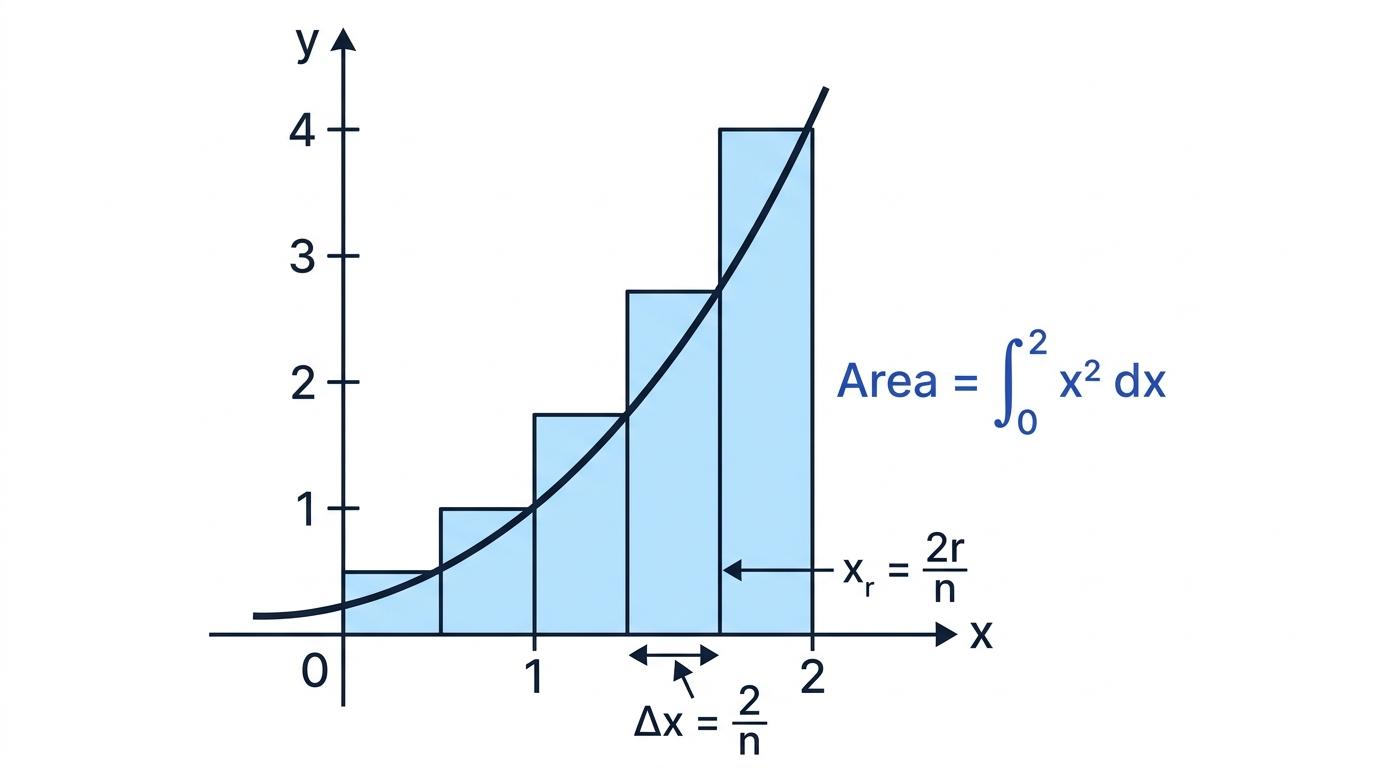
For an increasing function, right-endpoint rectangles usually give an overestimate. Left-endpoint rectangles usually give an underestimate. Both become more accurate as the strips become thinner.
More strips, better approximation
As nnn increases, the strip width Δx\Delta xΔx approaches zero and the tops of the rectangles fit the curve more closely.
Taking the limit
The notation n→∞n\to\inftyn→∞ means that the number of strips increases without bound.
As this happens,
Δx=b−an→0.\Delta x=\frac{b-a}{n}\to 0.Δx=nb−a→0.The limiting value of the Riemann sum is the exact definite integral:
∫abf(x) dx=limn→∞∑r=1nf(a+r(b−a)n)b−an\boxed{ \int_a^b f(x)\,dx = \lim_{n\to\infty} \sum_{r=1}^{n} f\left(a+\frac{r(b-a)}{n}\right) \frac{b-a}{n} }∫abf(x)dx=n→∞limr=1∑nf(a+nr(b−a))nb−aIntegration as the limit of a sum
Integration as the limit of a sum means defining a definite integral as the limiting value of a Riemann sum when the number of strips tends to infinity.
Forgetting the strip width
The summand must include the rectangle width Δx\Delta xΔx. Summing only the heights does not approximate an area.
Evaluating an integral from its limiting sum
To evaluate a limit of a sum, you usually:
- write the rectangle width and endpoint;
- expand the summand;
- apply standard sigma formulae;
- simplify before taking the limit.
Finding the area under a quadratic
Use the limit of a sum to evaluate ∫02x2 dx\displaystyle \int_0^2 x^2\,dx∫02x2dx.
-
Divide the interval from zero to two into nnn equal strips. Then
Δx=2n,xr=2rn.\Delta x=\frac{2}{n}, \qquad x_r=\frac{2r}{n}.Δx=n2,xr=n2r. -
Form the right-endpoint Riemann sum:
∫02x2 dx=limn→∞∑r=1n(2rn)22n.\int_0^2x^2\,dx = \lim_{n\to\infty} \sum_{r=1}^{n} \left(\frac{2r}{n}\right)^2\frac{2}{n}.∫02x2dx=n→∞limr=1∑n(n2r)2n2. -
Simplify the summand and take constants outside the sum:
=limn→∞8n3∑r=1nr2.=\lim_{n\to\infty} \frac{8}{n^3}\sum_{r=1}^{n}r^2.=n→∞limn38r=1∑nr2. -
Use ∑r=1nr2=n(n+1)(2n+1)6\displaystyle \sum_{r=1}^{n}r^2=\frac{n(n+1)(2n+1)}{6}r=1∑nr2=6n(n+1)(2n+1):
=limn→∞8n3⋅n(n+1)(2n+1)6.=\lim_{n\to\infty} \frac{8}{n^3}\cdot \frac{n(n+1)(2n+1)}{6}.=n→∞limn38⋅6n(n+1)(2n+1). -
Divide numerator and denominator by n3n^3n3:
=limn→∞4n(n+1)(2n+1)3n3=limn→∞43(1+1n)(2+1n).\begin{aligned} &=\lim_{n\to\infty} \frac{4n(n+1)(2n+1)}{3n^3}\\ &=\lim_{n\to\infty} \frac{4}{3} \left(1+\frac{1}{n}\right) \left(2+\frac{1}{n}\right). \end{aligned}=n→∞lim3n34n(n+1)(2n+1)=n→∞lim34(1+n1)(2+n1). -
As n→∞n\to\inftyn→∞, both 1n\frac{1}{n}n1 terms tend to zero:
∫02x2 dx=43×1×2=83.\int_0^2x^2\,dx =\frac{4}{3}\times 1\times 2 =\frac{8}{3}.∫02x2dx=34×1×2=38.
Taking the limit efficiently
Rewrite expressions using powers of 1n\frac{1}{n}n1. Every positive power of 1n\frac{1}{n}n1 tends to zero as n→∞n\to\inftyn→∞.
Recognising an integral from a sum
You may also need to work backwards and identify the integral represented by a limiting sum.
Compare the sum with
∑r=1nf(xr)Δx.\sum_{r=1}^{n}f(x_r)\Delta x.r=1∑nf(xr)Δx.Look for a factor behaving like the strip width and an expression behaving like the sample point.
Converting a limit into an integral
Express the following limit as a definite integral:
limn→∞∑r=1n(1+3rn)23n.\lim_{n\to\infty} \sum_{r=1}^{n} \left(1+\frac{3r}{n}\right)^2\frac{3}{n}.n→∞limr=1∑n(1+n3r)2n3.-
Identify the strip width:
Δx=3n.\Delta x=\frac{3}{n}.Δx=n3.Therefore, the total interval length is nΔx=3n\Delta x=3nΔx=3.
-
Identify the right endpoint:
xr=1+3rn.x_r=1+\frac{3r}{n}.xr=1+n3r.This has the form a+rΔxa+r\Delta xa+rΔx, so the lower limit is a=1a=1a=1.
-
Add the interval length to the lower limit to obtain the upper limit:
b=1+3=4.b=1+3=4.b=1+3=4. -
The rectangle height is f(xr)=xr2f(x_r)=x_r^2f(xr)=xr2, so f(x)=x2f(x)=x^2f(x)=x2. Hence,
limn→∞∑r=1n(1+3rn)23n=∫14x2 dx.\lim_{n\to\infty} \sum_{r=1}^{n} \left(1+\frac{3r}{n}\right)^2\frac{3}{n} = \int_1^4x^2\,dx.n→∞limr=1∑n(1+n3r)2n3=∫14x2dx.
Misreading the interval length
In a term such as 3n\frac{3}{n}n3, the numerator gives b−ab-ab−a, not necessarily the upper limit bbb. You must also identify the starting value aaa.
Why the method matters
Integration as the limit of a sum connects two viewpoints:
- Geometry: adding the areas of increasingly thin rectangles.
- Algebra: evaluating a limit involving sigma notation.
The rectangles only approximate the curved region for finite nnn. The exact area appears only after taking the limit as n→∞n\to\inftyn→∞.
The central result
A definite integral is the exact limiting value of a sum of increasingly thin rectangular areas.
In the exam
- Write Δx=b−an\Delta x=\frac{b-a}{n}Δx=nb−a and xr=a+rΔxx_r=a+r\Delta xxr=a+rΔx before forming the sum.
- Keep the factor Δx\Delta xΔx visible until you have written the complete Riemann sum.
- Use the standard formulae for ∑r\sum r∑r, ∑r2\sum r^2∑r2 and ∑r3\sum r^3∑r3, then simplify fully before taking the limit.
- When working backwards, identify Δx\Delta xΔx, the starting value aaa, the interval length b−ab-ab−a, and the function f(x)f(x)f(x) separately.
Check yourself
- How would you form a right-endpoint Riemann sum for ∫13f(x) dx\displaystyle \int_1^3 f(x)\,dx∫13f(x)dx?
- Can you use a limit of a sum to evaluate ∫01x2 dx\displaystyle \int_0^1 x^2\,dx∫01x2dx?
- Which definite integral is represented by limn→∞∑r=1n(2+4rn)4n\displaystyle \lim_{n\to\infty}\sum_{r=1}^{n}\left(2+\frac{4r}{n}\right)\frac{4}{n}n→∞limr=1∑n(2+n4r)n4?
