

What you'll learn
- How to differentiate a relation in which yyy is not isolated.
- Why differentiating a function of yyy requires the chain rule.
- How to find dydx\frac{dy}{dx}dxdy when xxx and yyy are both defined using a parameter.
- How to use derivatives to find gradients, stationary points and tangent equations.
Before You Start
You already know how to differentiate an explicit function, where yyy is written directly in terms of xxx, such as
y=x3+2x.y=x^3+2x.y=x3+2x.You also need the chain rule. If yyy depends on xxx, then differentiating a function of yyy with respect to xxx introduces a factor of dydx\frac{dy}{dx}dxdy. For example,
ddx(y3)=3y2dydx.\frac{d}{dx}\left(y^3\right)=3y^2\frac{dy}{dx}.dxd(y3)=3y2dxdy.This is the key idea behind implicit differentiation.
Forgetting the chain-rule factor
When differentiating a term involving yyy with respect to xxx, include dydx\frac{dy}{dx}dxdy. For instance, ddx(y2)=2ydydx\frac{d}{dx}(y^2)=2y\frac{dy}{dx}dxd(y2)=2ydxdy, not just 2y2y2y.
Implicit Relations
An equation such as
x2+y2=25x^2+y^2=25x2+y2=25describes a circle, but it does not initially give yyy as a single function of xxx. The variables are linked by a relation.
Implicit relation
An implicit relation is an equation connecting xxx and yyy without necessarily writing yyy explicitly as a function of xxx.
Although you could rearrange the circle equation to obtain y=±25−x2y=\pm\sqrt{25-x^2}y=±25−x2, this creates two branches. Implicit differentiation usually avoids that extra work.
Implicit Differentiation
To differentiate an implicit relation, differentiate every term with respect to xxx. Treat yyy as a function of xxx, even though that function has not been written down.
Differentiate through y
Whenever differentiation acts on a function of yyy, differentiate with respect to yyy and then multiply by dydx\frac{dy}{dx}dxdy.
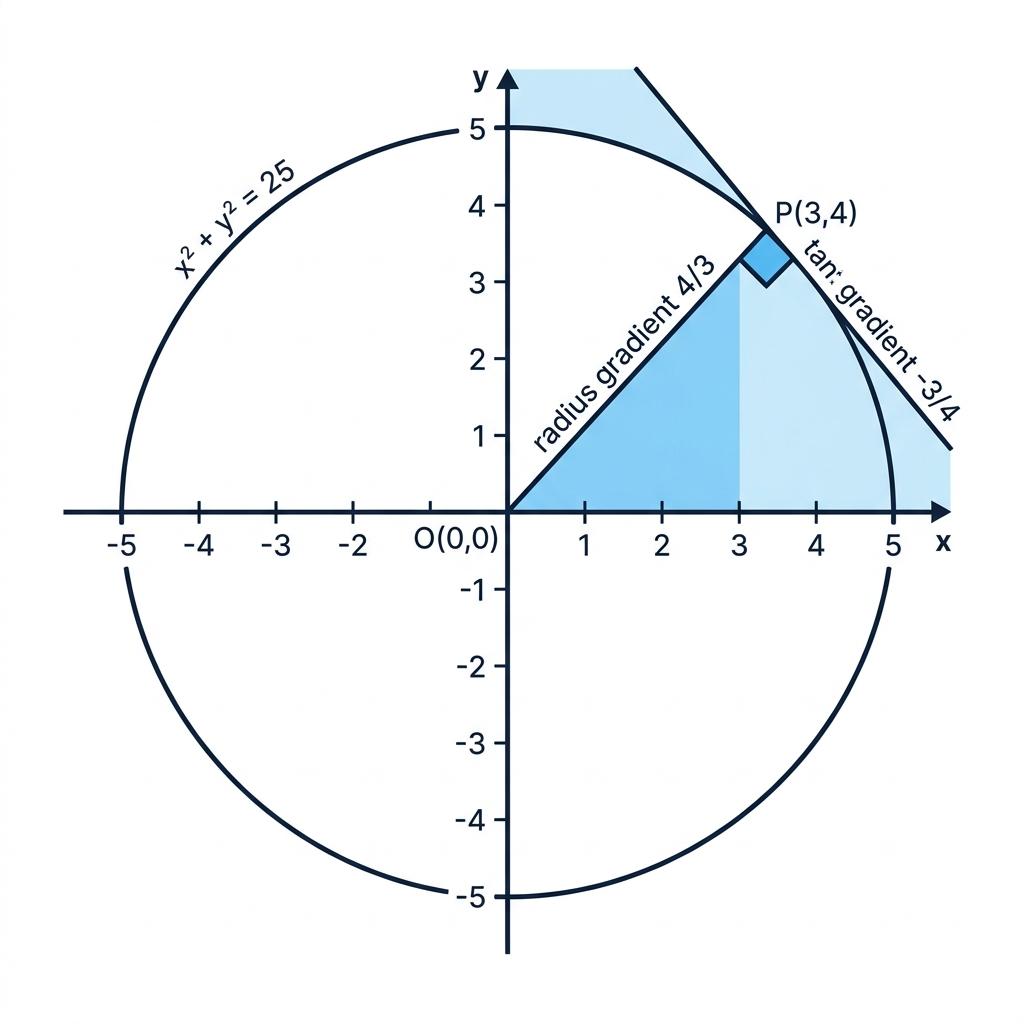
Finding the gradient of a circle
For the circle x2+y2=25x^2+y^2=25x2+y2=25, find dydx\frac{dy}{dx}dxdy and then find the gradient at (3,4)(3,4)(3,4).
-
Differentiate both sides with respect to xxx:
2x+2ydydx=0.2x+2y\frac{dy}{dx}=0.2x+2ydxdy=0. -
Collect the term containing dydx\frac{dy}{dx}dxdy and rearrange:
2ydydx=−2x,dydx=−xy.\begin{aligned} 2y\frac{dy}{dx}&=-2x,\\ \frac{dy}{dx}&=-\frac{x}{y}. \end{aligned}2ydxdydxdy=−2x,=−yx. -
Substitute x=3x=3x=3 and y=4y=4y=4:
dydx=−34.\frac{dy}{dx}=-\frac{3}{4}.dxdy=−43.Therefore, the tangent gradient at (3,4)(3,4)(3,4) is −34-\frac34−43.
The radius to (3,4)(3,4)(3,4) has gradient 43\frac4334, while the tangent has gradient −34-\frac34−43. Their product is negative one, confirming that they are perpendicular.
Products Containing x and y
An implicit relation may contain a product such as xyxyxy. Because both factors vary with xxx, use the product rule:
ddx(xy)=xdydx+y.\frac{d}{dx}(xy)=x\frac{dy}{dx}+y.dxd(xy)=xdxdy+y.Here, the derivative of xxx is one, while the derivative of yyy is dydx\frac{dy}{dx}dxdy.
Differentiating a relation with a product
Find dydx\frac{dy}{dx}dxdy if
x2+xy+y2=7.x^2+xy+y^2=7.x2+xy+y2=7.-
Differentiate each term, using the product rule on xyxyxy:
2x+(xdydx+y)+2ydydx=0.2x+\left(x\frac{dy}{dx}+y\right)+2y\frac{dy}{dx}=0.2x+(xdxdy+y)+2ydxdy=0. -
Group the terms containing dydx\frac{dy}{dx}dxdy:
(x+2y)dydx+2x+y=0.\left(x+2y\right)\frac{dy}{dx}+2x+y=0.(x+2y)dxdy+2x+y=0. -
Rearrange to make dydx\frac{dy}{dx}dxdy the subject:
dydx=−2x+yx+2y.\frac{dy}{dx}=-\frac{2x+y}{x+2y}.dxdy=−x+2y2x+y.
Collect before dividing
After differentiating, move every term containing dydx\frac{dy}{dx}dxdy to one side. Factor out dydx\frac{dy}{dx}dxdy before dividing.
Functions of y
The chain rule applies to powers, exponentials and trigonometric functions of yyy. For example,
ddx(siny)=cosydydx,ddx(ey)=eydydx,ddx(y)=12ydydx.\begin{aligned} \frac{d}{dx}(\sin y)&=\cos y\frac{dy}{dx},\\ \frac{d}{dx}(e^y)&=e^y\frac{dy}{dx},\\ \frac{d}{dx}\left(\sqrt{y}\right)&=\frac{1}{2\sqrt{y}}\frac{dy}{dx}. \end{aligned}dxd(siny)dxd(ey)dxd(y)=cosydxdy,=eydxdy,=2y1dxdy.Differentiating a trigonometric relation
Given
x2+siny=1,x^2+\sin y=1,x2+siny=1,find dydx\frac{dy}{dx}dxdy.
-
Differentiate both sides with respect to xxx:
2x+cosydydx=0.2x+\cos y\frac{dy}{dx}=0.2x+cosydxdy=0. -
Isolate the derivative term:
cosydydx=−2x.\cos y\frac{dy}{dx}=-2x.cosydxdy=−2x. -
Divide by cosy\cos ycosy:
dydx=−2xcosy.\frac{dy}{dx}=-\frac{2x}{\cos y}.dxdy=−cosy2x.
Tangents and Stationary Points
Once you have found dydx\frac{dy}{dx}dxdy, you can use it exactly as you would for an explicit function.
A tangent is a straight line that has the same gradient as the curve at the point of contact. A stationary point is a point where the tangent is horizontal, so dydx=0\frac{dy}{dx}=0dxdy=0.
Finding a tangent to an implicit curve
For x2+xy+y2=7x^2+xy+y^2=7x2+xy+y2=7, find the tangent at (1,2)(1,2)(1,2).
-
Use the derivative already obtained:
dydx=−2x+yx+2y.\frac{dy}{dx}=-\frac{2x+y}{x+2y}.dxdy=−x+2y2x+y. -
Substitute the coordinates:
dydx∣(1,2)=−2(1)+21+2(2)=−45.\left.\frac{dy}{dx}\right|_{(1,2)} =-\frac{2(1)+2}{1+2(2)} =-\frac45.dxdy(1,2)=−1+2(2)2(1)+2=−54. -
Use the point-gradient form y−y1=m(x−x1)y-y_1=m(x-x_1)y−y1=m(x−x1):
y−2=−45(x−1).y-2=-\frac45(x-1).y−2=−54(x−1).
When the derivative is undefined
If the denominator of your expression for dydx\frac{dy}{dx}dxdy is zero while the numerator is non-zero, the curve may have a vertical tangent. Do not describe this as a stationary point.
Parametric Curves
Sometimes xxx and yyy are each given in terms of a third variable.
Parameter
A parameter is an extra variable, usually ttt, that determines both coordinates of a point on a curve. Equations such as x=f(t)x=f(t)x=f(t) and y=g(t)y=g(t)y=g(t) are called parametric equations.
As ttt changes, the point (x,y)(x,y)(x,y) moves along the curve. To find its gradient, differentiate both coordinates with respect to ttt.
Parametric derivative
Provided dxdt≠0\frac{dx}{dt}\neq0dtdx=0,
dydx=dydtdxdt.\frac{dy}{dx}=\frac{\frac{dy}{dt}}{\frac{dx}{dt}}.dxdy=dtdxdtdy.This follows from the chain rule:
dydt=dydxdxdt.\frac{dy}{dt}=\frac{dy}{dx}\frac{dx}{dt}.dtdy=dxdydtdx.Differentiating parametric equations
A curve is defined by
x=t2+1,y=t3−3t.x=t^2+1,\qquad y=t^3-3t.x=t2+1,y=t3−3t.Find dydx\frac{dy}{dx}dxdy and its value when t=2t=2t=2.
-
Differentiate each coordinate with respect to ttt:
dxdt=2t,dydt=3t2−3.\frac{dx}{dt}=2t,\qquad \frac{dy}{dt}=3t^2-3.dtdx=2t,dtdy=3t2−3. -
Divide dydt\frac{dy}{dt}dtdy by dxdt\frac{dx}{dt}dtdx:
dydx=3t2−32t=3(t2−1)2t.\frac{dy}{dx} =\frac{3t^2-3}{2t} =\frac{3(t^2-1)}{2t}.dxdy=2t3t2−3=2t3(t2−1). -
Substitute t=2t=2t=2:
dydx=3(4−1)4=94.\frac{dy}{dx} =\frac{3(4-1)}{4} =\frac94.dxdy=43(4−1)=49.
Dividing in the wrong order
The correct order is dydt÷dxdt\frac{dy}{dt}\div\frac{dx}{dt}dtdy÷dtdx. Writing the fractions in the opposite order gives dxdy\frac{dx}{dy}dydx.
Stationary Points on Parametric Curves
For a horizontal tangent, you normally need
dydt=0\frac{dy}{dt}=0dtdy=0while also checking that dxdt≠0\frac{dx}{dt}\neq0dtdx=0.
If dxdt=0\frac{dx}{dt}=0dtdx=0, the formula for dydx\frac{dy}{dx}dxdy involves division by zero and may indicate a vertical tangent or another special point requiring closer inspection.
Finding a parametric stationary point
For
x=t2+1,y=t3−3t,x=t^2+1,\qquad y=t^3-3t,x=t2+1,y=t3−3t,find the points where the tangent is horizontal.
-
Set the numerator of dydx\frac{dy}{dx}dxdy equal to zero:
3t2−3=0⇒t2=1⇒t=±1.3t^2-3=0 \quad\Rightarrow\quad t^2=1 \quad\Rightarrow\quad t=\pm1.3t2−3=0⇒t2=1⇒t=±1. -
Check the denominator: dxdt=2t\frac{dx}{dt}=2tdtdx=2t, which is non-zero at both parameter values. Both give horizontal tangents.
-
Find the coordinates. When t=1t=1t=1, (x,y)=(2,−2)(x,y)=(2,-2)(x,y)=(2,−2). When t=−1t=-1t=−1, (x,y)=(2,2)(x,y)=(2,2)(x,y)=(2,2). Therefore, the stationary points are (2,−2)(2,-2)(2,−2) and (2,2)(2,2)(2,2).
In the exam
- For an implicit relation, differentiate every term with respect to xxx and attach dydx\frac{dy}{dx}dxdy whenever you differentiate a function of yyy.
- Use the product rule carefully for mixed terms such as xyxyxy, then collect and factor all derivative terms.
- For parametric equations, calculate dydt\frac{dy}{dt}dtdy and dxdt\frac{dx}{dt}dtdx separately before forming dydx\frac{dy}{dx}dxdy, and check the denominator before identifying a stationary point.
- Substitute both coordinates into an implicit derivative, but substitute the parameter value into a parametric derivative.
Check yourself
- Can you find dydx\frac{dy}{dx}dxdy for x3+y3=6xyx^3+y^3=6xyx3+y3=6xy?
- For x=2t+1x=2t+1x=2t+1 and y=t2−4ty=t^2-4ty=t2−4t, when is the tangent horizontal?
- What might it mean geometrically if dxdt=0\frac{dx}{dt}=0dtdx=0 but dydt≠0\frac{dy}{dt}\neq0dtdy=0?
