Question 14
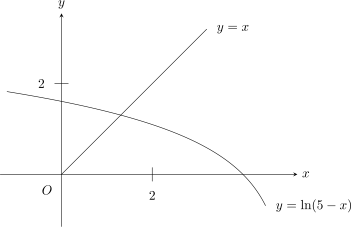
Figure 1 below shows the graphs of y=ln(5−x)y = \ln(5 - x)y=ln(5−x) and y=xy = xy=x. The curve meets the line at a single point, where x=αx = \alphax=α.
a.[2]
Show that 1<α<21 < \alpha < 21<α<2.
b.[3]
Use Figure 1, starting with x1=2x_1 = 2x1=2, to determine whether the iteration formula
xn+1=ln(5−xn)x_{n+1} = \ln(5 - x_n)xn+1=ln(5−xn)
can be used to find an approximation for α\alphaα. Justify your answer.
c.[2]
Use the iteration formula with x1=2x_1 = 2x1=2 to find x2x_2x2, x3 x_3\,x3 and x4x_4x4, giving your answers to four decimal places.
d.[1]
On Figure 1, draw a cobweb or staircase diagram to show how the convergence takes place.
1.12 I: Numerical methods (A-level only) Questions
125 exam-style questions on AQA A Level Maths 1.12 I: Numerical methods (A-level only), covering 1.12.1 Locating roots by change of sign (A-level only), 1.12.2 Iterative methods and Newton-Raphson (A-level only), 1.12.3 Numerical integration (A-level only), and 1.12.4 Numerical methods in context (A-level only). Each one has a worked solution and a mark scheme showing where the marks go.