

What you'll learn
- How the gradient of an exponential curve is connected to its height.
- How to differentiate functions of the form ekxe^{kx}ekx.
- How the sign and size of kkk affect the gradient.
- Why exponential functions are suitable models for growth and decay.
Prerequisites
The number eee
The number eee is a mathematical constant with approximate value 2.718. It is the base of the natural exponential function exe^xex.
The graph of y=exy=e^xy=ex:
- passes through (0,1)(0,1)(0,1) because e0=1e^0=1e0=1;
- is always positive;
- increases as xxx increases;
- has the xxx-axis as a horizontal asymptote as x→−∞x\to-\inftyx→−∞.
Natural exponential function
The natural exponential function is the function f(x)=exf(x)=e^xf(x)=ex, where eee is the mathematical constant approximately equal to 2.718.
Gradient and derivative
The gradient of a curve at a point is the gradient of the tangent to the curve at that point. It measures the curve's instantaneous rate of change.
The derivative of y=f(x)y=f(x)y=f(x) is written as either f′(x)f'(x)f′(x) or dydx\dfrac{dy}{dx}dxdy. It gives a formula for the gradient at any point on the curve.
For example, if dydx=6x\dfrac{dy}{dx}=6xdxdy=6x, then the gradient at x=2x=2x=2 is 12.
A special exponential function
The function exe^xex is unique because its derivative is equal to the original function:
ddx(ex)=ex.\frac{d}{dx}\left(e^x\right)=e^x.dxd(ex)=ex.Therefore, at every point on y=exy=e^xy=ex, the gradient is equal to the yyy-coordinate.
Finding a gradient on the curve
Find the gradient of y=exy=e^xy=ex at the point where x=ln5x=\ln 5x=ln5.
-
Differentiate the function:
dydx=ex.\frac{dy}{dx}=e^x.dxdy=ex. -
Substitute x=ln5x=\ln 5x=ln5 into the derivative:
dydx∣x=ln5=eln5.\left.\frac{dy}{dx}\right|_{x=\ln 5}=e^{\ln 5}.dxdyx=ln5=eln5. -
Use eln5=5e^{\ln 5}=5eln5=5, so the gradient is 5. Notice that the point also has yyy-coordinate 5.
Differentiating ekxe^{kx}ekx
Consider the function
y=ekx,y=e^{kx},y=ekx,where kkk is a constant.
The expression kxkxkx is an inner function: it is the expression being used as the exponent. Differentiating a composite function such as this requires the chain rule.
Chain rule
If y=f(g(x))y=f(g(x))y=f(g(x)), then the chain rule states that you differentiate the outer function and multiply by the derivative of the inner function:
dydx=f′(g(x))g′(x).\frac{dy}{dx}=f'(g(x))g'(x).dxdy=f′(g(x))g′(x).For y=ekxy=e^{kx}y=ekx:
- the outer function is the exponential function;
- the inner function is kxkxkx;
- the derivative of kxkxkx is kkk.
Therefore,
dydx=ekx×k=kekx.\frac{dy}{dx}=e^{kx}\times k=ke^{kx}.dxdy=ekx×k=kekx.The main differentiation rule
For any constant kkk,
ddx(ekx)=kekx.\boxed{\frac{d}{dx}\left(e^{kx}\right)=ke^{kx}}.dxd(ekx)=kekx.Differentiate the exponent kxkxkx to get kkk, then multiply by the original exponential expression.
Differentiating an exponential function
Differentiate y=e5xy=e^{5x}y=e5x and find its gradient at x=ln2x=\ln 2x=ln2.
-
The derivative of the exponent 5x5x5x is 5, so apply the chain rule:
dydx=5e5x.\frac{dy}{dx}=5e^{5x}.dxdy=5e5x. -
Substitute x=ln2x=\ln 2x=ln2:
dydx∣x=ln2=5e5ln2.\left.\frac{dy}{dx}\right|_{x=\ln 2} =5e^{5\ln 2}.dxdyx=ln2=5e5ln2. -
Use 5ln2=ln(25)=ln325\ln 2=\ln(2^5)=\ln 325ln2=ln(25)=ln32:
5e5ln2=5eln32=5×32=160.5e^{5\ln 2}=5e^{\ln 32}=5\times 32=160.5e5ln2=5eln32=5×32=160.The gradient is 160.
Forgetting the chain-rule multiplier
The derivative of e5xe^{5x}e5x is 5e5x5e^{5x}5e5x, not just e5xe^{5x}e5x. Always multiply by the derivative of the exponent.
How kkk affects the gradient
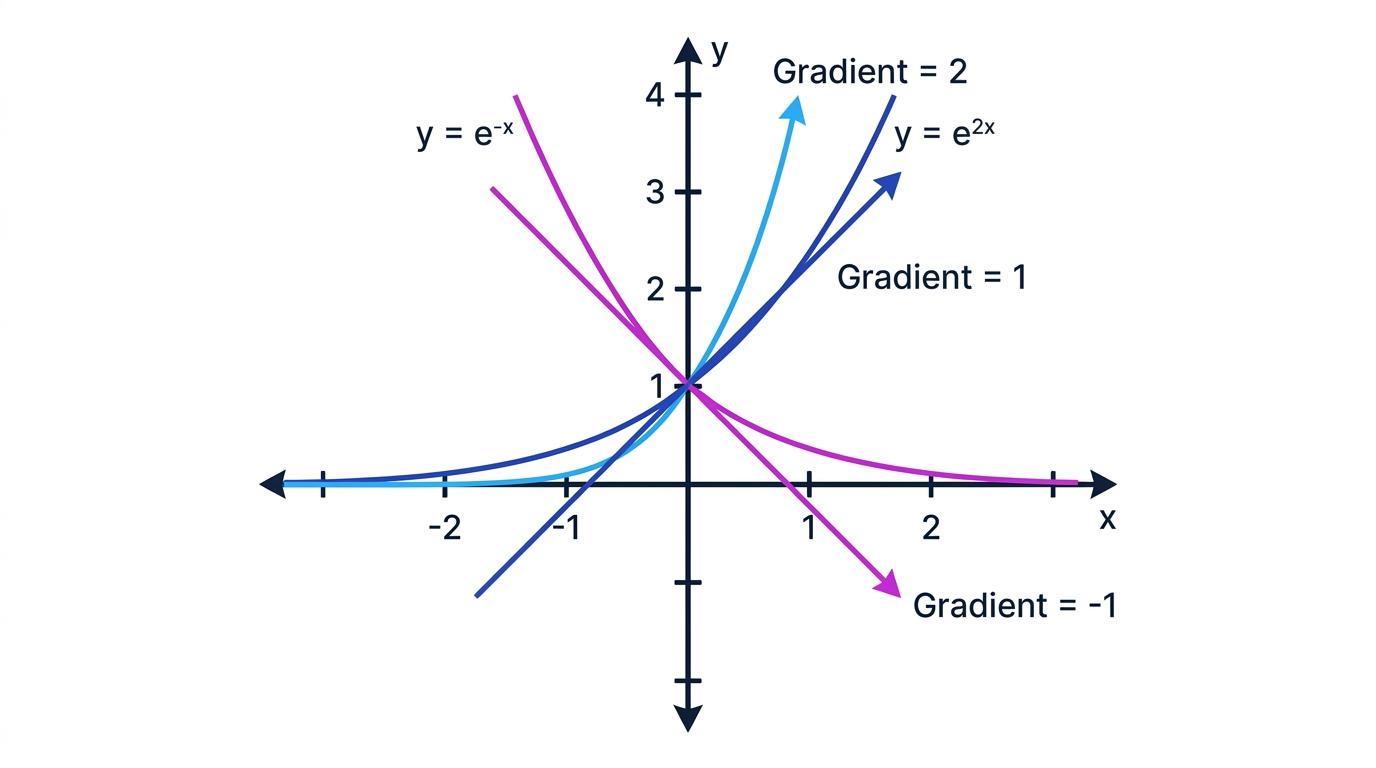
For y=ekxy=e^{kx}y=ekx,
dydx=kekx.\frac{dy}{dx}=ke^{kx}.dxdy=kekx.Since ekxe^{kx}ekx is always positive, the sign of the gradient is determined entirely by the sign of kkk:
- If k>0k>0k>0, then dydx>0\dfrac{dy}{dx}>0dxdy>0, so the curve is increasing.
- If k<0k<0k<0, then dydx<0\dfrac{dy}{dx}<0dxdy<0, so the curve is decreasing.
- If k=0k=0k=0, then y=e0=1y=e^0=1y=e0=1, which is a horizontal line with gradient zero.
At x=0x=0x=0,
dydx∣x=0=ke0=k.\left.\frac{dy}{dx}\right|_{x=0}=ke^0=k.dxdyx=0=ke0=k.Therefore, kkk itself is the gradient where the curve crosses the yyy-axis.
The curves below show how different values of kkk affect the steepness and direction of y=ekxy=e^{kx}y=ekx.
Determining where the gradient is a given value
For the curve y=e3xy=e^{3x}y=e3x, find the exact value of xxx where the gradient is 12.
-
Differentiate the function:
dydx=3e3x.\frac{dy}{dx}=3e^{3x}.dxdy=3e3x. -
Set the derivative equal to the required gradient:
3e3x=12.3e^{3x}=12.3e3x=12. -
Divide by 3 and take natural logarithms:
e3x=4⇒3x=ln4.e^{3x}=4 \quad\Rightarrow\quad 3x=\ln 4.e3x=4⇒3x=ln4. -
Hence,
x=ln43.x=\frac{\ln 4}{3}.x=3ln4.
A quick sign check
Because ekx>0e^{kx}>0ekx>0, the derivative kekxke^{kx}kekx must have the same sign as kkk. If your derivative has the wrong sign, check the chain-rule multiplier.
A constant multiple of ekxe^{kx}ekx
Exponential models are often written as
y=Aekx,y=Ae^{kx},y=Aekx,where AAA and kkk are constants.
The constant multiple rule gives
dydx=Akekx.\frac{dy}{dx}=Ake^{kx}.dxdy=Akekx.But Aekx=yAe^{kx}=yAekx=y, so this can also be written as
dydx=ky.\boxed{\frac{dy}{dx}=ky}.dxdy=ky.This equation says that the rate of change of yyy is proportional to the current value of yyy.
At x=0x=0x=0,
y=Ae0=A,y=Ae^0=A,y=Ae0=A,so AAA represents the initial value of the model.
Exponential model
An exponential model has the form y=Aekxy=Ae^{kx}y=Aekx. The constant AAA is the value when x=0x=0x=0, while kkk controls the continuous proportional rate of growth or decay.
Differentiating a population model
A population is modelled by
P=800e0.04t,P=800e^{0.04t},P=800e0.04t,where ttt is measured in years. Find the initial population and its rate of growth after 10 years.
-
At t=0t=0t=0,
P(0)=800e0=800,P(0)=800e^0=800,P(0)=800e0=800,so the initial population is 800.
-
Differentiate with respect to ttt:
dPdt=800(0.04)e0.04t=32e0.04t.\frac{dP}{dt}=800(0.04)e^{0.04t} =32e^{0.04t}.dtdP=800(0.04)e0.04t=32e0.04t. -
At t=10t=10t=10,
dPdt∣t=10=32e0.4.\left.\frac{dP}{dt}\right|_{t=10} =32e^{0.4}.dtdPt=10=32e0.4.The exact rate is 32e0.432e^{0.4}32e0.4 people per year, approximately 47.7 people per year.
Why exponential models are suitable
Many real quantities change at a rate that depends on how much is currently present.
For example:
- a large population may produce more new individuals than a small population;
- a larger investment may earn more interest than a smaller investment;
- a radioactive sample with more undecayed nuclei has more nuclei available to decay.
If y=Aekxy=Ae^{kx}y=Aekx, then
dydx=ky.\frac{dy}{dx}=ky.dxdy=ky.This is exactly the mathematical condition that the rate of change is proportional to the current quantity.
- When k>0k>0k>0, the model represents exponential growth.
- When k<0k<0k<0, the model represents exponential decay.
- The magnitude ∣k∣|k|∣k∣ controls how quickly the quantity changes.
If xxx is measured in time, the units of kkk must be reciprocal time, such as per year, so that the exponent kxkxkx has no units.
Confusing the amount with its rate of change
For y=Aekxy=Ae^{kx}y=Aekx, the amount is AekxAe^{kx}Aekx but the rate of change is AkekxAke^{kx}Akekx. They are proportional, but they are not equal unless k=1k=1k=1.
Limits of an exponential model
An exponential model assumes that the same proportional relationship continues. Real populations and investments may face changing conditions, so the model may only be reasonable over a limited interval.
In the exam
- Identify the exponent and differentiate it before writing the chain-rule multiplier.
- For y=Aekxy=Ae^{kx}y=Aekx, use dydx=Akekx\dfrac{dy}{dx}=Ake^{kx}dxdy=Akekx and simplify using dydx=ky\dfrac{dy}{dx}=kydxdy=ky when useful.
- Check the sign of your derivative against the context: growth requires k>0k>0k>0, while decay requires k<0k<0k<0.
- Keep answers involving eee or logarithms exact unless the question requests a decimal.
Check yourself
- What is the derivative of e−4xe^{-4x}e−4x?
- At what value of xxx does y=e2xy=e^{2x}y=e2x have gradient 10?
- Why does the equation dydx=ky\dfrac{dy}{dx}=kydxdy=ky make y=Aekxy=Ae^{kx}y=Aekx suitable for modelling growth and decay?
