

What you'll learn
- How an integral can define an accumulation function.
- Why differentiating an accumulated integral recovers the original function.
- How to evaluate definite integrals using antiderivatives.
- How to handle variable upper limits using the chain rule.
Prerequisites
Antiderivatives
An antiderivative of a function f(x)f(x)f(x) is a function whose derivative is f(x)f(x)f(x).
For example, since
ddx(x3)=3x2,\frac{d}{dx}\left(x^3\right)=3x^2,dxd(x3)=3x2,an antiderivative of 3x23x^23x2 is x3x^3x3.
Antiderivatives are not unique: differentiating a constant gives zero, so every function of the form x3+Cx^3+Cx3+C is also an antiderivative of 3x23x^23x2.
Indefinite integral
The indefinite integral represents the family of all antiderivatives of a function:
∫f(x) dx=F(x)+C,\int f(x)\,dx=F(x)+C,∫f(x)dx=F(x)+C,where F′(x)=f(x)F'(x)=f(x)F′(x)=f(x) and CCC is an arbitrary constant.
Definite integrals
A definite integral has a lower limit and an upper limit:
∫abf(x) dx.\int_a^b f(x)\,dx.∫abf(x)dx.Here, aaa is the lower limit, bbb is the upper limit, and f(x)f(x)f(x) is the integrand, meaning the function being integrated.
A definite integral is a number. Geometrically, it represents signed area between the graph and the horizontal axis:
- regions above the axis contribute positively;
- regions below the axis contribute negatively.
Integral is not always geometric area
A definite integral gives signed area. If the graph crosses the axis and the question asks for the total geometric area, split the integral at each root and make every area contribution positive.
Accumulation Functions
Suppose fff is continuous, and define
A(x)=∫axf(t) dt.A(x)=\int_a^x f(t)\,dt.A(x)=∫axf(t)dt.The value of A(x)A(x)A(x) is the signed area accumulated under the graph of fff from the fixed point aaa to the variable point xxx.
The letter ttt is a dummy variable: it is used only inside the integral. We use it so that the upper limit xxx is not confused with the integration variable.
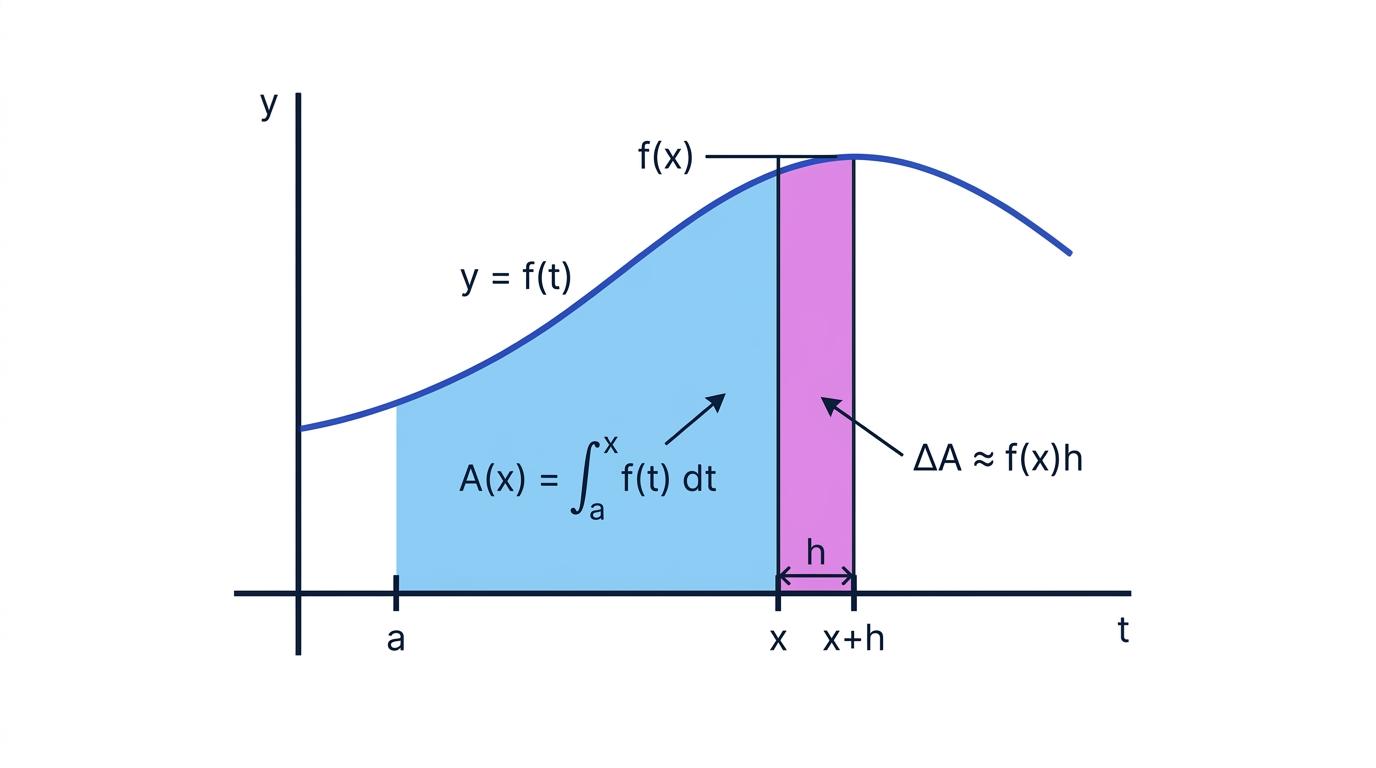
If xxx increases by a small amount hhh, the extra area is approximately a narrow rectangle of width hhh and height f(x)f(x)f(x). Therefore,
A(x+h)−A(x)≈f(x)h.A(x+h)-A(x)\approx f(x)h.A(x+h)−A(x)≈f(x)h.Dividing by hhh gives
A(x+h)−A(x)h≈f(x).\frac{A(x+h)-A(x)}{h}\approx f(x).hA(x+h)−A(x)≈f(x).As h→0h\to 0h→0, the approximation becomes exact. The left-hand side becomes the derivative of AAA, so
A′(x)=f(x).A'(x)=f(x).A′(x)=f(x).This is the first form of the Fundamental Theorem of Calculus.
Fundamental Theorem of Calculus: accumulation form
If fff is continuous and
A(x)=∫axf(t) dt,A(x)=\int_a^x f(t)\,dt,A(x)=∫axf(t)dt,then
A′(x)=f(x).A'(x)=f(x).A′(x)=f(x).In other words,
ddx(∫axf(t) dt)=f(x).\frac{d}{dx}\left(\int_a^x f(t)\,dt\right)=f(x).dxd(∫axf(t)dt)=f(x).Integration and differentiation are inverse processes
Integrating fff from a fixed lower limit to xxx, and then differentiating the result, returns f(x)f(x)f(x).
Differentiating an accumulation function
Let
A(x)=∫2x(t3+4t) dt.A(x)=\int_2^x \left(t^3+4t\right)\,dt.A(x)=∫2x(t3+4t)dt.Find A′(x)A'(x)A′(x).
- The integral has a fixed lower limit and upper limit xxx, so it is in the direct accumulation form of the theorem.
- Replace the dummy variable ttt in the integrand by the upper-limit variable xxx.
- Therefore,
There is no need to evaluate the integral first.
Variable Upper Limits
The theorem applies directly when the upper limit is exactly xxx. If the upper limit is a function such as x2x^2x2, combine the theorem with the chain rule.
If
A(x)=∫ag(x)f(t) dt,A(x)=\int_a^{g(x)}f(t)\,dt,A(x)=∫ag(x)f(t)dt,then
A′(x)=f(g(x))g′(x).A'(x)=f\left(g(x)\right)g'(x).A′(x)=f(g(x))g′(x).You first substitute the upper limit into the integrand, then multiply by the derivative of the upper limit.
Differentiating with a variable upper limit
Differentiate
A(x)=∫1x21+t3 dt.A(x)=\int_1^{x^2}\sqrt{1+t^3}\,dt.A(x)=∫1x21+t3dt.- The upper limit is g(x)=x2g(x)=x^2g(x)=x2, so substitute t=x2t=x^2t=x2 into the integrand:
- Differentiate the upper limit:
- Multiply these results using the chain rule:
Forgetting the chain-rule factor
For an upper limit g(x)g(x)g(x), the derivative is not just f(g(x))f(g(x))f(g(x)). You must multiply by g′(x)g'(x)g′(x).
Variable lower limits
If the variable appears as the lower limit, reversing the limits introduces a minus sign:
∫xaf(t) dt=−∫axf(t) dt.\int_x^a f(t)\,dt=-\int_a^x f(t)\,dt.∫xaf(t)dt=−∫axf(t)dt.Therefore,
ddx(∫xaf(t) dt)=−f(x).\frac{d}{dx}\left(\int_x^a f(t)\,dt\right)=-f(x).dxd(∫xaf(t)dt)=−f(x).More generally,
ddx(∫g(x)af(t) dt)=−f(g(x))g′(x).\frac{d}{dx}\left(\int_{g(x)}^a f(t)\,dt\right) =-f\left(g(x)\right)g'(x).dxd(∫g(x)af(t)dt)=−f(g(x))g′(x).Track which limit moves
A moving upper limit gives a positive contribution; a moving lower limit gives a negative contribution.
Evaluating Definite Integrals
The second form of the theorem gives the standard method for calculating a definite integral.
Fundamental Theorem of Calculus: evaluation form
If fff is continuous on the interval from aaa to bbb, and F′(x)=f(x)F'(x)=f(x)F′(x)=f(x), then
∫abf(x) dx=F(b)−F(a).\int_a^b f(x)\,dx=F(b)-F(a).∫abf(x)dx=F(b)−F(a).The notation
[F(x)]ab\left[F(x)\right]_a^b[F(x)]abmeans F(b)−F(a)F(b)-F(a)F(b)−F(a).
The theorem links the two meanings of integration:
- accumulating signed area;
- finding an antiderivative.
Instead of estimating the area using many narrow strips, you find an antiderivative and evaluate it at the endpoints.
Evaluating a definite integral
Evaluate
∫13(2x2−4x+1) dx.\int_1^3 \left(2x^2-4x+1\right)\,dx.∫13(2x2−4x+1)dx.- Find an antiderivative of the integrand:
- Apply the limits, keeping the substitution grouped:
- Simplify both endpoint values:
Hence,
∫13(2x2−4x+1) dx=3−(−13)=103.\int_1^3 \left(2x^2-4x+1\right)\,dx =3-\left(-\frac{1}{3}\right) =\frac{10}{3}.∫13(2x2−4x+1)dx=3−(−31)=310.Subtracting only part of the lower-limit value
The whole of F(a)F(a)F(a) must be subtracted. Write F(b)−(F(a))F(b)-\left(F(a)\right)F(b)−(F(a)) using brackets, especially when the lower-limit value is negative.
Why there is no constant of integration
For an indefinite integral, you include +C+C+C. For a definite integral, any constant cancels:
(F(b)+C)−(F(a)+C)=F(b)−F(a).\left(F(b)+C\right)-\left(F(a)+C\right)=F(b)-F(a).(F(b)+C)−(F(a)+C)=F(b)−F(a).You therefore do not write +C+C+C in the final value of a definite integral.
Continuity condition
The standard statement assumes that fff is continuous on the interval. Functions with undefined points, vertical asymptotes or other discontinuities may require methods involving improper integrals, which are not covered by simply substituting endpoints.
In the exam
- Decide whether you are differentiating an integral or evaluating a definite integral.
- For differentiation, substitute the moving limit into the integrand and multiply by its derivative; include a minus sign if it is the lower limit.
- For evaluation, find an antiderivative, write the limits clearly, and calculate upper value minus lower value using brackets.
- Check the sign against the graph: a function that is positive throughout the interval should give a positive integral.
Check yourself
- What is ddx(∫4xcost dt)\frac{d}{dx}\left(\int_4^x \cos t\,dt\right)dxd(∫4xcostdt)?
- How would you differentiate ∫03x−1et2 dt\int_0^{3x-1} e^{t^2}\,dt∫03x−1et2dt?
- Why does the constant of integration cancel when evaluating a definite integral?
