Question 5
The cross-section of a industrial drainage channel is modeled by a curve C C\,C with equation
y=(x−k)2x,x>0 y = \frac{(x - k)^2}{\sqrt{x}}, \quad x > 0 y=x(x−k)2,x>0where k k\,k is a positive constant.
a.[4]
Show that
∫116(x−k)2x dx=ak2+bk+20465 \int_{1}^{16} \frac{(x - k)^2}{\sqrt{x}} \, dx = ak^2 + bk + \frac{2046}{5} ∫116x(x−k)2dx=ak2+bk+52046where a a\,a and b b\,b are integers to be found.
b.[2]
A sketch of the curve C C\,C and a straight line l l\,l are shown. The line l l\,l represents the water level during a flood, intersecting the curve C C\,C at point A(1,9)A(1, 9)A(1,9) and at point B(16,q)B(16, q)B(16,q), where q q\,q is a constant.
Show that k=4k = 4k=4.
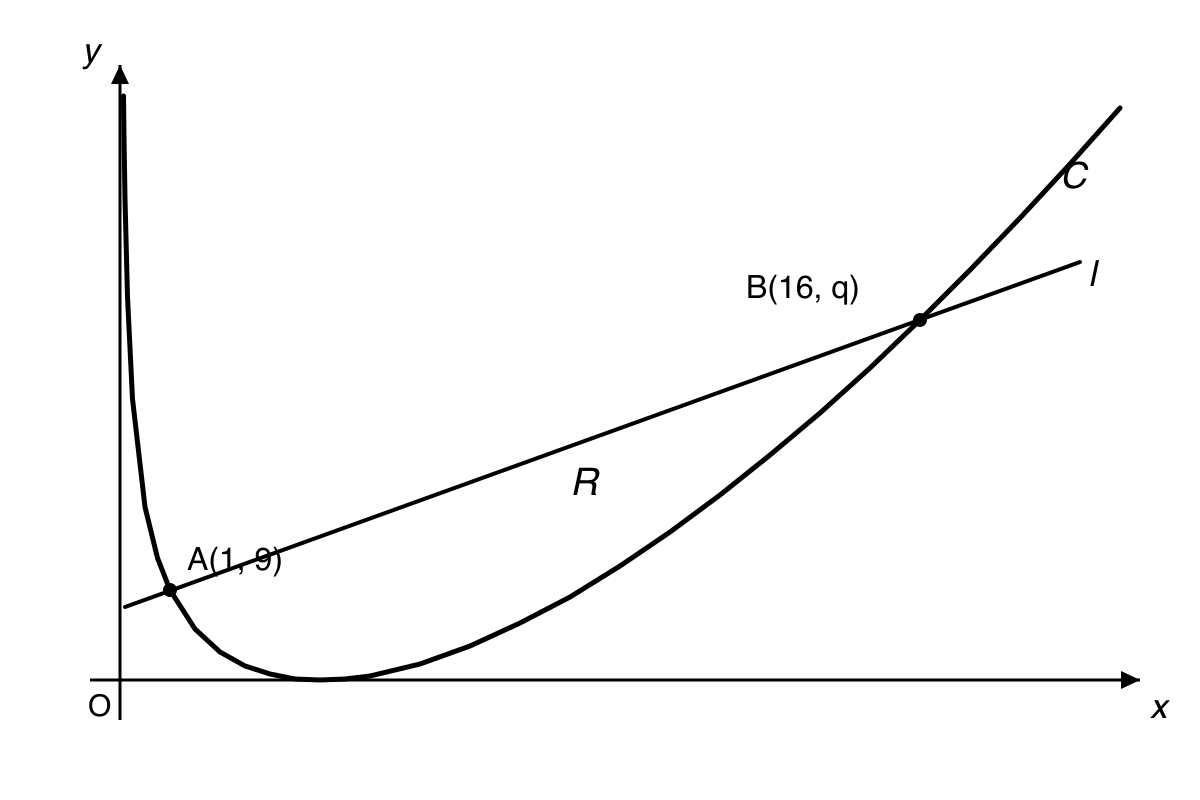
c.[4]
The region R R\,R is the cross-sectional area of the water, bounded by the curve C C\,C and the line l l\,l between points A A\,A and BBB. Using the results from parts (a) and (b),
find the area of region RRR.
1.11.3 Definite integrals and areas Questions
26 exam-style questions on AQA A Level Maths 1.11.3 Definite integrals and areas. Each one has a worked solution and a mark scheme showing where the marks go.