

What you'll learn
- How to find the gradient, tangent and normal at a point on a curve.
- How to locate and classify stationary points, including maxima, minima and stationary points of inflection.
- How to identify intervals where a function is increasing or decreasing.
- How to use differentiation to solve practical optimisation problems.
The derivative as a gradient
Before applying differentiation, remember that the derivative of a function f(x)f(x)f(x) is written as f′(x)f'(x)f′(x) or dydx\frac{dy}{dx}dxdy.
It gives the gradient of the curve at a particular value of xxx. Because the gradient may change along a curve, you first differentiate and then substitute the required xxx-coordinate.
Gradient at a point
If y=f(x)y=f(x)y=f(x), then the gradient of the curve at x=ax=ax=a is f′(a)f'(a)f′(a).
Finding the gradient of a curve
Find the gradient of y=2x3−5x2+4y=2x^3-5x^2+4y=2x3−5x2+4 at the point where x=2x=2x=2.
- Differentiate the function:
- Substitute x=2x=2x=2 into the derivative:
- Therefore, the gradient of the curve at x=2x=2x=2 is 4.
Tangents and normals
A tangent is a straight line that has the same gradient as the curve at the point where it touches the curve.
A normal is a straight line perpendicular to the tangent at that point.
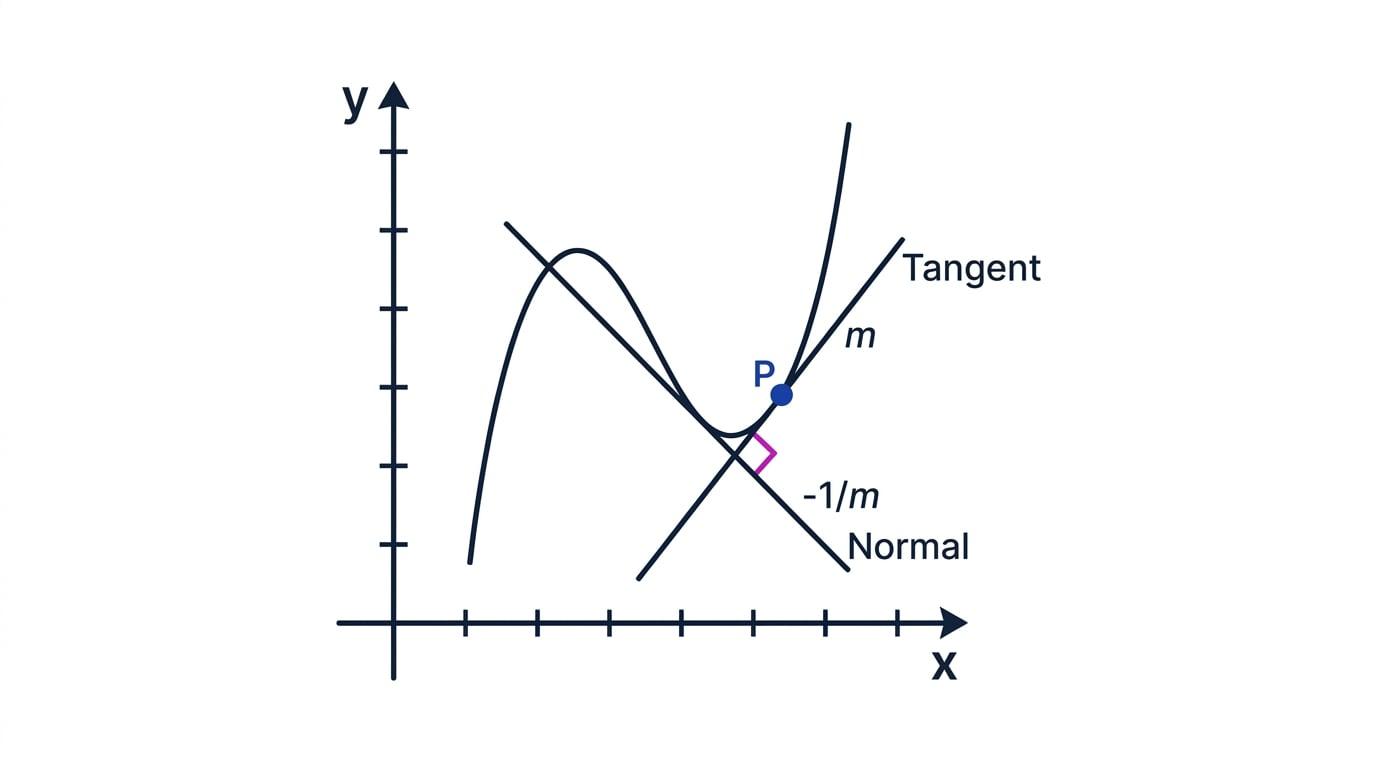
For a line with gradient mmm passing through (x1,y1)(x_1,y_1)(x1,y1), use the point-gradient equation
y−y1=m(x−x1). y-y_1=m(x-x_1). y−y1=m(x−x1).If the tangent has a non-zero gradient mmm, the normal gradient is its negative reciprocal:
mnormal=−1m. m_{\text{normal}}=-\frac{1}{m}. mnormal=−m1.This works because the gradients of perpendicular non-vertical lines satisfy
mtangentmnormal=−1. m_{\text{tangent}}m_{\text{normal}}=-1. mtangentmnormal=−1.Finding tangent and normal equations
Find the equations of the tangent and normal to y=x2+3xy=x^2+3xy=x2+3x at the point where x=1x=1x=1.
- Find the point on the curve:
so the point is (1,4)(1,4)(1,4).
- Differentiate and substitute x=1x=1x=1:
- Use the tangent gradient and the point (1,4)(1,4)(1,4):
so the tangent is
y=5x−1. y=5x-1. y=5x−1.- The normal gradient is −15-\frac{1}{5}−51. Therefore,
or equivalently,
y=−15x+215. y=-\frac{1}{5}x+\frac{21}{5}. y=−51x+521.Using the wrong normal gradient
Do not simply change the sign of the tangent gradient. The negative reciprocal of 5 is −15-\frac{1}{5}−51, not −5-5−5.
Horizontal and vertical lines
If the tangent is horizontal, its gradient is zero and its equation is y=y1y=y_1y=y1. The corresponding normal is vertical, with equation x=x1x=x_1x=x1, so its gradient is undefined.
Stationary points
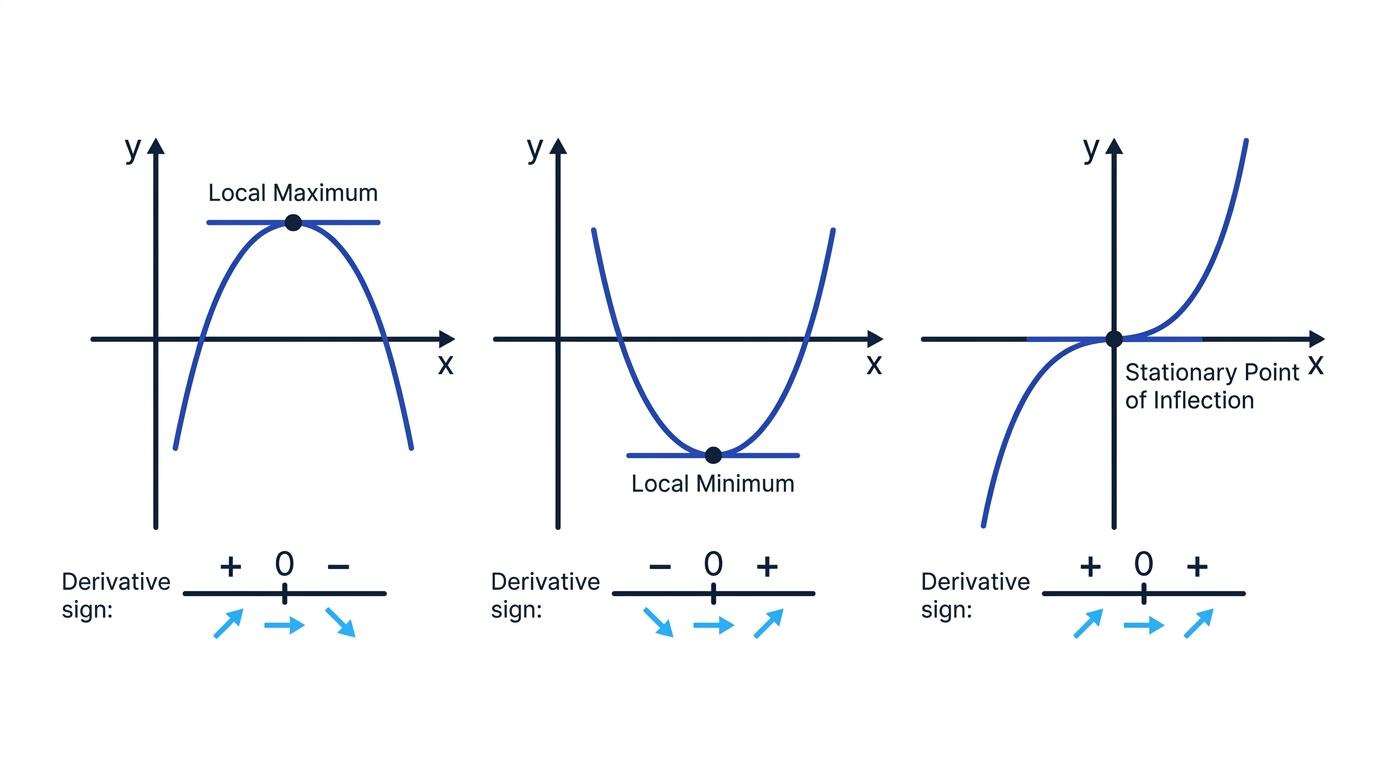
A stationary point is a point on a curve where the gradient is zero. Its tangent is therefore horizontal.
Stationary point
A stationary point occurs at a value of xxx satisfying
f′(x)=0. f'(x)=0. f′(x)=0.The three main types you need to recognise are:
- A local maximum, where the function changes from increasing to decreasing.
- A local minimum, where the function changes from decreasing to increasing.
- A stationary point of inflection, where the tangent is horizontal but the function continues in the same direction on both sides.
The word local means that the point is highest or lowest compared with nearby points. It may not be the highest or lowest point over the function’s entire domain.
Finding stationary points
Find the stationary points of f(x)=x3−3x2−9x+5f(x)=x^3-3x^2-9x+5f(x)=x3−3x2−9x+5.
- Differentiate and set the derivative equal to zero:
so
3x2−6x−9=0. 3x^2-6x-9=0. 3x2−6x−9=0.- Divide by 3 and factorise:
Therefore, x=3x=3x=3 or x=−1x=-1x=−1.
- Substitute these values into the original function:
- The stationary points are therefore (−1,10)(-1,10)(−1,10) and (3,−22)(3,-22)(3,−22). They still need to be classified.
Forgetting the coordinates
Solving f′(x)=0f'(x)=0f′(x)=0 gives the stationary values of xxx. Substitute them into the original function, not the derivative, to find the full coordinates.
Classifying stationary points
The first derivative test
The first derivative test examines the sign of f′(x)f'(x)f′(x) immediately before and after a stationary point.
- Positive to negative means a local maximum.
- Negative to positive means a local minimum.
- No sign change means the point is not a maximum or minimum; it may be a stationary point of inflection.
Using the first derivative test
Classify the stationary points of f(x)=x3−3x2−9x+5f(x)=x^3-3x^2-9x+5f(x)=x3−3x2−9x+5.
- From the earlier calculation,
with stationary values x=−1x=-1x=−1 and x=3x=3x=3.
- Test one value in each interval. For x<−1x<-1x<−1, use x=−2x=-2x=−2:
so the function is increasing.
- For −1<x<3-1<x<3−1<x<3, use x=0x=0x=0:
so the function is decreasing. The change at x=−1x=-1x=−1 is positive to negative, so (−1,10)(-1,10)(−1,10) is a local maximum.
- For x>3x>3x>3, use x=4x=4x=4:
The change at x=3x=3x=3 is negative to positive, so (3,−22)(3,-22)(3,−22) is a local minimum.
The second derivative test
The second derivative, written f′′(x)f''(x)f′′(x) or d2ydx2\frac{d^2y}{dx^2}dx2d2y, measures how the gradient is changing.
At a stationary point x=ax=ax=a:
- If f′′(a)<0f''(a)<0f′′(a)<0, the point is a local maximum.
- If f′′(a)>0f''(a)>0f′′(a)>0, the point is a local minimum.
- If f′′(a)=0f''(a)=0f′′(a)=0, the test is inconclusive.
An inconclusive result
The condition f′′(a)=0f''(a)=0f′′(a)=0 does not prove that there is a point of inflection. Use the first derivative test or examine the behaviour of f′′(x)f''(x)f′′(x) on either side.
Points of inflection
A point of inflection is a point where the curve changes its direction of curvature. Informally, it changes from bending one way to bending the other.
A point of inflection may be stationary, as for y=x3y=x^3y=x3 at the origin, or non-stationary.
A useful test is that f′′(x)f''(x)f′′(x) changes sign at the point.
Identifying a stationary point of inflection
Classify the stationary point of f(x)=x3f(x)=x^3f(x)=x3.
- Differentiate:
Setting f′(x)=0f'(x)=0f′(x)=0 gives x=0x=0x=0, and f(0)=0f(0)=0f(0)=0.
-
For every x≠0x\neq0x=0, 3x2>03x^2>03x2>0. Therefore, f′(x)f'(x)f′(x) is positive on both sides of zero, so the function is increasing on both sides.
-
The second derivative is
This changes from negative to positive as xxx passes through zero, so the curvature changes.
- Therefore, (0,0)(0,0)(0,0) is a stationary point of inflection.
Increasing and decreasing functions
A function is increasing where its derivative is positive and decreasing where its derivative is negative.
Derivative sign
Finding increasing and decreasing intervals
Find where f(x)=x3−3x2−9x+5f(x)=x^3-3x^2-9x+5f(x)=x3−3x2−9x+5 is increasing or decreasing.
- Factorise the derivative:
-
The derivative is zero at x=−1x=-1x=−1 and x=3x=3x=3, dividing the number line into three intervals.
-
Using the signs found earlier,
so the function is increasing on these intervals.
- Also,
so the function is decreasing on this interval.
Optimisation
Optimisation means finding the greatest or least possible value of a quantity. You usually form a function, differentiate it and locate its relevant maximum or minimum.
Maximising the area of a rectangle
A rectangle has perimeter 40 cm. Find its maximum possible area.
- Let its length be xxx cm and its width be yyy cm. The perimeter condition gives
- Express the area as a function of one variable:
- Differentiate and find the stationary value:
Therefore, y=20−10=10y=20-10=10y=20−10=10.
- Check the type of stationary point:
so the area is maximised.
- The maximum area is
Restricted domains
In optimisation questions, use the physical restrictions on the variables. Here, both side lengths must be positive, so 0<x<200<x<200<x<20.
In the exam
- Differentiate before substituting a point, and use the original function to find missing coordinates.
- For stationary points, show f′(x)=0f'(x)=0f′(x)=0 and justify the classification using a derivative sign change or the second derivative.
- In optimisation, define variables clearly, reduce the problem to one variable and check that the answer lies in the allowed domain.
- Give exact equations and values unless the question specifically requests a decimal.
Check yourself
- How would you find the equation of the normal when the tangent gradient is −32-\frac{3}{2}−23?
- What sign change in f′(x)f'(x)f′(x) identifies a local maximum?
- Why does f′′(a)=0f''(a)=0f′′(a)=0 not automatically prove that x=ax=ax=a is a point of inflection?
