

What you'll learn
- How the doctrine of stare decisis makes past cases legally important.
- How to identify ratio decidendi and obiter dicta in a judgment.
- How the civil and criminal court hierarchies affect binding precedent.
- How judges use overruling, reversing and distinguishing, plus the main advantages and disadvantages of precedent.
The basic idea: law made through cases
Judicial precedent is part of common law: law developed by judges through decisions in cases. When a court decides a legal issue, later courts may have to follow the legal rule from that earlier case.
Judicial precedent
Judicial precedent means a legal rule or principle from an earlier court decision which is used in later cases with similar legal issues.
The important point is that precedent is not just “what happened in the previous case”. It is the legal reason for the decision which matters.
The doctrine of stare decisis
Stare decisis
Stare decisis means “stand by what has been decided”. In law, it means courts should follow previous decisions where the earlier decision is binding.
This doctrine creates a structured system. Higher courts set rules which lower courts must apply. This supports consistency: similar cases should be decided in similar ways.
The headline rule
A precedent is binding when it comes from a court above the present court in the hierarchy and the relevant legal rule is part of the earlier case’s ratio decidendi.
Ratio decidendi and obiter dicta
A judgment can contain lots of reasoning, examples and comments. You need to separate the binding part from the non-binding part.
Ratio and obiter
- Ratio decidendi means “the reason for deciding”. It is the legal principle necessary for the court’s decision and can be binding.
- Obiter dicta means “things said by the way”. These are comments, illustrations or hypothetical points which were not necessary to decide the case. They are not binding but may be persuasive.
For example, Donoghue v Stevenson (1932) involved a consumer who became ill after finding a snail in a bottle of ginger beer; the case established that a manufacturer may owe a duty of care to the ultimate consumer where harm is reasonably foreseeable.
Separating ratio from obiter in R v Howe
-
In R v Howe (1987), defendants charged with murder argued they acted under threats; the House of Lords held that duress is not a defence to murder. That rule was necessary to decide the murder appeals, so it was the ratio decidendi.
-
The judges also commented that duress should not be a defence to attempted murder. That issue was not directly before the court, so this part was obiter dicta.
-
In R v Gotts (1992), the defendant was charged with attempted murder and argued duress; the House of Lords considered the earlier obiter statement in Howe.
-
Because the statement in Howe was persuasive rather than binding, the court was not forced to follow it — but it chose to do so, holding that duress is not a defence to attempted murder.
The court hierarchy
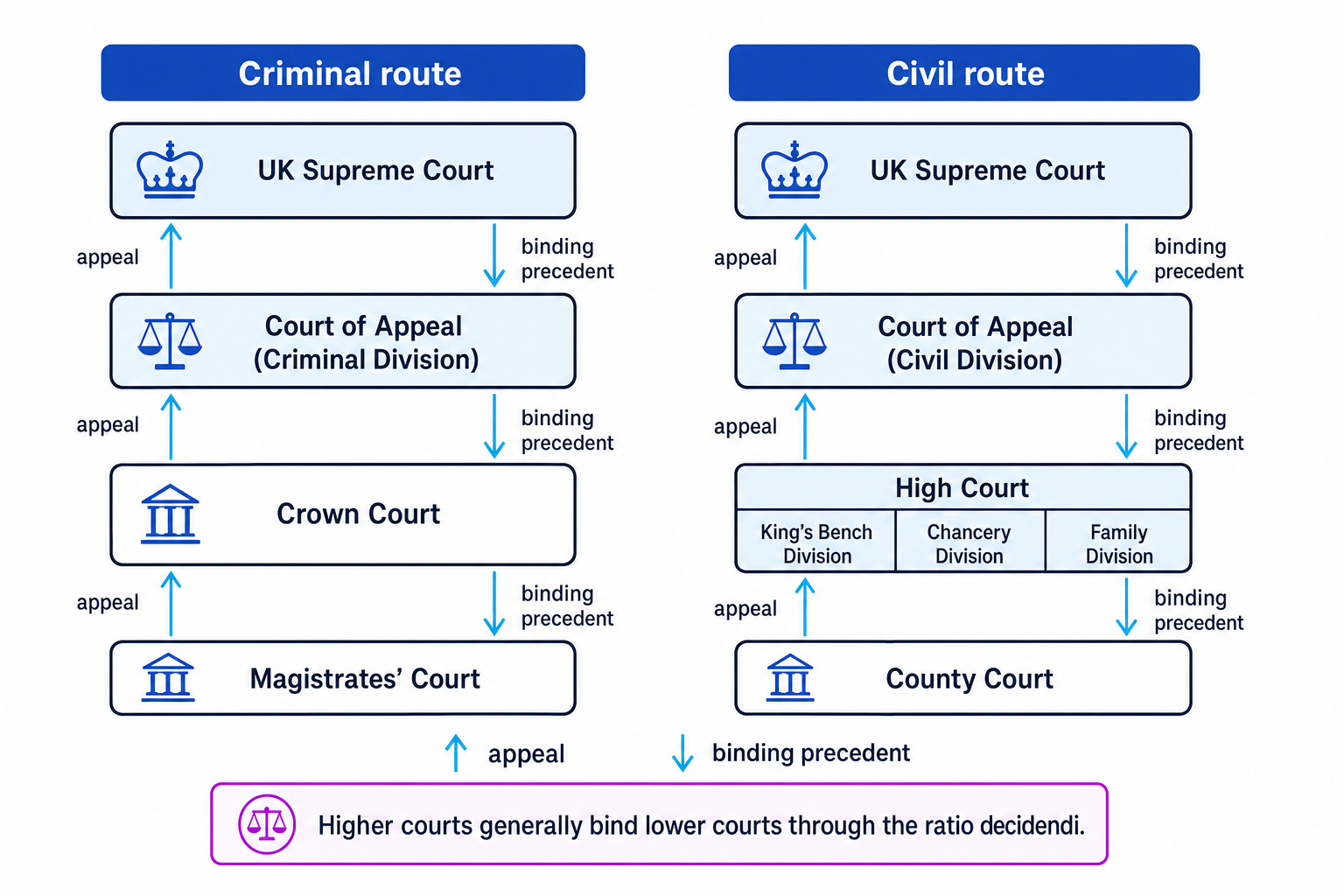
Precedent only works if you know which courts are above others. In general, decisions flow downwards: higher courts bind lower courts.
Criminal hierarchy
The main criminal route is:
- Magistrates’ Court and Crown Court
- Court of Appeal, Criminal Division
- UK Supreme Court
The Crown Court is very important for trials and sentencing, but its decisions do not usually create binding precedent. Binding criminal precedent mainly comes from the Court of Appeal, Criminal Division, and the UK Supreme Court.
Civil hierarchy
The main civil route is:
- County Court and High Court
- Court of Appeal, Civil Division
- UK Supreme Court
The High Court has three divisions: King’s Bench Division, Chancery Division and Family Division. High Court decisions may be persuasive or sometimes binding on lower courts, but the strongest binding precedent comes from the Court of Appeal and UK Supreme Court.
Older cases
Before 2009, the highest domestic appeal court was the House of Lords. Its decisions are treated like UK Supreme Court decisions for precedent purposes unless later overruled.
Binding, persuasive and original precedent
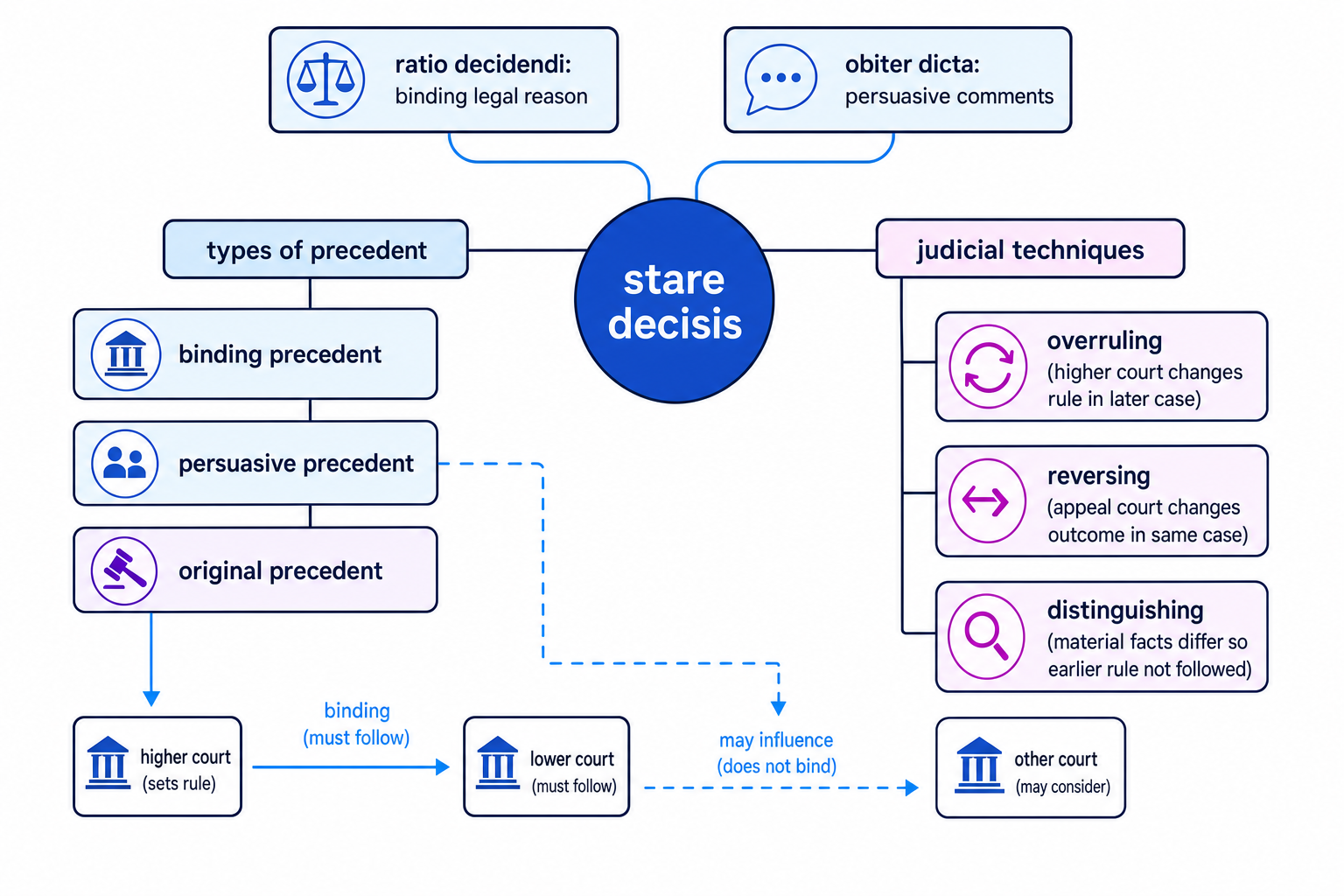
Types of precedent
- Binding precedent must be followed by the later court.
- Persuasive precedent does not have to be followed, but the court may choose to use it.
- Original precedent is created when there is no existing binding authority, so the judge develops a new rule by analogy with existing legal principles.
Persuasive precedent can come from obiter dicta, dissenting judgments, decisions of lower courts, decisions of the Judicial Committee of the Privy Council, or decisions from other common law jurisdictions.
Donoghue v Stevenson (1932) is a classic example of original precedent: there was no direct previous case on a decomposed snail in a drink bottle, so the court developed the “neighbour principle” for negligence.
Deciding whether a precedent binds
-
Suppose a Crown Court is dealing with a defendant who claims duress as a defence to attempted murder. The court must first identify where the relevant authority comes from.
-
R v Gotts (1992) was decided by the House of Lords, the predecessor to the UK Supreme Court; its legal rule was that duress is not available for attempted murder.
-
The Crown Court is lower in the hierarchy than the House of Lords/UK Supreme Court, and the legal issue is the same. The ratio decidendi in Gotts is therefore binding.
-
The Crown Court must apply Gotts and reject the defence of duress to attempted murder.
Exceptions to strict stare decisis
Precedent aims for certainty, but the system would be too rigid if no court could ever correct old mistakes.
The UK Supreme Court
Under UK Supreme Court Practice Directions 3 and 4, the UK Supreme Court will normally follow its own previous decisions, but it may depart from them when it appears right to do so. This continues the approach of the House of Lords’ Practice Statement 1966.
British Railways Board v Herrington (1972) involved a child trespasser injured on railway land; the House of Lords departed from the old rule in Addie v Dumbreck (1929), where a child trespasser had been injured by machinery and the occupier owed only a very limited duty. The new principle recognised a more humane duty towards child trespassers.
R v Shivpuri (1986) involved a defendant who believed he was importing drugs, though the substance was harmless; the House of Lords overruled Anderton v Ryan (1985), where a defendant bought a video recorder she believed was stolen and the court had taken a narrower approach to impossible attempts.
The Court of Appeal and Young v Bristol Aeroplane
The Court of Appeal is generally bound by its own previous decisions and by the UK Supreme Court.
Young v Bristol Aeroplane (1944) arose from claims following an aircraft accident; it established three exceptions where the Court of Appeal may depart from its own earlier decision:
- There are two conflicting Court of Appeal decisions, so it must choose which to follow.
- A later UK Supreme Court or House of Lords decision has effectively overruled the earlier Court of Appeal decision.
- The earlier decision was made per incuriam, meaning “through lack of care”, usually because a relevant statute or binding authority was overlooked.
The Criminal Division has shown slightly more flexibility where liberty is at stake. R v Gould (1968) involved a bigamy conviction and an earlier misunderstanding of the law; the Court of Appeal, Criminal Division accepted that it could depart from a previous decision to avoid injustice.
Historic resistance by the Court of Appeal
The Court of Appeal has not always accepted strict hierarchy comfortably. In Broome v Cassell (1972), a libel damages dispute, the Court of Appeal tried to avoid the House of Lords’ approach in Rookes v Barnard (1964), where trade union threats led to loss of employment and the House of Lords restricted exemplary damages. The House of Lords strongly criticised this and confirmed that the Court of Appeal must follow decisions of the House of Lords — now the UK Supreme Court.
Ignoring the hierarchy
Do not say the Court of Appeal can refuse to follow the UK Supreme Court just because it thinks the earlier decision is wrong. It can criticise or distinguish where possible, but it cannot simply ignore binding authority.
How judges deal with precedent
Judges do not only “follow” precedent. They have techniques for developing the law.
Overruling, reversing and distinguishing
- Overruling happens when a higher court in a later case decides that an earlier legal rule is wrong.
- Reversing happens when a higher court changes the decision in the same case on appeal.
- Distinguishing happens when a court avoids following an earlier case because the material facts are different.
For overruling, use R v Shivpuri (1986): the House of Lords overruled Anderton v Ryan (1985) on impossible attempts.
For reversing, use Gillick v West Norfolk and Wisbech AHA (1985): the House of Lords reversed the Court of Appeal and held that some under-16s can consent to medical treatment if they have sufficient understanding, known as Gillick competence.
For distinguishing, use Balfour v Balfour (1919) and Merritt v Merritt (1970). In Balfour, a married couple living amicably were presumed not to intend legal relations over a domestic allowance. In Merritt, separated spouses who made a written agreement were treated differently, so the earlier case was distinguished.
Distinguishing Balfour from Merritt
-
Start with the earlier rule: Balfour v Balfour (1919) suggests domestic agreements between spouses are usually not legally enforceable because there is no intention to create legal relations.
-
Compare the material facts in Merritt v Merritt (1970): the couple were separated, the agreement was written down, and it concerned financial arrangements after the relationship had broken down.
-
Decide whether the factual differences matter legally. Separation and a written financial agreement make the situation more commercial and serious than an ordinary domestic arrangement.
-
Conclude that the court can distinguish Balfour and find an intention to create legal relations in Merritt.
Advantages and disadvantages of precedent
Advantages
Precedent promotes certainty because people and lawyers can predict how courts are likely to decide future cases. It also supports consistency, as similar cases should be treated alike.
It can be efficient: judges do not have to reinvent the law in every case. It also gives law practical detail because rules develop from real disputes.
Precedent is not completely rigid. Techniques such as distinguishing and overruling allow judges to update the law, as seen in R v Shivpuri (1986) and British Railways Board v Herrington (1972).
Disadvantages
Precedent can be rigid. A lower court may have to follow a rule even if it seems outdated or unfair. This may delay reform until a suitable case reaches the UK Supreme Court or Parliament intervenes.
It can also be complex. There are thousands of reported cases, and identifying the true ratio decidendi can be difficult. Judges may create artificial distinctions to avoid an inconvenient precedent.
There is also a democratic criticism: judges are unelected, yet precedent allows them to develop law. However, this is balanced by the fact that judges decide real disputes, give reasons publicly, and remain subject to Parliament’s ability to legislate.
AO3 balance
A strong evaluation does not just list advantages and disadvantages. It weighs them: precedent gives certainty and consistency, but those benefits can come at the cost of flexibility and simplicity.
In the exam
-
Start with the hierarchy: identify which court decided the earlier case and which court is hearing the current case.
-
Use precise terminology: say whether the point is ratio decidendi or obiter dicta, and whether the precedent is binding, persuasive or original.
-
Support every method with authority: Young v Bristol Aeroplane (1944) for Court of Appeal exceptions, R v Shivpuri (1986) for overruling, Gillick (1985) for reversing, and Merritt (1970) for distinguishing.
Check yourself
- What is the difference between ratio decidendi and obiter dicta?
- What are the three exceptions from Young v Bristol Aeroplane (1944)?
- Why might precedent be both fair and unfair?
