What you'll learn
- The membership, role and legal functions of the main EU institutions.
- The difference between treaties, regulations and directives.
- How EU law created rights individuals could use in national courts.
- Why EU supremacy affected Parliamentary sovereignty during the UK’s EU membership.
Starting point: why EU law mattered
A Member State is a country that belongs to the European Union. While the UK was a Member State, EU law was not just “foreign” or international law: it became a source of law in England and Wales.
The key domestic gateway was s2(1) European Communities Act 1972, which allowed directly enforceable EU rights to take effect in UK law. s2(4) European Communities Act 1972 required UK legislation to be interpreted and applied subject to EU law where relevant.
European Union law
European Union law means the legal rules created by EU treaties, EU legislation and decisions of the Court of Justice of the European Union. During UK membership, those rules could affect domestic law and individual rights in England and Wales.
The main EU institutions
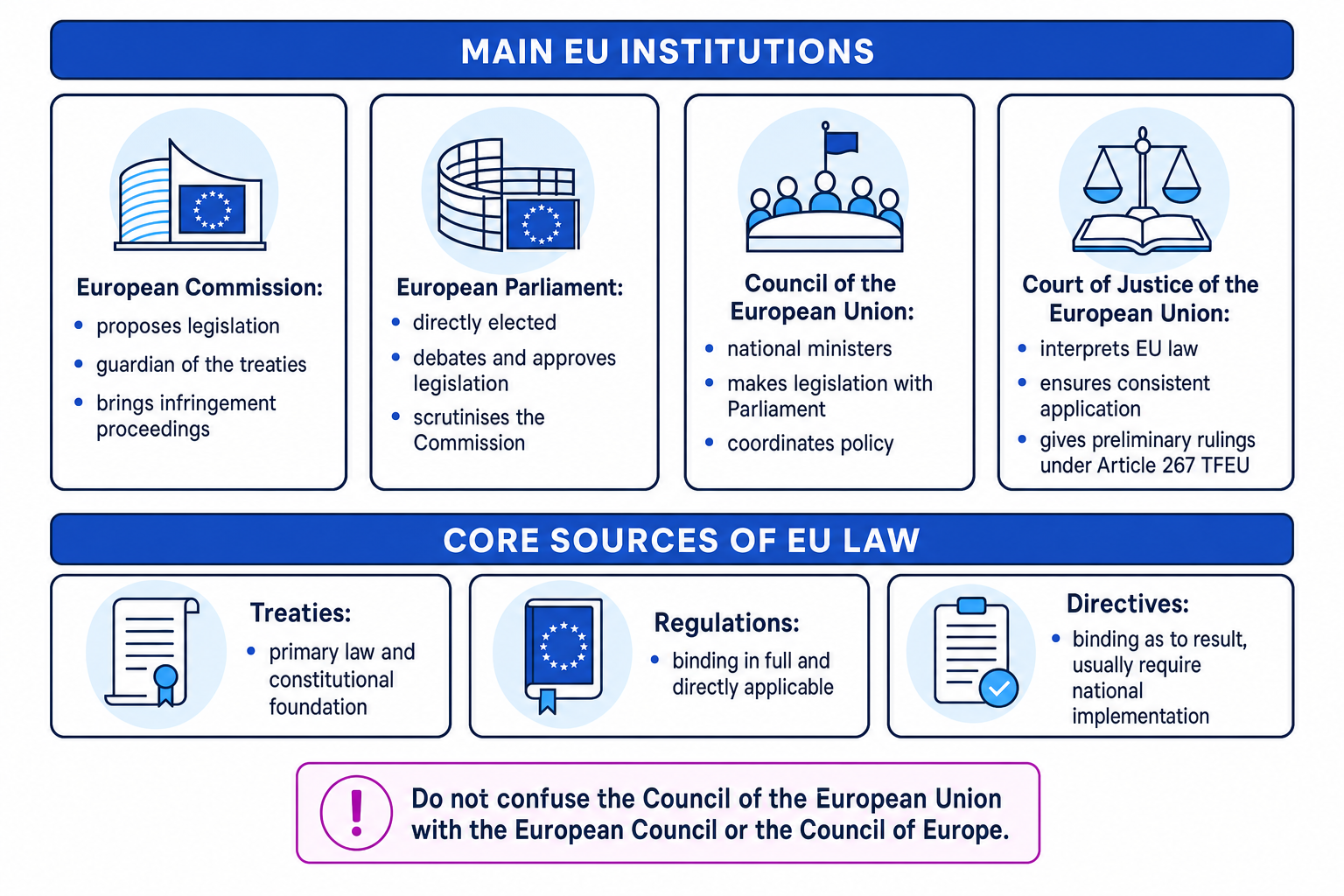
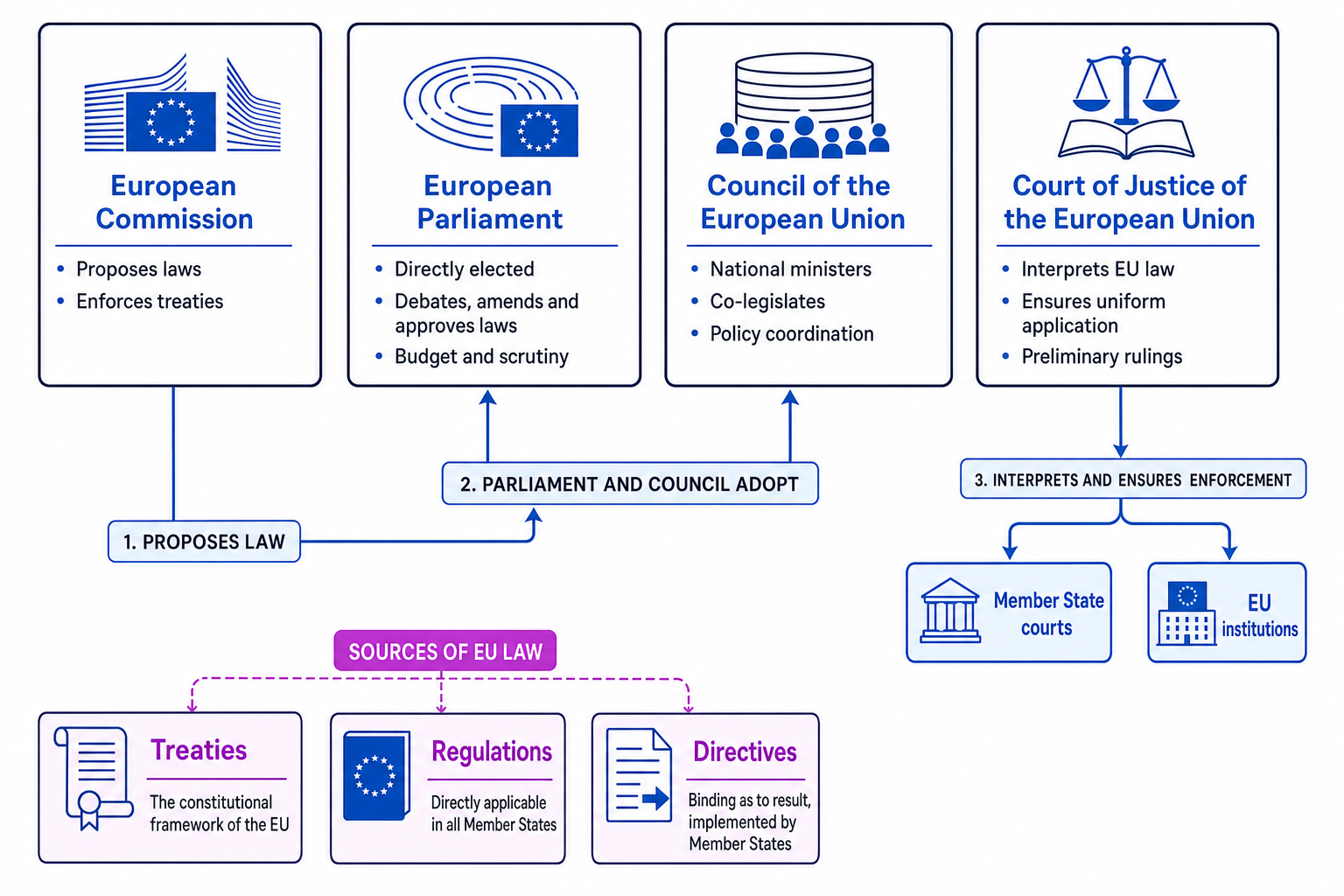
You need four institutions: the European Commission, the European Parliament, the Council of the European Union, and the Court of Justice of the European Union.
European Commission
The European Commission is made up of one Commissioner from each Member State. Commissioners are meant to act independently in the interests of the EU as a whole, not as national representatives.
Its main legal functions are to:
- propose new EU legislation;
- act as “guardian of the treaties” by checking Member States comply with EU law;
- bring infringement proceedings against Member States before the Court of Justice of the European Union;
- help administer EU policies and budget.
European Parliament
The European Parliament is directly elected by EU citizens. During UK membership, UK citizens elected Members of the European Parliament, called MEPs.
Its main legal functions are to:
- debate, amend and approve EU legislation with the Council of the European Union;
- approve the EU budget;
- scrutinise the Commission;
- approve the appointment of the Commission and, in extreme cases, dismiss it.
Council of the European Union
The Council of the European Union consists of government ministers from each Member State. The exact minister depends on the topic: for example, finance ministers meet on finance issues, and environment ministers meet on environmental issues.
Its main legal functions are to:
- make EU legislation jointly with the European Parliament;
- coordinate Member State policies;
- approve some international agreements;
- share budgetary power with the European Parliament.
Do not mix up the Councils
The Council of the European Union is an EU law-making body. The Council of Europe is a separate organisation linked to the European Convention on Human Rights, not EU law. The European Council is also different: it is the meeting of national leaders setting broad EU direction.
Court of Justice of the European Union
The Court of Justice of the European Union, often shortened to CJEU, is the EU’s judicial institution. The Court of Justice has one judge from each Member State, assisted by Advocates General. The wider CJEU also includes the General Court.
Its main legal functions are to:
- interpret EU law;
- ensure EU law is applied consistently across Member States;
- decide cases between EU institutions, Member States and individuals;
- give preliminary rulings under Article 267 Treaty on the Functioning of the European Union, where a national court asks the CJEU to clarify the meaning or validity of EU law.
Sources of EU law
The three sources OCR expects here are treaties, regulations and directives.
The three core sources
Treaties are the constitutional foundation of the EU. Regulations apply automatically and are binding in full. Directives set a result Member States must achieve, but usually need national implementation.
Treaties
Treaties are the EU’s primary law. They create the EU institutions, give them powers and set out core rights and principles. Important examples include the Treaty on European Union and the Treaty on the Functioning of the European Union.
In Van Gend en Loos (1963), a Dutch importer challenged a customs duty; the CJEU held that EU treaty provisions could create rights for individuals enforceable in national courts.
Regulations
A regulation is binding in its entirety and directly applicable in all Member States under Article 288 Treaty on the Functioning of the European Union.
Direct applicability and direct effect
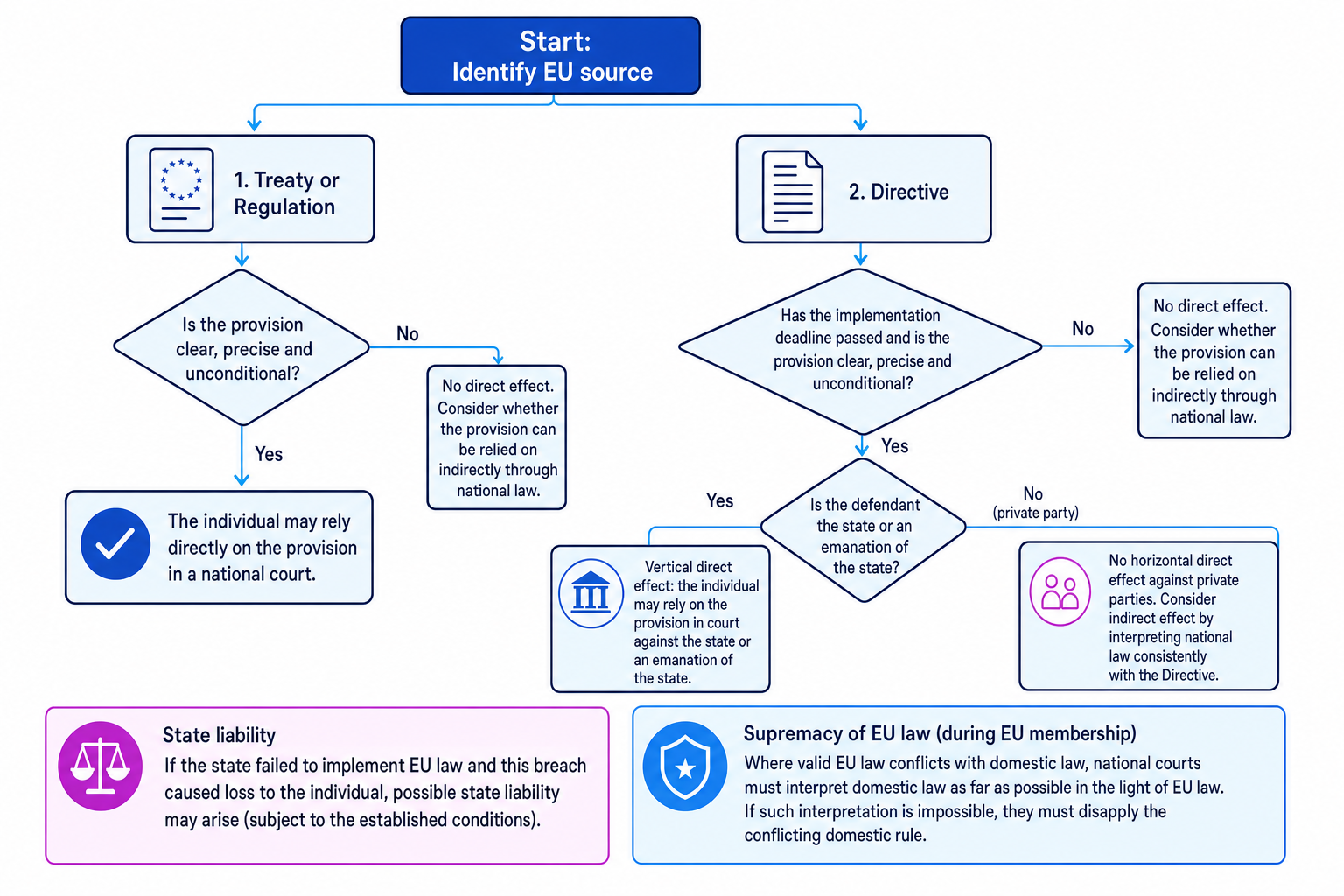
Direct applicability means an EU rule becomes part of national law without needing a new Act of Parliament. Direct effect means an individual can rely on an EU rule in a national court, provided the rule is sufficiently clear, precise and unconditional.
Directives
A directive is binding as to the result to be achieved, but Member States choose the form and method of implementation. In England and Wales, directives were often implemented through Acts of Parliament or delegated legislation.
Directives are different from regulations: they are not automatically fully applicable in the same way. However, CJEU case law developed ways for individuals to rely on them in some situations.
Choosing the legal effect of an EU measure
A regulation says food businesses must display allergen information. A directive says Member States must create further safety penalties by a set deadline. A customer wants to sue a private supermarket before the directive has been implemented.
-
Identify the regulation first: because regulations are binding in full and directly applicable, the customer may rely on the regulation if its wording is clear and precise.
-
Analyse the directive separately: a directive normally needs national implementation, so it does not automatically create a claim against a private supermarket.
-
Check the timing and defendant: if the implementation deadline has not passed, direct effect is unlikely; if the defendant is private, a directive cannot usually have horizontal direct effect.
-
Conclude: the regulation is the stronger direct route; the directive may only help through national implementing law or indirect interpretation if available.
How EU law extended rights to individuals
EU law expanded individual rights because people could sometimes rely on EU rules directly in domestic courts. This was largely developed by the CJEU, then applied by national courts.
Direct effect
Direct effect allows individuals to rely on EU law in national courts.
- Van Gend en Loos (1963): a Dutch company challenged an import duty; EU law could create enforceable individual rights.
- Van Duyn v Home Office (1974): a Dutch national refused entry to work for the Church of Scientology relied on a directive against the UK; directives can sometimes have direct effect against the state.
- Marshall v Southampton and South-West Hampshire AHA (1986): a woman dismissed because of retirement rules relied on an equal treatment directive against a health authority; directives can have vertical direct effect, but not horizontal direct effect.
Vertical direct effect means relying on EU law against the state or an emanation of the state. Horizontal direct effect means relying on EU law against another private individual or private business.
In Foster v British Gas (1990), British Gas was treated as an emanation of the state because it provided a public service under state control with special powers.
Indirect effect
Indirect effect means national courts interpret domestic law, as far as possible, to comply with EU law.
- Von Colson (1984): two women denied prison jobs relied on an equal treatment directive; national law had to be interpreted in light of the directive.
- Marleasing (1990): a Spanish company dispute; national courts had to interpret domestic law consistently with directives where possible.
- Litster v Forth Dry Dock (1989): workers dismissed before a business transfer; the House of Lords interpreted UK regulations purposively to comply with an EU directive.
State liability
State liability allows an individual to claim damages where a Member State breaches EU law and causes loss.
In Francovich v Italy (1991), workers lost pay when their employer became insolvent and Italy had failed to implement a directive protecting them; the CJEU held that a state may be liable in damages for failing to implement EU law.
Relying on an unimplemented directive
Sofia works for an NHS hospital. An EU directive gives workers a clear right to safety protection, the implementation deadline has passed, but the UK has not implemented it properly.
-
Identify the issue: Sofia is trying to rely on an unimplemented directive in a national court.
-
State the rule: under Van Duyn v Home Office (1974), a clear, precise and unconditional directive can have vertical direct effect after the implementation deadline has passed.
-
Classify the defendant: an NHS hospital is likely to be part of the state or an emanation of the state, following the reasoning in Foster v British Gas (1990).
-
Apply and conclude: Sofia can probably rely on the directive against the hospital. If her employer were a private company, Marshall (1986) means she would need to consider indirect effect or state liability instead.
Supremacy of EU law and Parliamentary sovereignty
Supremacy of EU law
Supremacy means that, where valid EU law conflicted with national law during membership, EU law had priority and the national court had to give effect to EU law.
The CJEU developed supremacy in major cases:
- Costa v ENEL (1964): an Italian shareholder challenged nationalisation of electricity; the CJEU held that Member States had limited their sovereign rights by joining the EU legal order.
- Simmenthal (1978): an Italian court faced a conflict between EU law and national law; the CJEU held national courts must set aside conflicting domestic law.
In the UK, the dramatic authority is R v Secretary of State for Transport, ex parte Factortame (No 2) (1991). Spanish-owned fishing companies challenged the Merchant Shipping Act 1988 because it conflicted with EU rights. The House of Lords disapplied parts of the Act, showing EU law could override even later Acts of Parliament during membership.
Parliamentary sovereignty
Parliamentary sovereignty means Parliament can make or unmake any law, and no other body can normally override an Act of Parliament.
EU supremacy qualified this principle in practice. During membership, Parliament had accepted EU law’s priority through the European Communities Act 1972. In Thoburn v Sunderland City Council (2002), the “metric martyrs” argued that later weights and measures law had impliedly repealed EU-based rules; the court held the European Communities Act 1972 was a constitutional statute and could not be impliedly repealed.
Resolving a conflict with an Act of Parliament
An EU regulation gives traders a right to sell a product across Member States. A later UK Act bans that product in a way that conflicts with the regulation.
-
Identify the conflict: a directly applicable EU regulation clashes with a domestic Act of Parliament.
-
State the rule: under Costa v ENEL (1964) and Simmenthal (1978), EU law has supremacy; in the UK, Factortame (No 2) (1991) shows courts could disapply conflicting Acts during membership.
-
Apply the domestic gateway: because s2 European Communities Act 1972 gave effect to EU law in UK law, the court would try to interpret the UK Act compatibly with EU law.
-
Conclude: if compatible interpretation is impossible, the court would disapply the conflicting UK provision for that case.
The sovereignty balance
A strong AO3 point is: EU law limited Parliament’s sovereignty in day-to-day legal operation, but orthodox UK theory says Parliament chose that limit by enacting the European Communities Act 1972 and could remove it by express repeal.
Keep the time period clear
For this specification point, focus on the UK during EU membership. Do not write as if new EU law still automatically overrides Acts of Parliament after Brexit.
Evaluating the impact of EU law
EU law had a major practical impact on English and Welsh law. It gave individuals enforceable rights in areas such as employment, equality, consumer protection and free movement. Doctrines like direct effect, indirect effect and state liability made EU law useful to ordinary claimants, not just governments.
There were also rule-of-law benefits. Supremacy promoted consistency across Member States, and preliminary references allowed national courts to get authoritative answers from the CJEU.
However, EU law also raised constitutional concerns. Factortame (No 2) (1991) was controversial because courts disapplied an Act of Parliament. Critics argue this weakened democratic control. Others argue the limitation was legitimate because Parliament voluntarily accepted it through the European Communities Act 1972, and EU law-making also involved elected ministers in the Council and elected MEPs in the European Parliament.
A balanced conclusion is best: EU law significantly constrained Parliament during membership, but it did so through a legal structure Parliament had accepted.
In the exam
-
For AO1, organise your answer around institutions, sources, individual rights, and supremacy.
-
For AO2, identify the source first: treaty, regulation or directive. Then decide whether direct effect, indirect effect, state liability or supremacy applies.
-
For AO3, balance the practical loss of sovereignty shown by Factortame against the argument that Parliament consented through the European Communities Act 1972.
Check yourself
- What is the difference between a regulation and a directive?
- Why did Van Gend en Loos (1963) matter for individuals?
- How did Factortame (No 2) (1991) affect Parliamentary sovereignty during UK membership?