What you'll learn
- How OCR A Level Law H418 is organised across compulsory and optional components.
- The difference between the legal system, law making, and the nature of law.
- What lawyers mean by legal liability, legal method, statutory interpretation, and judicial precedent.
- How AO1, AO2 and AO3 shape strong law answers from the beginning of the course.
The big picture: what is this course about?
OCR H418 is an A Level in the law of England and Wales. That matters because the UK has more than one legal system: Scotland and Northern Ireland have separate legal arrangements in many areas.
At A Level, you are not just memorising rules. You are learning how legal rules are made, interpreted, applied to disputes, and evaluated.
Law
Law is a system of rules recognised and enforced by the state, usually through courts, tribunals and public authorities.
The course gives you a foundation in the English legal system and then introduces you to areas of private law and public law.
Private law and public law
Private law deals mainly with disputes between individuals or organisations, such as tort and contract. Public law deals with the relationship between individuals and the state, such as criminal law and human rights law.
Classifying a legal problem
Imagine Nina is arrested at a protest, and a bystander is injured during the incident.
-
Nina’s complaint that the police detained her unlawfully is a public law issue because it concerns state power over an individual. It may connect to Article 5 ECHR, the right to liberty, or Article 10 ECHR, freedom of expression.
-
The bystander’s claim for compensation for injury is a private law issue if they sue Nina personally. That would likely be considered through the law of tort.
-
If the Crown Prosecution Service brings a case against Nina for assault, that becomes a criminal law matter because the state is prosecuting alleged wrongdoing.
The course structure
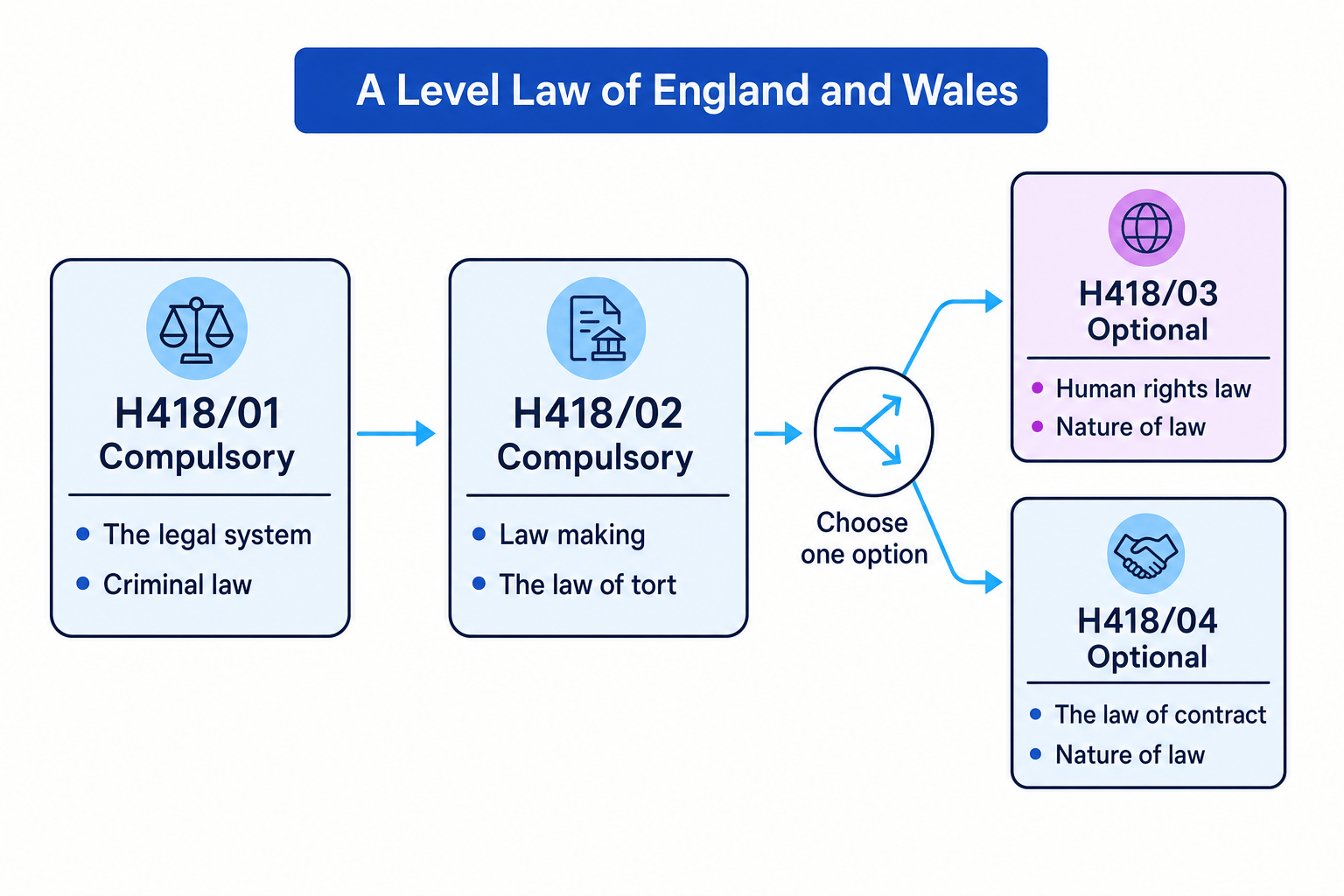
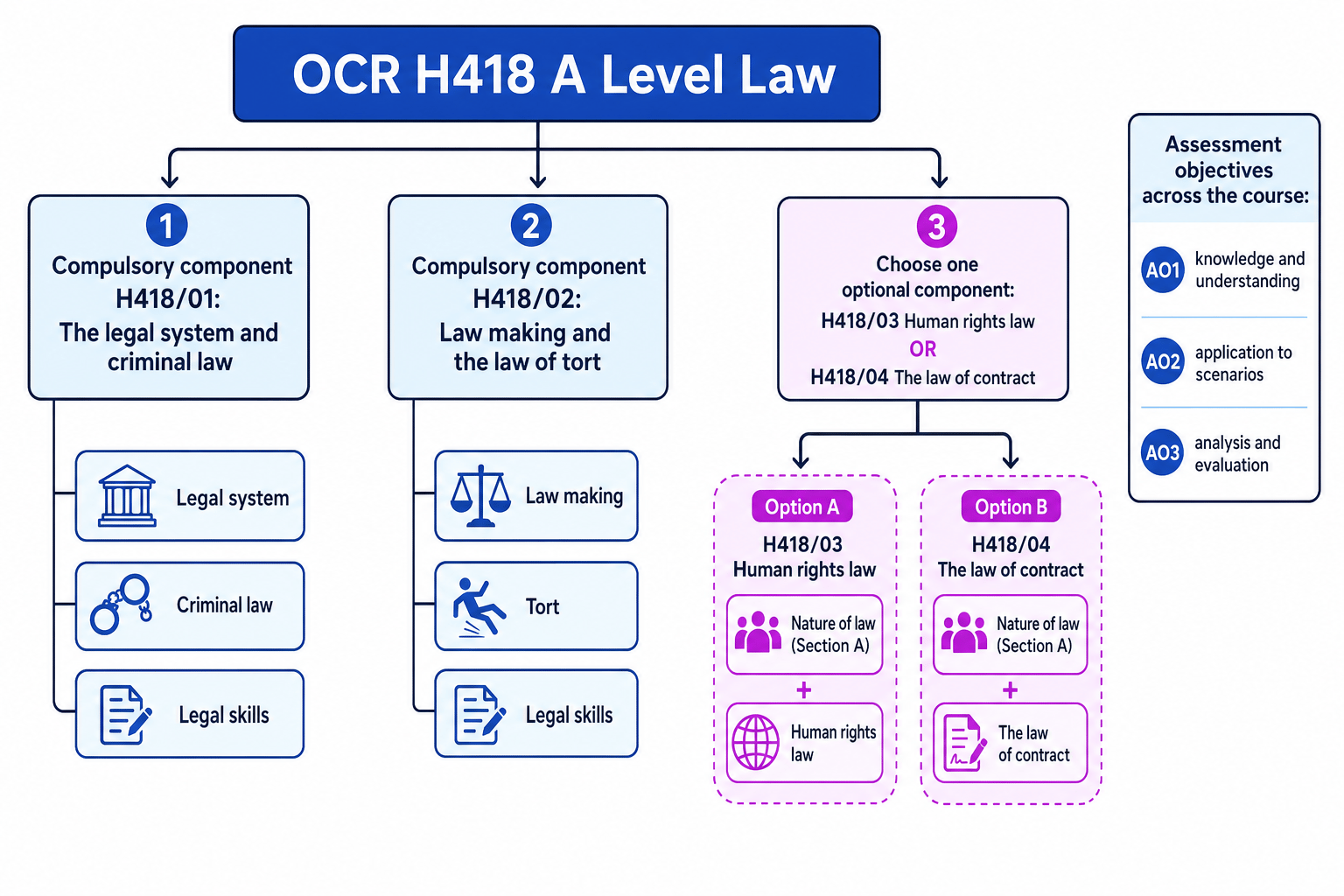
The H418 course has two compulsory components and one optional component. You study either human rights law or the law of contract, not both for the exam route.
Compulsory component: H418/01
This component covers:
- The legal system
- Criminal law
The legal system gives you the background: courts, personnel, access to justice, criminal process and civil process. Criminal law then introduces legal liability through offences and defences.
Compulsory component: H418/02
This component covers:
- Law making
- The law of tort
Law making includes Parliament, delegated legislation, statutory interpretation and judicial precedent. Tort then introduces civil liability, especially where one person suffers harm because of another’s wrongdoing.
Optional component: H418/03 or H418/04
You then study one of:
- H418/03 Human rights law
- H418/04 The law of contract
Both options include a nature of law section, so whichever option you take, you still need to think critically about what law is for and how it connects to society.
Do not mix the options
For the final optional paper, you study human rights law or contract law. Do not assume you need both unless your teacher has chosen to teach both for wider understanding.
The three foundation areas
The specification says the English legal system and the nature of law are split into three broad sections.
1. The legal system
The legal system is about institutions and processes: courts, judges, juries, magistrates, legal professionals, funding, and how cases move through civil and criminal justice.
This helps you understand where legal rules are used in real disputes.
2. Law making
Law making is about where legal rules come from. The two central sources you study are legislation and case law.
Legislation
Legislation is law made by Parliament or under powers given by Parliament. An Act of Parliament is also called a statute, such as the Theft Act 1968 or the Human Rights Act 1998.
Case law
Case law is law developed through judicial decisions in decided cases. Courts may create, clarify or apply legal principles when resolving disputes.
3. The nature of law
The nature of law asks broader questions. For example:
- What is the relationship between law and morality?
- Does law always achieve justice?
- How should law balance individual freedom and social control?
- How does law respond to social change?
This is where AO3 evaluation becomes especially important.
The foundation sections matter
The legal system tells you where law operates, law making tells you where rules come from, and the nature of law asks whether law is doing its job well.
Legal method and reasoning
A major aim of the course is to develop your legal method. This means using legal sources properly and reasoning from rules to conclusions.
Legal method
Legal method is the disciplined way lawyers identify issues, select relevant legal rules, use authority, apply rules to facts, and reach reasoned conclusions.
Two key tools are statutory interpretation and judicial precedent.
Statutory interpretation
Statutory interpretation is the process by which judges work out the meaning of words in legislation.
This matters because statutory words can be broad, unclear or difficult to apply to new facts. A statute may look straightforward until a real dispute exposes uncertainty.
Judicial precedent
Judicial precedent
Judicial precedent is the system where courts follow legal principles from earlier cases. The Latin phrase stare decisis means “stand by what has been decided”.
The most important part of a case is its ratio decidendi.
Ratio decidendi and obiter dicta
The ratio decidendi is the legal reason for the decision and may bind later courts. Obiter dicta are other comments made by the judge which are not binding but may be persuasive.
A classic example is Donoghue v Stevenson (1932): Mrs Donoghue became ill after drinking ginger beer allegedly containing a decomposed snail. The House of Lords established the neighbour principle and a manufacturer’s duty of care to the ultimate consumer.
Using precedent as authority
Sam buys a sealed bottle of soft drink. It contains glass fragments and Sam is injured.
-
Identify the legal issue: Sam may have a negligence claim against the manufacturer because the harm came from a defective product.
-
Select the relevant authority: in Donoghue v Stevenson (1932), the court recognised that a manufacturer can owe a duty of care to the ultimate consumer where the product reaches them without reasonable opportunity for inspection.
-
Apply the principle to the facts: Sam bought a sealed bottle, so they probably could not inspect the contents before drinking. This is similar to the sealed ginger beer bottle in Donoghue.
-
Reach a cautious conclusion: Sam is likely to establish a duty of care, though a full negligence claim would still require breach, causation and damage.
Legal liability
Legal liability
Legal liability means legal responsibility for conduct or consequences. It can lead to punishment, compensation, declarations, injunctions or other legal outcomes.
Criminal liability
Criminal law is concerned with offences against society. The state prosecutes the defendant, and possible outcomes include imprisonment, fines, community orders or other sentences.
Two key terms appear throughout criminal law:
Actus reus and mens rea
Actus reus means the external element of a crime, such as an act, omission or state of affairs. Mens rea means the mental element, such as intention, recklessness or knowledge.
For example, R v Cunningham (1957) involved a defendant who tore a gas meter from a wall, causing gas to leak and endanger another person. The case is important for subjective recklessness: the defendant must foresee a risk and go on to take it.
Tort liability
Tort law is mainly about civil wrongs. The usual remedy is damages, meaning financial compensation.
For example, negligence uses authorities such as Caparo v Dickman (1990), where investors relied on company accounts and suffered loss; the case gave a three-stage duty test of foreseeability, proximity, and whether it is fair, just and reasonable to impose a duty. Later, Robinson v Chief Constable of West Yorkshire (2018) clarified that courts should usually apply established precedent rather than treat Caparo as a universal test for every duty situation.
Human rights and contract
Human rights law focuses on the protection of rights and freedoms, often involving public authorities. For example, Article 5 ECHR protects liberty, and Article 10 ECHR protects freedom of expression.
Contract law focuses on legally binding agreements. It includes formation, terms, exclusion clauses and remedies. For example, Pao On v Lau Yiu Long (1980) concerned promises connected to a share transaction and is important for when past consideration may still be valid if specific conditions are met.
The assessment objectives: AO1, AO2 and AO3
A strong A Level Law answer usually combines three skills.
AO1: Knowledge and understanding
AO1 is your legal knowledge: definitions, statutes, sections, cases, principles and accurate terminology.
For example, writing s1 Theft Act 1968 is stronger than just saying “the law on theft”.
AO2: Application
AO2 is applying the law to the facts of a scenario. You must connect the rule to the details you are given.
This is where many marks are won in problem questions.
AO3: Analysis and evaluation
AO3 is about making reasoned judgments. Depending on the topic, you may evaluate fairness, effectiveness, reform, balancing interests, protection of rights, or criticisms of a law.
Treating AO3 as opinion only
AO3 is not just saying “I think this is unfair”. You need a reasoned argument supported by legal examples, consequences, competing interests or reform ideas.
The basic problem-question method: IRAC
A helpful structure for scenario questions is IRAC.
IRAC
IRAC stands for Issue, Rule, Application, Conclusion. It is a simple structure for turning facts into a legal argument.
Building an IRAC paragraph
A customer is injured by glass in a sealed drink bottle.
-
Issue: The issue is whether the manufacturer may owe the customer a duty of care in negligence.
-
Rule: Under Donoghue v Stevenson (1932), a manufacturer can owe a duty to the ultimate consumer where the product reaches the consumer without reasonable opportunity for inspection.
-
Application: The bottle was sealed, so the customer could not realistically check for glass before drinking. This makes the facts close to Donoghue.
-
Conclusion: The manufacturer is likely to owe a duty of care, though the claimant would still need to prove the remaining elements of negligence.
Think like a lawyer from the start
When you learn a case, do not only memorise the name. Learn: facts, legal principle, and how it could apply to a new scenario.
Scope and precision
OCR specification guidance matters. Some parts of the specification tell you what is required, and some explicitly say that particular detail is not required. Treat those exclusions seriously: learning extra material is fine for interest, but exam answers should stay focused on what OCR assesses.
Also remember that A Level Law is untiered. There is no Foundation or Higher tier.
In the exam
-
Start by identifying the area of law: criminal, tort, law making, legal system, human rights, contract, or nature of law.
-
Use authority precisely: cite the relevant statute section or case name with the legal principle it proves.
-
Keep AO2 and AO3 distinct: apply rules closely to scenario facts in problem questions, and evaluate with balanced reasons in essay questions.
Check yourself
- What is the difference between private law and public law?
- Which two H418 components are compulsory, and what optional choice must students make?
- What do AO1, AO2 and AO3 each require you to do?