The allocation of resources
What you'll learn
- What resource allocation means and why scarcity forces choices.
- How incentives influence households, firms and governments.
- How market, planned and mixed economies allocate resources differently.
- How to explain and evaluate productive efficiency and allocative efficiency.
The starting point: scarcity and choice
Economics begins with scarcity: resources are limited, but human wants are effectively unlimited. This means every society has to choose what to produce, how to produce it, and who receives the final goods and services.
The main scarce resources are the factors of production:
- Land: natural resources, such as oil, water, land and minerals.
- Labour: human effort, skills and time.
- Capital: man-made resources used to produce output, such as machinery, factories and technology.
- Enterprise: the willingness to take risks and organise production.
Allocation of resources
The allocation of resources is the way scarce factors of production are distributed between competing uses, and the way final goods and services are distributed between people.
Because resources are scarce, choosing one use normally means giving up another. That sacrifice is called opportunity cost: the value of the next best alternative forgone.
The three allocation questions
Every economic system must answer: what should be produced, how should it be produced, and for whom should it be produced?
Incentives: why economic agents change behaviour
An economic agent is a decision-maker in the economy. The main agents are households, firms, governments and, in open-economy analysis, the foreign sector.
Incentive
An incentive is something that encourages or discourages an economic agent to behave in a particular way by changing the expected costs, benefits or risks of a decision.
Incentives can be:
- Positive, such as subsidies, bonuses, profits, discounts or rewards.
- Negative, such as taxes, fines, higher prices or penalties.
- Financial, such as wages, prices and profits.
- Non-financial, such as reputation, convenience, social pressure or legal rules.
A subsidy is a government payment that lowers the cost of an activity and encourages more of it. A tax is a compulsory payment that can make an activity more expensive and discourage it.
In markets, incentives often work through the price mechanism.
Price mechanism
The price mechanism is the way prices signal information, ration scarce goods and create incentives for consumers and producers.
For example, if the price of coffee rises, consumers have an incentive to buy less coffee or switch to tea. Producers have an incentive to supply more coffee because profit opportunities may increase. Resources may then move towards coffee production.
Using a charge to reduce single-use plastic bags
-
The government introduces a charge per plastic bag, so each extra bag now has a direct financial cost to consumers.
-
Some consumers compare the bag charge with the lower long-run cost of reusing bags, so reusable bags become relatively more attractive.
-
If consumers are responsive to the charge, supermarkets issue fewer single-use bags and order fewer from suppliers.
-
Resources such as plastic, delivery capacity and shelf space can then be reallocated away from single-use bags and towards alternatives such as bags for life.
Assuming incentives always work
An incentive changes the expected costs or benefits of a choice, but it does not guarantee behaviour will change. The response depends on size, timing, information, alternatives and habits.
Evaluating incentives
Incentives are often effective because they work with self-interest. A higher wage can encourage more workers to enter an occupation. A tax on cigarettes can reduce demand. A subsidy for insulation can encourage households to improve energy efficiency.
However, the strength of the response depends on several factors.
Incentives tend to be more effective when:
- The incentive is large enough to matter.
- People understand it clearly.
- There are good substitutes available.
- The behaviour is not too habitual or addictive.
- Agents have time to adjust.
- The policy is trusted and properly enforced.
They may be less effective when the good is a necessity. For example, during the UK cost-of-living squeeze, higher gas and electricity prices encouraged some households to reduce usage, but heating and lighting are difficult to cut beyond a certain point.
How to evaluate incentives
Ask: How big is the incentive? Who faces it? Are there substitutes? Is the response short-run or long-run? Could there be unintended consequences?
A strong evaluation point is that incentives do not affect all agents equally. A £12.50 daily charge, such as London’s ULEZ charge, may strongly affect a low-income driver but be less significant for a high-income commuter or a firm that can pass costs on to customers.
Economic systems
An economic system is the set of institutions and rules used to allocate resources in an economy.
Market economic system
A market economy allocates resources mainly through private ownership, consumer choice, competition and prices. Firms produce goods and services because they expect to make profit. Consumers influence output through what they choose to buy.
Adam Smith described this as the invisible hand: individuals pursuing their own self-interest can, under certain conditions, lead resources towards goods and services that people want.
Market allocation can be powerful because prices act as signals. If demand for electric vehicles rises, their prices and profits may increase. Firms then have an incentive to invest in battery production, charging networks and related technology.
Planned economic system
A planned economy allocates resources mainly through government decisions. The state may own many resources, set production targets, control prices and decide who receives goods and services.
This can allow resources to be directed towards national priorities, such as healthcare, defence, infrastructure or basic housing. However, central planners may lack detailed local information about consumer preferences and production costs. Friedrich Hayek argued that dispersed information is difficult for governments to collect and process efficiently.
Mixed economic system
A mixed economy combines market forces with government intervention. Most real economies, including the UK, are mixed economies.
In the UK, food, clothing and many consumer goods are largely allocated by markets. Healthcare through the NHS is allocated more by need than ability to pay. Education, transport, energy and housing involve a mixture of private provision, public funding, regulation and subsidies.
Allocating healthcare resources
-
In a pure market system, healthcare would mainly go to consumers willing and able to pay, so price would ration scarce doctors, medicines and hospital capacity.
-
In a planned system, the government could allocate healthcare according to assessed need, using budgets, waiting lists and clinical priorities rather than market prices.
-
In a mixed system like the UK, the NHS provides healthcare largely free at the point of use, while private healthcare also exists for those who choose and can afford it.
-
The judgement depends on the objective: markets may improve choice and responsiveness, but planning may improve equity and access for essential care.
Economic efficiency
Economic efficiency is about using scarce resources well. It is not the same as fairness. An economy can be efficient but unequal, or fairer but less efficient.
Productive efficiency
Productive efficiency
Productive efficiency occurs when goods and services are produced using the fewest possible resources for a given level of output. For a whole economy, this means producing on the production possibility curve.
A production possibility curve shows the maximum combinations of two types of goods an economy can produce using all available resources and current technology.
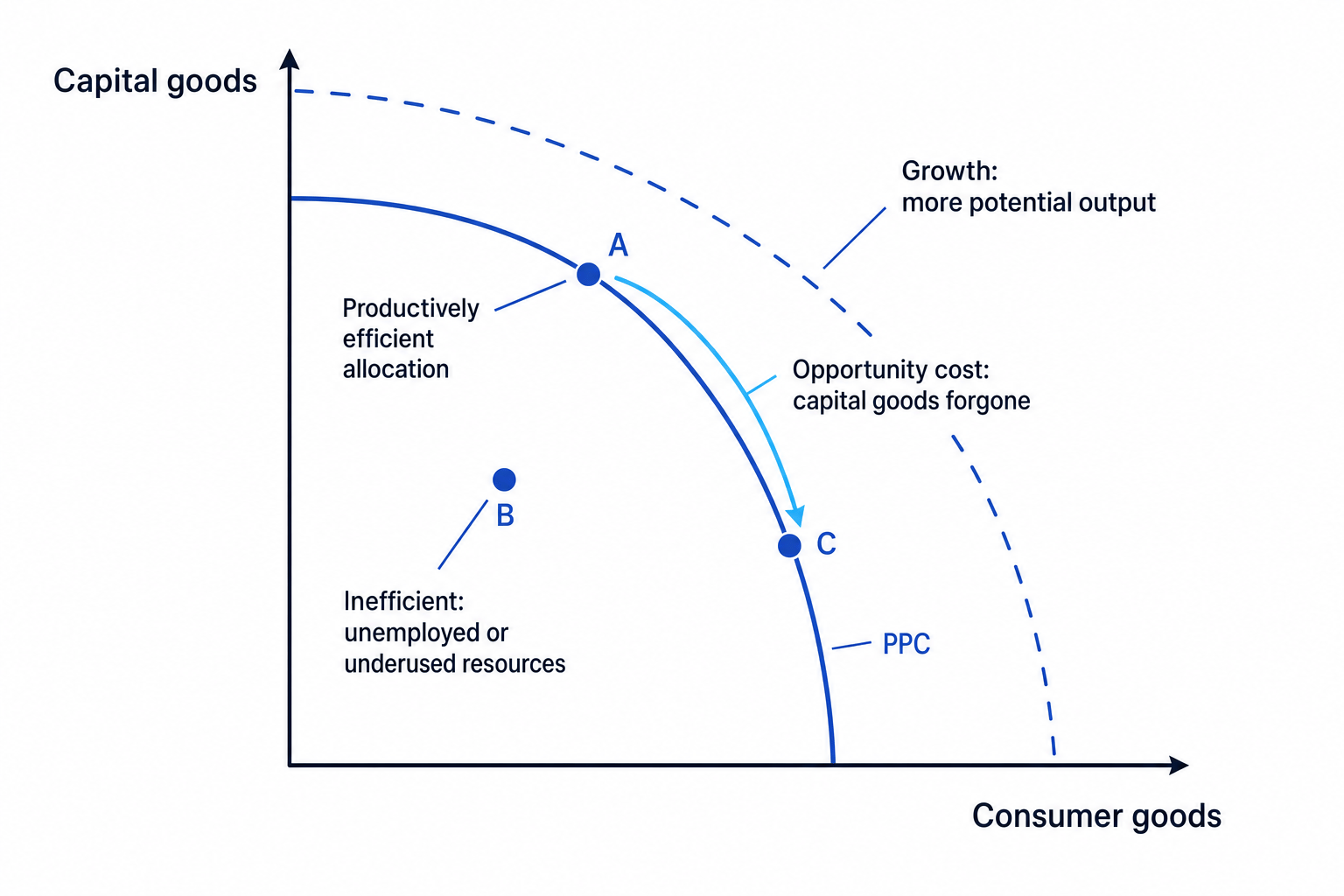
Interpreting productive efficiency on a PPC
-
Point B is inside the PPC, so the economy is not using all resources fully or efficiently. There may be unemployment or underused machinery.
-
Point A is on the PPC, so the economy is productively efficient: it cannot produce more of one good without producing less of another.
-
Moving from A to C increases consumer goods but reduces capital goods, so the opportunity cost is the capital goods forgone.
-
The outward shift shows economic growth: the economy’s potential output has increased because of more resources or better technology.
Allocative efficiency
Before defining allocative efficiency, you need two helpful terms. Marginal benefit is the extra benefit gained from consuming one more unit. Marginal cost is the extra cost of producing one more unit.
Allocative efficiency
Allocative efficiency occurs when resources are used to produce the combination of goods and services that maximises welfare. In a simple competitive market with no externalities, this occurs where marginal benefit equals marginal cost: MB=MCMB = MCMB=MC.
In the diagram below, demand represents marginal benefit and supply represents marginal cost. At equilibrium, the quantity produced is allocatively efficient because the value consumers place on the last unit equals the cost of producing it.
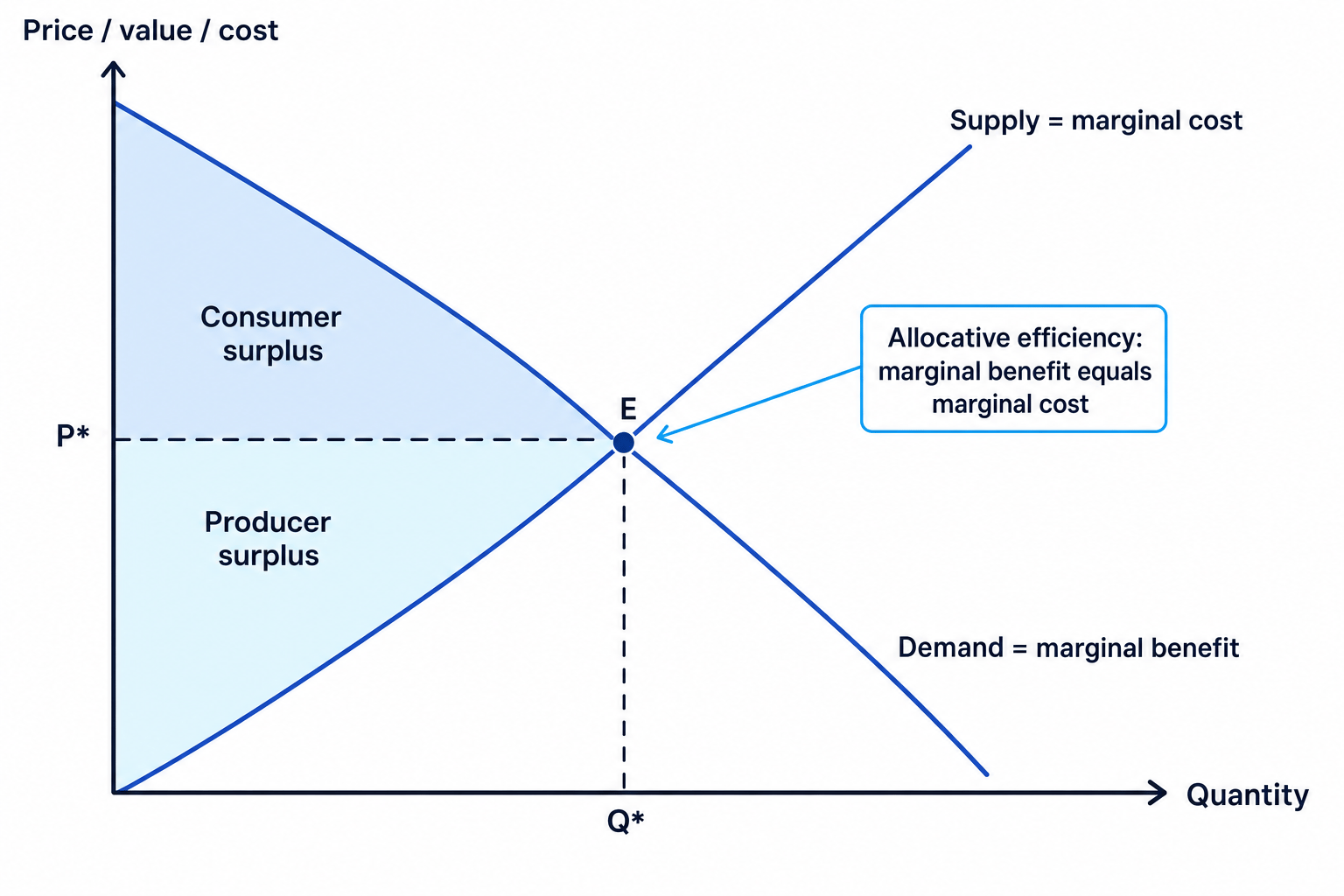
Consumer surplus is the extra benefit consumers receive when they pay less than the maximum they were willing to pay. Producer surplus is the extra benefit producers receive when they sell for more than the minimum price they were willing to accept.
Checking allocative efficiency in a market
-
If output is below Q*, marginal benefit is greater than marginal cost, so society values an extra unit more than it costs to produce.
-
Producing extra units up to Q* increases total welfare because the additional benefit exceeds the additional cost.
-
If output is above Q*, marginal cost is greater than marginal benefit, so too many resources are being used in this market.
-
At Q*, marginal benefit equals marginal cost, so total surplus is maximised in this simple model.
Productive efficiency is not allocative efficiency
A firm may produce at the lowest possible cost, but still produce the wrong good or the wrong quantity from society’s point of view.
Evaluating resource allocation in different systems
Market economies can allocate resources effectively when competition is strong, consumers have good information, prices reflect true costs and benefits, and goods are easy to buy and sell. They encourage innovation, choice and efficiency because firms face profit incentives and the threat of failure.
However, markets can fail. They may underprovide public goods, ignore external costs such as pollution, produce inequality, and allocate essential goods according to ability to pay rather than need. For example, housing markets may allocate homes efficiently to those with purchasing power, but still leave affordability problems.
Planned economies can direct resources towards social objectives, such as universal healthcare, strategic infrastructure or rapid mobilisation during crises. They may avoid some inequalities created by market allocation.
However, planning can suffer from weak incentives, bureaucracy, shortages, surpluses and poor information. If planners set prices too low, demand may exceed supply, causing queues. If they set output targets incorrectly, resources may be wasted.
Mixed economies try to get the benefits of both systems. Markets allocate many goods, while governments intervene with taxes, subsidies, regulation and public services. The UK’s green transition is a good example: private firms invest in renewable energy, but government policy influences incentives through regulation, carbon pricing and subsidies.
The strongest judgement is that no system is automatically best. Market allocation is usually strong for ordinary private goods where competition works well. Government planning is often more justified for public goods, merit goods, essential services and cases of market failure. The quality of resource allocation in a mixed economy depends heavily on the quality of government intervention.
In the exam
-
Start by defining the key term precisely: incentive, market system, planned system, productive efficiency or allocative efficiency.
-
Build a clear chain of analysis: incentive changes costs or benefits, agents change behaviour, resources move, and output or welfare changes.
-
Evaluate by comparing systems or policies using factors such as information, incentives, equity, externalities, time period and government failure.
Check yourself
- Why might a tax on sugary drinks reduce consumption for some consumers but not others?
- Can an economy be productively efficient but allocatively inefficient?
- Why are most real-world economies, including the UK, mixed rather than purely market or planned?