Revenue and profit
What you'll learn
- How to calculate total revenue, average revenue and marginal revenue.
- How to calculate whether a firm has made a profit or a loss.
- The difference between accounting profit, normal profit and supernormal profit.
- Why these ideas matter for business objectives and exam answers.
Start with the basics: revenue, costs and profit
A firm sells goods or services. The money coming in from those sales is revenue. The money spent producing those goods or services is cost. What is left over, if anything, is profit.
Revenue
Revenue is the income a firm receives from selling goods or services, before any costs are subtracted.
A key first distinction is:
- Revenue = money coming in from sales.
- Profit = money left after costs.
- Loss = when costs are greater than revenue.
Revenue is not profit
A firm with high revenue is not automatically profitable. A supermarket may take millions of pounds in sales but still have thin profit margins if rent, wages, energy and supplier costs are high.
Total, average and marginal revenue
Before the formulas, make sure the words feel intuitive:
- Total means “altogether”.
- Average means “per unit”.
- Marginal means “extra” or “additional”.
Total revenue
Total revenue
Total revenue is the total income a firm receives from selling a given quantity of output.
If a firm sells all units at the same price:
TR=P×QTR = P \times QTR=P×Qwhere TRTRTR is total revenue, PPP is price per unit, and QQQ is quantity sold.
For example, if a bakery sells 200 loaves at £2 each, total revenue is £400.
Average revenue
Average revenue
Average revenue is revenue per unit sold.
If each unit is sold at the same price, average revenue equals the price:
AR=PAR = PAR=PSo if a firm’s total revenue is £1,000 from selling 250 units, average revenue is £4 per unit.
Marginal revenue
Marginal revenue
Marginal revenue is the extra revenue gained from selling one more unit of output.
The symbol Δ\DeltaΔ means “change in”. So marginal revenue asks: how much did total revenue change when quantity changed?
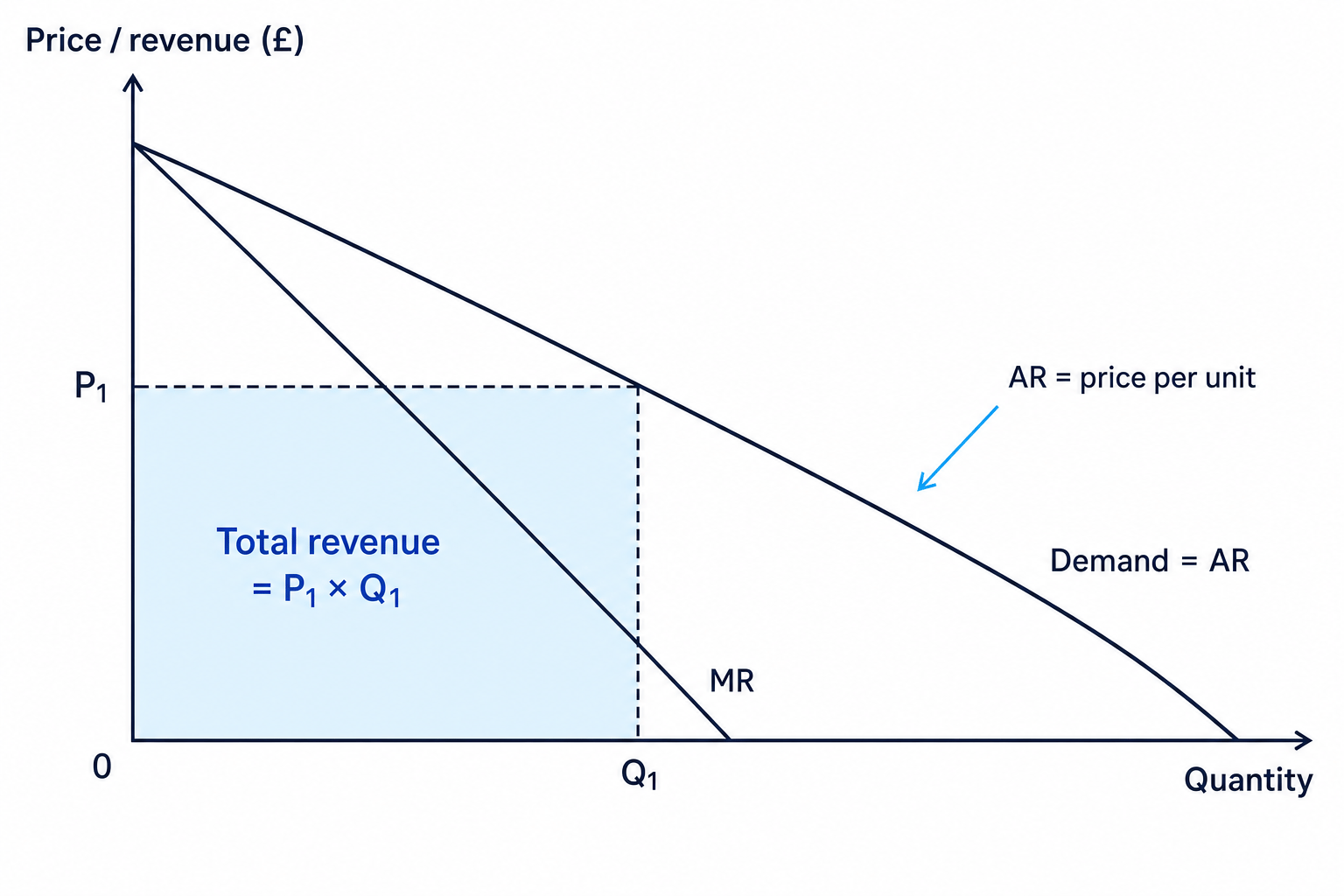
The diagram below links these ideas. The demand curve shows the price customers are willing to pay, so it is also the average revenue curve. If the firm must cut price to sell more units, marginal revenue lies below average revenue because the lower price may apply to existing units too.
Calculating total, average and marginal revenue
A café sells 100 coffees at £3 each. It then cuts the price to £2.80 and sells 130 coffees.
- Calculate total revenue before the price cut: 3×100=3003 \times 100 = 3003×100=300, so total revenue is £300.
- Calculate total revenue after the price cut: 2.80×130=3642.80 \times 130 = 3642.80×130=364, so total revenue is £364.
- Calculate average revenue after the price cut: AR=364130=2.80AR = \frac{364}{130} = 2.80AR=130364=2.80, so average revenue is £2.80 per coffee.
- Calculate the change in revenue and quantity: revenue rises by £64 and quantity rises by 30 coffees.
- Calculate marginal revenue over the extra coffees: MR=6430≈2.13MR = \frac{64}{30} \approx 2.13MR=3064≈2.13, so each extra coffee adds about £2.13 of revenue on average.
When does marginal revenue equal price?
If the firm can sell extra units without cutting price, then MR=AR=PMR = AR = PMR=AR=P. If the firm cuts price to sell more, marginal revenue is usually less than price.
Profit and loss
To calculate profit, you need total cost.
Total cost
Total cost is the full cost of producing a given level of output. It includes all costs relevant to the calculation, such as wages, rent, raw materials and energy.
The basic profit formula is:
Profit=TR−TC\text{Profit} = TR - TCProfit=TR−TCwhere TCTCTC is total cost.
There are three possible outcomes:
- If total revenue is greater than total cost, the firm makes a profit.
- If total revenue equals total cost, the firm breaks even.
- If total revenue is less than total cost, the firm makes a loss.
Calculating profit or loss
A small manufacturer sells 2,000 units at £25 each. Fixed costs are £15,000 and variable costs are £18 per unit.
- Calculate total revenue: 25×2000=5000025 \times 2000 = 5000025×2000=50000, so total revenue is £50,000.
- Calculate variable costs: 18×2000=3600018 \times 2000 = 3600018×2000=36000, so variable costs are £36,000.
- Add fixed and variable costs: £15,000 plus £36,000 gives total cost of £51,000.
- Subtract total cost from total revenue: £50,000 minus £51,000 gives -£1,000.
- Interpret the sign: the negative result means the firm has made a loss of £1,000.
The profit test
Profit depends on both revenue and costs. A firm can increase sales revenue but still suffer lower profit if costs rise faster.
This matters in real-world contexts. During the UK cost-of-living squeeze, many restaurants and retailers raised prices, which increased revenue per sale. But higher energy bills, wage costs and supplier prices often squeezed profit.
Accounting, normal and supernormal profit
Economists use the word “profit” more carefully than everyday language does. You need to know which costs have been included.
Accounting profit
Accounting profit
Accounting profit is total revenue minus explicit costs.
Explicit costs are actual money payments made by the firm, such as wages, rent, electricity bills and payments to suppliers.
So:
Accounting profit=TR−explicit costs\text{Accounting profit} = TR - \text{explicit costs}Accounting profit=TR−explicit costsThis is closest to the profit figure you might see in company accounts.
Normal profit
Normal profit
Normal profit is the minimum reward needed to keep the entrepreneur in their current business activity.
Normal profit is linked to opportunity cost: the value of the next best alternative given up. For example, if the owner could earn £35,000 a year working for another firm, their current business needs to compensate them for giving up that alternative.
In economics, normal profit is treated as part of the firm’s total cost. This is because it is the cost of keeping enterprise in the business.
Normal profit does not mean average profit
Normal profit does not mean “typical” or “medium-sized” accounting profit. It means the minimum profit required to keep the entrepreneur in that line of production.
Supernormal profit
Supernormal profit
Supernormal profit is profit above normal profit. It is also called economic profit or abnormal profit.
A firm earns supernormal profit when total revenue is greater than total economic cost, where economic cost includes both explicit costs and opportunity costs.
Economic profit=TR−(explicit costs+implicit costs)\text{Economic profit} = TR - \left(\text{explicit costs} + \text{implicit costs}\right)Economic profit=TR−(explicit costs+implicit costs)Implicit costs are opportunity costs that do not involve a direct cash payment, such as the entrepreneur’s own time or capital.
Classifying accounting, normal and supernormal profit
A shop earns total revenue of £120,000. Its explicit costs are £90,000. The owner’s next best alternative is a job paying £25,000, so the required normal profit is £25,000.
- Calculate accounting profit: £120,000 minus £90,000 gives £30,000.
- Add the opportunity cost of the owner’s time to get economic cost: £90,000 plus £25,000 gives £115,000.
- Calculate economic profit: £120,000 minus £115,000 gives £5,000.
- Classify the result: the firm earns £30,000 accounting profit, covers normal profit, and makes £5,000 supernormal profit.
Why profit matters as a business objective
Profit is important because it can:
- reward entrepreneurs and shareholders;
- provide retained profit to fund investment;
- help a firm survive shocks, such as rising interest rates or supply-chain disruption;
- signal where resources may be profitably reallocated.
However, profit is not the only possible business objective. Some firms may prioritise growth, market share, sales revenue, ethical goals, environmental targets or survival. For example, a start-up might accept short-term losses to build a customer base, while a mutual or social enterprise may place more weight on members, workers or community outcomes.
Supernormal profit can also be controversial. It may reward innovation and risk-taking, but it may also suggest market power if firms can keep prices high because of barriers to entry. Recent debates about energy companies during global gas price shocks show how profit analysis can link to government policy, windfall taxes and fairness.
In the exam
- State clearly which concept you are using: total revenue, average revenue, marginal revenue, accounting profit, normal profit or supernormal profit.
- Carry units through calculations: use £ for money, “per unit” for average revenue, and “per extra unit” for marginal revenue.
- For marginal revenue, calculate the change in total revenue divided by the change in quantity; do not assume it always equals price.
- For profit questions, check whether the costs include opportunity costs. If they do, you are dealing with economic profit and supernormal profit.
- Interpret the result in words: a negative profit figure is a loss, and zero economic profit means the firm is earning normal profit.
Check yourself
- A firm cuts price from £10 to £8 and sales rise from 100 to 140 units. How would you calculate marginal revenue?
- Why can a firm make accounting profit but no supernormal profit?
- What does normal profit tell you about whether an entrepreneur will stay in the market?