Contestable markets
What you'll learn
- What makes a market contestable, and why the number of firms is not the whole story.
- How the threat of entry can affect prices, profits, output and efficiency.
- Why contestable markets may improve productive and allocative efficiency.
- How to evaluate the advantages and disadvantages for consumers, firms and regulators.
Starting point: competition can be actual or potential
In earlier market structures, you often compare the number of firms: many firms in perfect competition, one dominant firm in monopoly, a few firms in oligopoly.
Contestable market theory adds a different idea: even if there is only one firm, it may still behave competitively if it fears new firms entering the market.
Contestable market
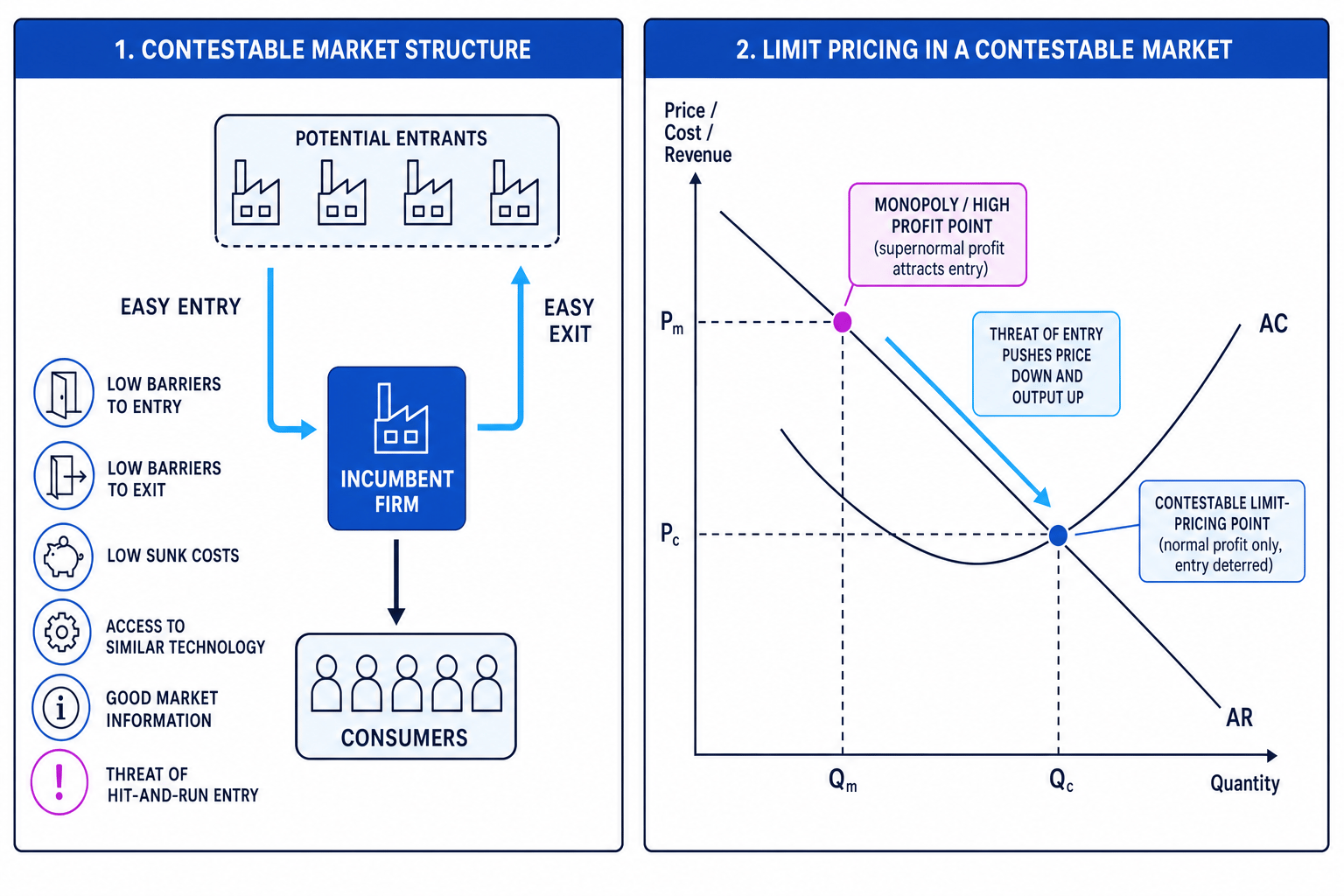
A contestable market is a market where incumbent firms face a credible threat of new entry because barriers to entry and exit are low. This potential competition can discipline the behaviour of firms already in the market.
An incumbent firm is a firm already operating in the market. A potential entrant is a firm outside the market that could enter if profit opportunities are attractive.
This theory is closely associated with William Baumol, who argued that market performance may depend more on the threat of competition than on the actual number of firms.
The big idea
A market can be highly concentrated but still behave competitively if entry and exit are easy enough.
The characteristics of a contestable market
1. Low barriers to entry
A barrier to entry is anything that makes it difficult or costly for a new firm to enter a market.
Examples include:
- Legal restrictions, such as licences or patents.
- High start-up costs, such as building a rail network.
- Strong brand loyalty.
- Exclusive access to key suppliers or distribution channels.
- Network effects, where a service becomes more valuable because many people already use it.
In a contestable market, these barriers are low. New firms can enter quickly if existing firms are making high profits.
2. Low barriers to exit
A barrier to exit is anything that makes it difficult or costly for a firm to leave a market.
This matters because firms are more willing to enter if they know they can leave without huge losses.
Sunk costs
Sunk costs are costs that cannot be recovered once they have been spent. For example, a highly specific advertising campaign or specialist machinery with no resale value.
Low sunk costs are central to contestability. If a firm can enter, make sales, and leave without losing much money, the threat of entry becomes much more credible.
3. Hit-and-run competition
Hit-and-run competition occurs when firms enter a market to take advantage of supernormal profits, then leave when the opportunity disappears.
Normal profit is the minimum profit needed to keep a firm in the market. It is treated as part of total cost. Supernormal profit is profit above normal profit.
If incumbent firms charge very high prices and earn supernormal profits, entrants may “hit” the market, undercut the price, gain customers, and then “run” before the incumbent can respond fully.
4. Similar access to technology and information
For a market to be strongly contestable, potential entrants need access to similar technology, production methods and information as incumbent firms.
If the existing firm has secret technology, exclusive data, or a major cost advantage, entry is less credible.
5. Consumers can switch easily
Contestability is stronger when consumers are willing and able to switch supplier. If customers are locked into long contracts, loyalty schemes or ecosystems, the threat of entry is weaker.
For example, online banking may look contestable because app-based banks can enter, but switching current accounts still involves trust, regulation and customer inertia.
Assessing an airline route
Suppose a low-cost airline is considering entering a UK domestic route currently served by one incumbent airline.
-
Check entry barriers: if aircraft can be leased and staff can be hired, entry is easier. But if airport landing slots are scarce, especially at airports such as Heathrow, entry is less contestable.
-
Check exit barriers: if leased aircraft can be redeployed to another route, exit costs are low. If the airline has signed long-term airport contracts or spent heavily on route-specific advertising, exit is harder.
-
Check consumer switching: passengers may switch if the entrant offers lower fares and convenient times. But frequent-flyer schemes and brand reputation may reduce switching.
-
Reach a judgement: the route may be partly contestable, but not perfectly contestable, because airport slots and brand loyalty are significant barriers.
Counting firms only
Do not assume “one firm = not competitive” or “many firms = contestable”. Contestability is about the ease of entry and exit, not just the number of firms.
Limit pricing: how potential entry affects behaviour
A firm in a contestable market may use limit pricing.
Limit pricing
Limit pricing occurs when an incumbent firm sets a price low enough to discourage new firms from entering the market.
The logic is:
- If the incumbent sets a high price, supernormal profit attracts entrants.
- If entry is easy, entrants can undercut the incumbent.
- To avoid this, the incumbent may set a lower price, closer to average cost.
- This leaves little or no supernormal profit for entrants to capture.
On a diagram, a firm’s average revenue (AR) curve represents price when one price is charged. Average cost (AC) is total cost per unit. If price is above AC, the firm earns supernormal profit. If price equals AC, the firm earns normal profit.
In a perfectly contestable market, price tends towards the level where:
AR=ACAR = ACAR=ACThis means supernormal profit is competed away by the threat of entry.
Productive efficiency in a contestable market
Productive efficiency
Productive efficiency occurs when a firm produces at the lowest possible average cost. On a cost diagram, this is the minimum point of the average cost curve.
Contestability can encourage productive efficiency because firms know that high costs create an opportunity for entrants. If an incumbent is inefficient and charges high prices, a leaner entrant may enter and undercut it.
This reduces X-inefficiency, which means unnecessary internal waste caused by weak competitive pressure, such as overstaffing, poor management or outdated production methods.
However, contestability does not automatically guarantee productive efficiency. A firm may set price equal to average cost without producing at the minimum point of average cost. Also, in some markets, a large incumbent may have economies of scale that a new entrant cannot match.
Allocative efficiency in a contestable market
Allocative efficiency
Allocative efficiency occurs when resources are allocated according to consumer preferences, where price equals marginal cost: P=MCP = MCP=MC.
Contestability can improve allocative efficiency compared with monopoly because the threat of entry usually pushes price down and output up.
But be careful: a contestable market tends to push price towards average cost, not necessarily marginal cost. So the outcome may be closer to allocative efficiency, but not perfectly allocatively efficient.
Testing efficiency after limit pricing
A bus operator faces possible entry on a local route. It cuts its fare to £4. Average cost is £4 per passenger, and marginal cost is £3 per passenger. The minimum possible average cost is also £4.
-
Compare price and average cost. Since price equals average cost, the firm earns normal profit only. This makes entry less attractive because there is no supernormal profit to capture.
-
Test productive efficiency. The firm’s average cost is £4, which is also the minimum possible average cost, so the firm is productively efficient.
-
Test allocative efficiency. Allocative efficiency requires P=MCP = MCP=MC. Here, price is £4 and marginal cost is £3, so P>MCP > MCP>MC. The market is not allocatively efficient, although it is more efficient than if a monopoly price were much higher.
Use the two efficiency tests separately
Productive efficiency asks: “Is average cost minimised?” Allocative efficiency asks: “Does price equal marginal cost?” Contestability may improve both, but it does not guarantee both.
Advantages of contestable markets
Lower prices for consumers
The main advantage is that the threat of entry can stop incumbent firms exploiting monopoly power. Firms may keep prices low to avoid attracting entrants.
This raises consumer surplus and can be especially important in concentrated markets such as airlines, broadband, supermarkets or digital services.
Higher efficiency
Contestability can push firms to reduce costs, improve management and avoid X-inefficiency. Firms know that inefficient behaviour creates room for entrants.
This can improve productive efficiency and move the market closer to allocative efficiency.
Better quality and innovation
Potential entrants may compete not just on price, but also through better service, convenience or technology. For example, challenger banks in the UK used app-based services to pressure traditional banks to improve digital banking.
Less need for direct regulation
If the threat of entry is strong enough, the market may discipline firms without heavy government intervention. This may reduce the risk of regulatory failure, where regulation is costly, poorly targeted or captured by the industry.
Disadvantages and limitations of contestable markets
Perfect contestability is rare
In reality, many markets have sunk costs, brand loyalty, regulation, economies of scale or network effects.
For example, digital platform markets may appear easy to enter because a website or app can be launched quickly. But data advantages, user networks, advertising costs and trust can create major barriers.
Incumbents may act strategically
Incumbent firms may use strategies to deter entry, such as:
- Limit pricing.
- Heavy advertising to build brand loyalty.
- Exclusive contracts with suppliers.
- Loyalty schemes.
- Predatory pricing, where prices are cut aggressively to drive rivals out.
Some of these strategies may reduce competition in the long run.
Entry may be unstable or inefficient
Hit-and-run entry can create short-term instability. Firms may enter only the most profitable parts of a market and leave less profitable consumers underserved.
For example, in transport markets, entrants may focus on busy routes while avoiding rural or low-demand routes.
Lower profits may reduce investment
If firms fear that any supernormal profit will quickly attract entrants, they may have less incentive to invest in research and development. This could reduce dynamic efficiency in the long run.
Natural monopoly
In a natural monopoly, one firm may be able to supply the whole market at lower average cost than two or more firms. In this case, forcing entry may duplicate fixed costs and reduce productive efficiency.
Overall judgement
Contestable markets are usually good for consumers when the threat of entry is genuine. Prices are likely to be lower, output higher, and firms more cost-conscious than in an unchallenged monopoly.
However, the strength of this effect depends on how low the barriers really are. The most important issues are usually sunk costs, access to technology, brand loyalty, switching costs, legal restrictions and economies of scale.
A strong evaluation answer should avoid saying “contestable markets are always efficient”. A better judgement is:
- Contestability can make even concentrated markets behave more competitively.
- It improves efficiency most when entry and exit are genuinely easy.
- Its benefits are weaker where sunk costs, network effects, regulation or strategic incumbent behaviour protect existing firms.
In the exam
-
Define contestability clearly: focus on low barriers to entry and exit, not just the number of firms.
-
Use the chain of analysis: low barriers → credible threat of entry → incumbent lowers price or improves efficiency → consumer welfare rises.
-
Evaluate with realism: ask whether sunk costs, brand loyalty, switching costs, regulation, economies of scale or network effects weaken the threat of entry.
Check yourself
- Why might a monopoly still charge a relatively low price in a contestable market?
- What is the difference between productive efficiency and allocative efficiency?
- Give one reason why a digital market might be less contestable than it first appears.