x

Balance of payments

What you'll learn

  • What the balance of payments records and why it always balances in an accounting sense.
  • How to explain and calculate the four parts of the current account.
  • Why countries can run current account deficits or surpluses, and when these become a problem.
  • How to evaluate the causes and consequences of balance of payments imbalances.

The big picture: money flows between countries

When the UK trades, invests, borrows, lends, pays interest, receives dividends, sends aid, or receives remittances, money flows between UK residents and the rest of the world.

Economists record these flows in the balance of payments.

Definition

Balance of payments

The balance of payments is a record of all economic transactions between the residents of one country and the residents of the rest of the world over a period of time, usually a quarter or a year.

A credit is money flowing into the UK, such as export revenue or foreign investment into the UK. A debit is money flowing out of the UK, such as spending on imports or UK firms investing abroad.

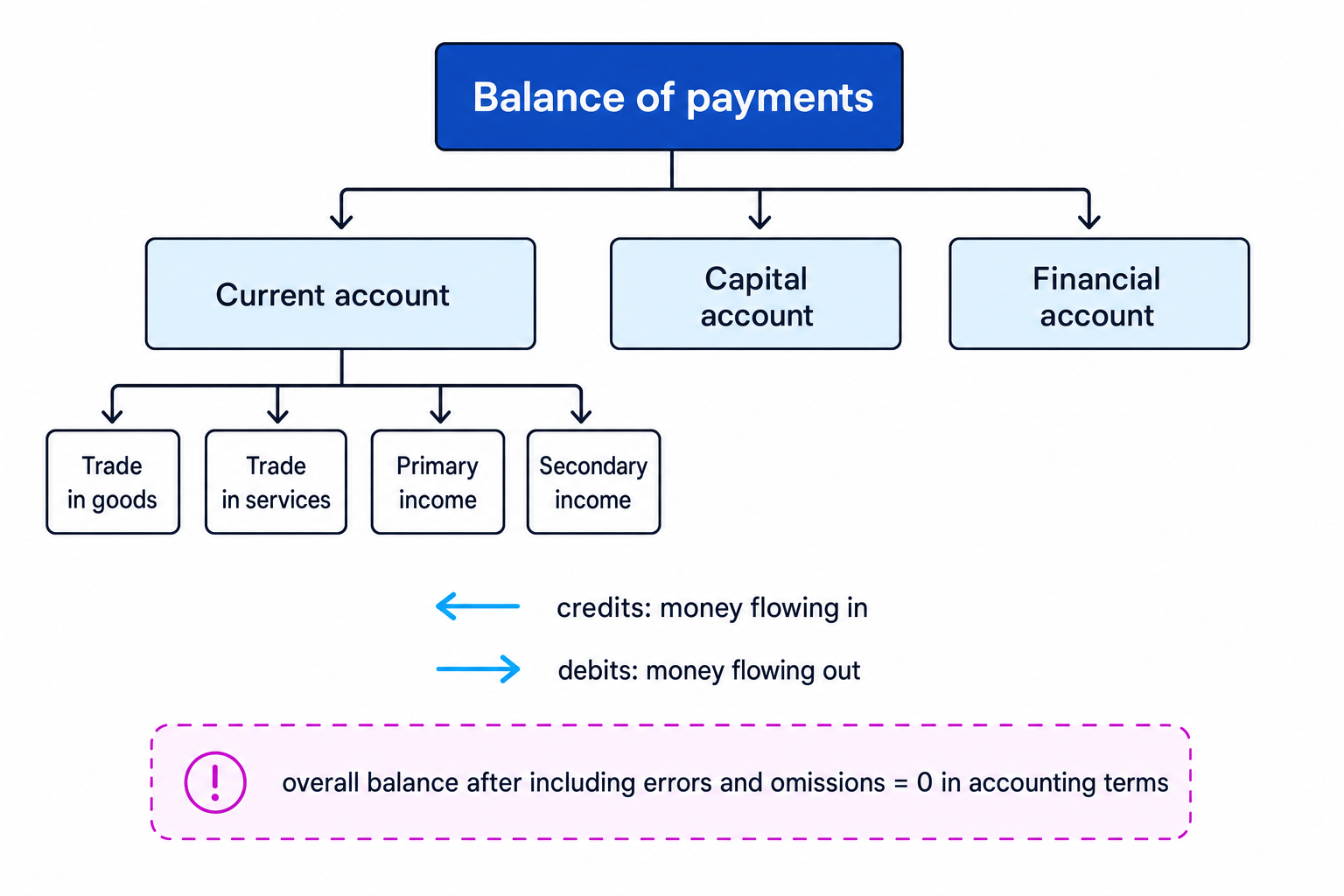
The diagram shows how credits and debits are organised into the main balance of payments accounts, with the current account broken into the four components you need for OCR.

Schematic of the balance of payments accounts, showing credits, debits, current account components, capital account and financial account

Key Idea

Accounting balance vs economic imbalance

The overall balance of payments must balance once the current account, capital account, financial account and errors and omissions are included. When economists talk about a “balance of payments problem”, they usually mean a persistent current account deficit or a potentially unstable dependence on financial inflows.

The current account

The current account records flows of goods, services, income and transfers between the UK and the rest of the world.

Definition

Current account

The current account is the part of the balance of payments that records trade in goods, trade in services, primary income and secondary income.

The current account balance is the sum of four component balances:

current account balance=goods balance+services balance+primary income balance+secondary income balance\text{current account balance} = \text{goods balance} + \text{services balance} + \text{primary income balance} + \text{secondary income balance}current account balance=goods balance+services balance+primary income balance+secondary income balance

For each component:

component balance=credits−debits\text{component balance} = \text{credits} - \text{debits}component balance=credits−debits

A positive balance is a surplus. A negative balance is a deficit.

The four components of the current account

1. Trade in goods

Trade in goods means exports and imports of physical products, such as cars, oil, food, clothing, machinery and pharmaceuticals.

  • Exports of goods are credits because foreign consumers and firms pay UK producers.
  • Imports of goods are debits because UK consumers and firms pay foreign producers.

The UK has often run a trade in goods deficit, partly because it imports many manufactured goods, energy products and consumer goods.

2. Trade in services

Trade in services means exports and imports of non-physical services, such as financial services, insurance, legal advice, tourism, education, transport and digital services.

The UK often runs a trade in services surplus, helped by sectors such as financial services in London, higher education, consultancy, insurance and creative industries.

Tip

Goods vs services

If you can physically ship it, it is usually a good. If it is expertise, travel, finance, education, insurance or digital provision, it is usually a service.

3. Primary income

Primary income records income earned from employment and investment across borders.

Examples include:

  • Wages earned by UK residents working temporarily abroad.
  • Profits, dividends and interest received by UK residents from overseas assets.
  • Profits, dividends and interest paid to foreign owners of UK assets.

If many UK firms own profitable assets abroad, primary income credits rise. If many foreign firms own UK assets and send profits overseas, primary income debits rise.

4. Secondary income

Secondary income records transfers of money where no good, service or asset is directly exchanged in return.

Examples include:

  • Overseas aid.
  • Remittances sent by workers to family abroad.
  • Some government transfers to international organisations.

Secondary income is often smaller than trade in goods or services, but it still affects the current account balance.

Example

Calculating current account component balances

Suppose the UK records the following annual figures: goods exports £340bn, goods imports £520bn, services exports £420bn, services imports £260bn, primary income credits £190bn, primary income debits £230bn, secondary income credits £25bn, secondary income debits £55bn. GDP is £2,500bn.

  1. Calculate each component using credits minus debits: goods is 340−520=−180340 - 520 = -180340−520=−180, services is 420−260=+160420 - 260 = +160420−260=+160, primary income is 190−230=−40190 - 230 = -40190−230=−40, and secondary income is 25−55=−3025 - 55 = -3025−55=−30. All figures are in £bn.

  2. Add the four component balances: −180+160−40−30=−90-180 + 160 - 40 - 30 = -90−180+160−40−30=−90. The current account balance is -£90bn, so the UK has a current account deficit.

  3. Scale the deficit relative to GDP: −902500×100=−3.6%\frac{-90}{2500} \times 100 = -3.6\%2500−90​×100=−3.6%. This means the current account deficit is 3.6% of GDP, which gives a better sense of significance than the £bn figure alone.

The policy objective: a sustainable balance of payments position

A government does not normally aim for a current account balance of exactly zero. The objective is a sustainable balance of payments position.

Definition

Sustainable balance of payments position

A sustainable balance of payments position means a country can finance its external transactions over time without causing serious problems such as excessive foreign debt, sharp currency depreciation, loss of investor confidence or damaging cuts to domestic demand.

A current account deficit may be sustainable if it is financed by stable long-term investment, such as foreign direct investment into productive UK industries. It is more worrying if it is financed by short-term borrowing or volatile portfolio flows that can leave quickly.

A current account surplus may look strong, but it is not automatically ideal. It may reflect weak domestic consumption, excessive saving, or dependence on export demand from other countries.

Common Mistake

Thinking surplus always means success

A current account surplus is not automatically “good”, and a deficit is not automatically “bad”. The key question is whether the position is sustainable and what is causing it.

Imbalances on the balance of payments

An imbalance usually means a persistent current account deficit or surplus.

Current account deficit

A current account deficit occurs when current account debits exceed credits. In simple terms, the country is spending more on imports, income payments and transfers than it earns from exports, income receipts and transfers.

Possible causes include:

  • Low price competitiveness: UK goods and services may be relatively expensive if domestic inflation is higher than competitors’ inflation.
  • Weak non-price competitiveness: exports may suffer if quality, reliability, branding, innovation or after-sales service is poor.
  • Strong domestic demand: if UK households and firms spend more, imports often rise.
  • High marginal propensity to import: a large share of extra UK income may be spent on foreign goods and services.
  • Exchange rate appreciation: if the pound strengthens, UK exports become more expensive abroad and imports become cheaper for UK buyers.
  • Supply-side weaknesses: low productivity or limited manufacturing capacity can reduce export performance.
  • External shocks: for example, higher global energy prices can worsen the UK goods balance if the UK imports more expensive fuel.

Current account surplus

A current account surplus occurs when current account credits exceed debits.

Possible causes include:

  • Strong export competitiveness.
  • An undervalued exchange rate.
  • High domestic saving relative to investment.
  • Weak domestic demand, which limits import spending.
  • Specialisation in globally demanded goods or services.

Exchange rates and the J-curve

An important cause of current account changes is the exchange rate, which is the price of one currency in terms of another. For example, if £1 = $1.30, one pound buys 1.30 US dollars.

A depreciation of the pound means the pound falls in value. UK exports become cheaper to foreign buyers, while imports become more expensive for UK consumers and firms. In theory, this should improve the current account — but not always immediately.

The diagram shows the J-curve effect: after a depreciation, the current account may worsen first because import prices rise before consumers and firms can change the quantity they buy.

J-curve diagram showing current account balance worsening after depreciation before improving over time if demand is elastic

The later improvement depends on the Marshall-Lerner condition: a depreciation improves the current account in the long run if the combined price responsiveness of export and import demand is sufficiently high.

Common Mistake

Assuming depreciation always improves the current account

A weaker pound can worsen the current account in the short run if import demand is price inelastic or contracts are fixed. This is especially relevant for necessities such as energy, where the UK may keep importing similar quantities even at higher prices.

Consequences of balance of payments imbalances

Consequences of a current account deficit

A deficit can have some benefits. UK consumers may enjoy a wider choice of imported goods, and firms may import capital equipment that improves productivity. A deficit can also be manageable if it is financed by stable foreign investment.

But persistent deficits can create problems:

  • Leakage from aggregate demand: import spending is a leakage from the circular flow, reducing demand for domestic output.
  • Pressure on domestic firms: import competition may reduce output and employment in some industries.
  • Foreign debt or asset sales: the deficit must be financed by borrowing from abroad or selling assets to overseas investors.
  • Currency vulnerability: if investors lose confidence, sterling may depreciate sharply.
  • Inflation risk: depreciation raises import prices, adding to cost-push inflation.
  • Policy trade-offs: reducing a deficit through lower domestic demand may reduce growth and increase unemployment.

Consequences of a current account surplus

A surplus may support jobs in export industries and allow a country to build up foreign assets. It may also make the economy more resilient if export revenues are strong.

However, persistent surpluses can also have downsides:

  • The economy may become too dependent on external demand.
  • Trading partners may accuse the country of unfair currency or trade policies.
  • A surplus may reflect weak domestic consumption and lower living standards than households could otherwise enjoy.
  • Large global surpluses and deficits can contribute to international financial instability.
Example

Judging whether a deficit is sustainable

Imagine the UK current account deficit widens to 5% of GDP during a period of strong growth.

  1. Consider the cause: if the deficit reflects households buying more imported consumer goods, it may be less sustainable than if firms are importing machinery that raises future productive capacity.

  2. Consider the financing: if the deficit is funded by long-term foreign direct investment, the risk is lower than if it depends on short-term financial inflows that could leave quickly.

  3. Reach a judgement: the deficit is more likely to be sustainable if productivity and export capacity improve over time; it is more worrying if it reflects weak competitiveness, rising foreign debt and falling investor confidence.

Evaluation: how serious is an imbalance?

The seriousness of a balance of payments imbalance depends on context.

A deficit is more concerning when it is large as a percentage of GDP, persistent over many years, caused by poor competitiveness, and financed by unstable borrowing. It is less concerning when it is temporary, linked to investment, and financed by stable long-term inflows.

A surplus is more beneficial when it reflects genuine productivity and export strength. It is less beneficial if it comes from suppressed domestic demand, an artificially weak currency, or over-reliance on foreign markets.

For the UK, a common evaluation point is that persistent goods deficits have been partly offset by services surpluses. However, Brexit trade frictions, global supply-chain shocks and energy price volatility can all affect the sustainability of the current account position.

Exam technique

In the exam

  1. Define the exact balance you are discussing: goods, services, primary income, secondary income, current account or overall balance of payments.

  2. Use “credits minus debits” for calculations, keep units as £bn, and comment on whether the answer is a surplus or deficit.

  3. Evaluate sustainability by discussing cause, size relative to GDP, duration, financing method, exchange rate effects and short-run versus long-run impacts.

Self review

Check yourself

  • Why can the overall balance of payments balance while the current account is in deficit?
  • What is the difference between primary income and secondary income?
  • When might a current account deficit be sustainable rather than harmful?

Recap questions

Test yourself with 5 quick questions on this guide. Answer them all correctly to complete it.

PreviousNext

How was this guide?

Balance of payments Revision Guide

  1. A Level
  2. /Economics
  3. /Balance of payments