Definition
Central bank: the public body that oversees monetary policy and the stability of the financial system, not a profit-seeking commercial bank.
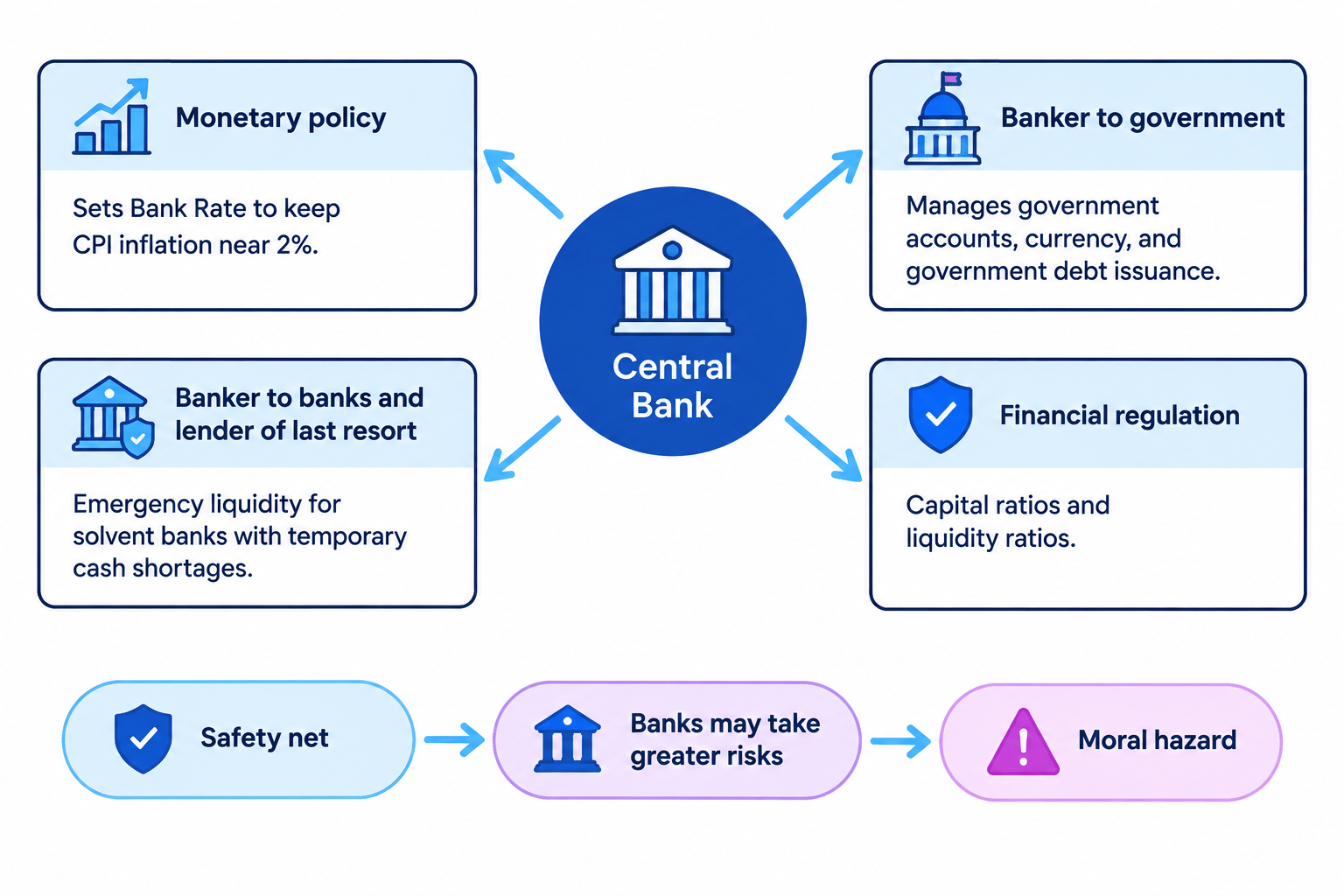
- A central bank performs four key functions, and its aims differ from those of an ordinary bank.
Monetary Policy and Banker to Government
Definition
Monetary policy: central-bank action, chiefly setting the interest rate, to meet the inflation target.
- Implementing monetary policy: the Bank of England sets Bank Rate to keep CPI inflation close to the 2% target, raising rates to cool demand and cutting them to support it.
- Banker to the government: it manages the government's accounts and the issue of government debt and currency.
Banker to the Banks and Lender of Last Resort
Definition
Lender of last resort: the central bank's role of lending emergency cash to solvent banks facing a temporary liquidity shortage.
Moral hazard: the tendency to take greater risks once protected from the consequences.
- A solvent bank can still run short of ready cash, so emergency liquidity stops a temporary shortage becoming a collapse and prevents contagion across the banking system, as when the Bank of England provided emergency support to Northern Rock in 2007.
- But the promise of rescue can encourage excessive risk-taking, the moral hazard cost of providing a safety net.
Regulating the Banking Industry
Definition
Capital ratio: the share of a bank's assets funded by its own capital, which lets it absorb losses.
Liquidity ratio: the share of assets held in cash or easily sold form, so a bank can meet withdrawals.
- Regulation promotes stability and protects depositors: capital and liquidity ratios make banks safer and less likely to fail, curbing the moral hazard left by the safety net.
Should central banks regulate finance more tightly?
- It holds because tighter capital and liquidity rules make banks more resilient, protect depositors and cut the risk of a systemic crisis that would spill into the real economy.
- But regulation carries compliance costs, can be dodged through shadow banking, risks regulatory capture and is hard to police in a global financial system.
- On balance it depends on striking the right balance: enough regulation to contain moral hazard and contagion without choking lending and growth.
Exam technique
- Name the four functions, then focus on the lender-of-last-resort and regulation roles.
- Note the moral-hazard tension that the safety net creates.
- Weigh the benefits of regulation against its costs when evaluating.
Common Mistake
- Do not confuse the central bank with an ordinary commercial bank, since it manages policy and stability rather than seeking profit.
- Do not assume more regulation is always better, because its costs and limits must be weighed against the benefits.
Self review
- Name four functions of a central bank.
- What does lender of last resort mean?
- Why can the safety net create moral hazard?
- Name two tools used to regulate banks.
- Give one reason why more regulation is not always better.