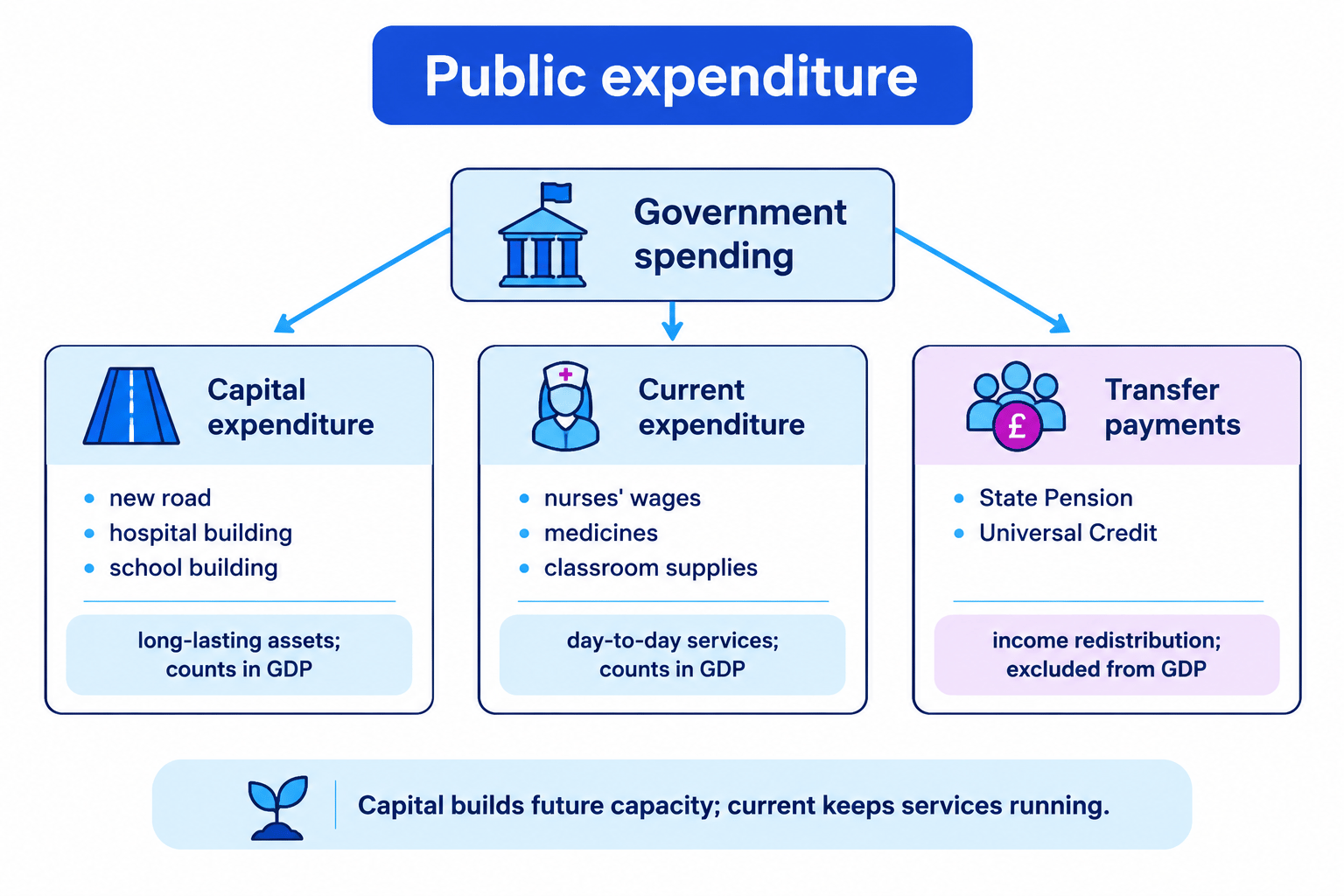
Public expenditure: government spending on goods, services and transfers, split into capital spending, current spending and transfer payments.
Capital expenditure: spending on long-lasting assets such as new roads, hospitals and school buildings.
Current expenditure: day-to-day spending on running public services, such as NHS staff wages and medicines.
Transfer payments: payments that move income from one group to another with no good or service produced in return, such as the State Pension or Universal Credit.
- Capital and current spending buy real output, so both count in GDP, whereas transfer payments only redistribute income and are excluded from GDP.
- Capital spending builds the economy's future productive capacity, while current spending keeps today's services running.
- Transfers are financed mainly from taxation, so they shift purchasing power between households rather than adding to national output.
Changing Size and Composition
- Ageing populations raise spending on pensions and healthcare.
- Rising expectations of public services increase demand for health and education spending.
- The economic cycle matters, since recessions automatically raise spending on unemployment-related benefits.
- Global shocks such as financial crises, pandemics and security threats raise spending across many countries at once.
- A country's level of development shapes the mix, with developing economies spending relatively more on basic infrastructure.
- The 2008 financial crisis and the Covid-19 pandemic pushed public spending sharply higher across most economies.
- Ageing populations in the UK and Japan steadily raise pension and healthcare budgets, with Japan now spending among the highest shares of GDP on its over-65s.
- In the UK the Office for Budget Responsibility (OBR) forecasts public spending while HMRC collects the taxes that fund it, splitting the total into capital projects, current service costs and transfers such as Universal Credit.
- The 2022 energy price shock forced the UK to raise current spending quickly through the Energy Price Guarantee, showing how an external shock lifts public expenditure.
Spending as a Share of GDP
public expenditureGDP×100 \dfrac{\text{public expenditure}}{\text{GDP}} \times 100 GDPpublic expenditure×100Suppose public expenditure is 1,200 and GDP is 2,500 (both in billions of pounds). The share of GDP taken by public spending is:
12002500×100=48% \dfrac{1200}{2500} \times 100 = 48\% 25001200×100=48%A 48% share sits at the top of the 35% to 50% range typical of advanced economies, signalling a large state relative to the size of the economy.
- Expressing spending as a share of GDP allows fair comparison over time and between countries; advanced economies often spend 35% to 50% of GDP, developing economies less.
- Spending on infrastructure, education and health can raise productivity and long-run growth.
- Public services and transfers can raise living standards, especially for lower-income households, and so reduce inequality.
- Higher spending usually requires higher taxation, which can weaken work and investment incentives.
Crowding Out
Crowding out: a rise in government spending and borrowing that reduces private-sector activity, mainly by pushing up interest rates.
- Extra government borrowing raises the demand for loanable funds and can push up interest rates.
- Dearer borrowing then deters private-sector investment and interest-sensitive consumption.
- Near full capacity crowding out is more likely, while with spare capacity spending can crowd in private activity instead.
Should public spending be a larger share of GDP?
- It can be justified because well-targeted capital spending on infrastructure and skills raises productivity, shifting LRAS to the right and lifting long-run growth.
- But higher spending must be funded by higher taxation or borrowing, which can blunt incentives and, near full capacity, crowd out private investment.
- The gains to living standards and equality are largest when spending reaches lower-income households, but shrink if funds are wasted on low-value projects.
- On balance it depends on the state of the economy, how the spending is financed and whether it is productive rather than wasteful.
- Express public expenditure as a share of GDP so comparisons over time and between countries are fair.
- Judge the effect of higher spending against the state of the economy and how it is funded.
- Do not count transfer payments as part of national output, because no good or service is produced in return.
- Do not treat crowding out as automatic, because it depends on whether the economy has spare capacity.
- Distinguish capital expenditure, current expenditure and a transfer payment.
- Give two reasons the size of public expenditure changes over time.
- How can public spending as a share of GDP affect productivity and growth?
- What is crowding out and when is it most likely?
- How does public spending affect equality?