2.1.3a Measuring employment and unemployment
Measuring unemployment
Unemployment: people without work who are able to start and are actively seeking a job.
Claimant count: a measure that records those claiming unemployment-related benefits such as Jobseeker's Allowance.
ILO measure (Labour Force Survey): a survey-based measure that counts anyone available for and actively seeking work, whether or not they claim benefits.
- The claimant count only captures benefit claimants, so it usually reads lower than the wider ILO measure.
- The claimant count is like counting only those who sign on for benefits, missing job-seekers who do not claim.
- The ILO survey is like a headcount of everyone available for and actively seeking work.
Employment categories
Unemployed: without work but able to start and actively seeking it.
Under-employed: in work but wanting more hours, or working below their skill level.
Economically inactive: of working age but neither working nor seeking work.
- Someone who has given up looking for work is counted as inactive, not unemployed, which is why the two measures can move in opposite directions.
- Someone on benefits and actively job-hunting appears in both measures of unemployment.
- A part-time worker who wants full-time hours is under-employed, not unemployed.
- In recent years the UK's headline ILO rate from the Labour Force Survey has hovered around 4%, while the narrower claimant count records a different, usually lower, total.
The three rates
Unemployment rate: the share of the labour force out of work but seeking it.
Employment rate: the share of working-age people in work.
Inactivity rate: the share of working-age people neither working nor seeking work.
- A labour force is made up of 32 million employed and 1.4 million unemployed.
- So about 4.2% of the labour force is unemployed, close to the UK's recent headline ILO rate of around 4%.
- The three rates must be read together, because a change in one need not signal a healthier labour market.
- A falling unemployment rate can reflect people leaving the labour force into inactivity rather than moving into jobs.
- Distinguish the claimant count from the ILO Labour Force Survey measure.
- Read the unemployment, employment and inactivity rates together, not in isolation.
- Do not treat everyone not in work as unemployed, since the inactive are not counted as unemployed.
- Do not assume a falling unemployment rate always means more jobs, as it can reflect rising inactivity.
- What is the claimant count?
- How does the ILO measure of unemployment work?
- How does under-employment differ from unemployment?
- Why can a falling unemployment rate be misleading?
2.1.3b Causes and effects of unemployment
Types of unemployment
Frictional unemployment: short-term joblessness as workers move between jobs.
Structural unemployment: a lasting mismatch between workers' skills or location and the jobs available.
Seasonal unemployment: joblessness following predictable changes in demand over the year.
- Frictional unemployment is like the brief gap between finishing one job and starting the next.
- Structural unemployment is deeper, like a factory town whose main industry has closed for good.
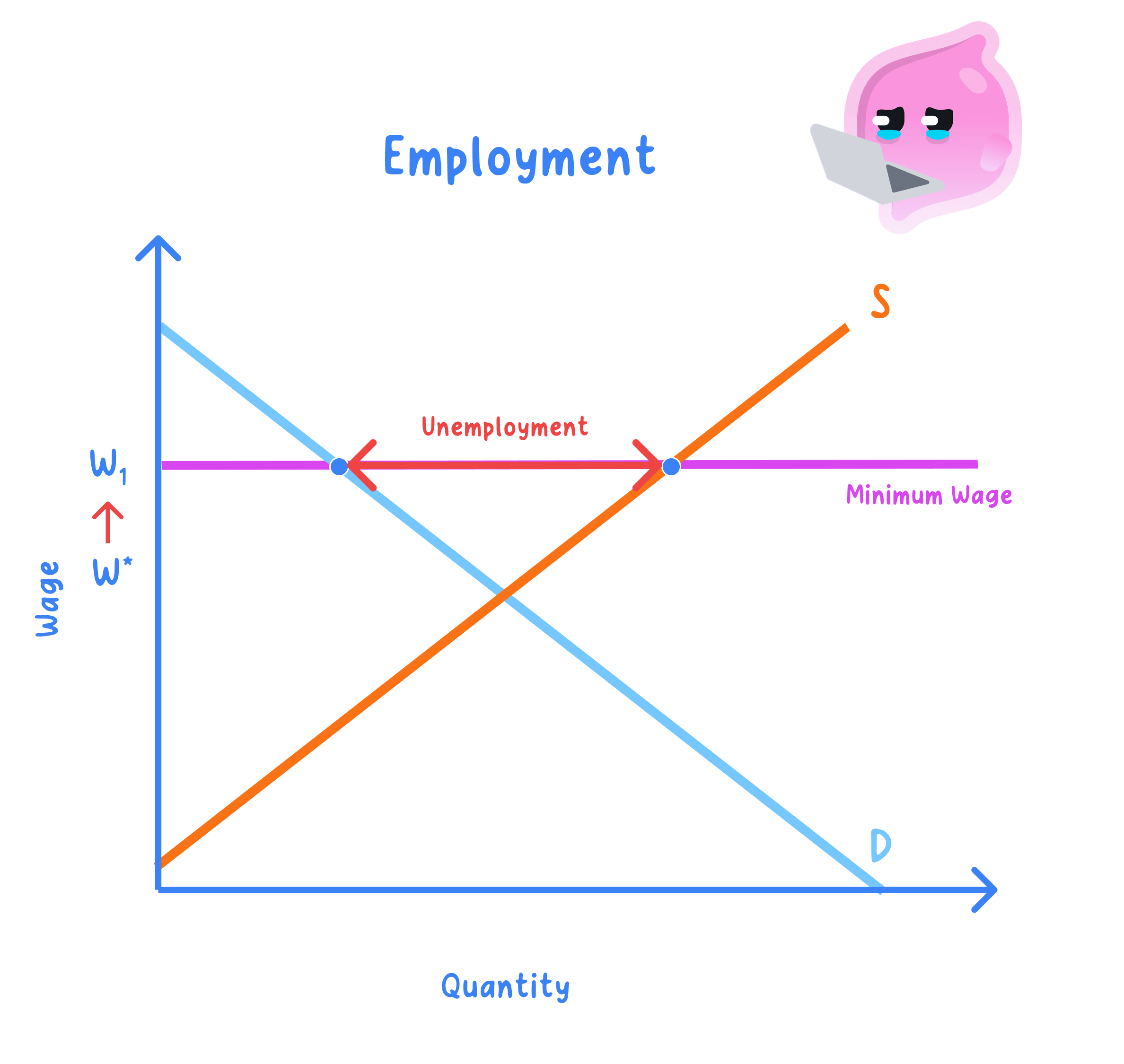
Cyclical and real-wage
Cyclical (demand-deficient) unemployment: unemployment caused by a fall in aggregate demand during a downturn.
Real-wage inflexibility: unemployment that arises when wages are held above the market-clearing level, creating an excess supply of labour.
- A minimum wage set above the clearing wage, or strong union bargaining, can hold the real wage too high and leave labour supply exceeding demand.
- The UK's coal and steel regions suffered lasting structural unemployment after those industries contracted sharply in the 1980s.
- The 2008-09 financial crisis cut aggregate demand and pushed UK unemployment up towards 8%, a clear case of cyclical unemployment.
- Seaside resorts and farming areas see seasonal unemployment when tourism and harvest work fall away in winter.
Migration and skills
Net migration: immigration minus emigration, which adds to the supply of labour and can fill skill shortages.
Labour mobility: the ease with which workers move between occupations (occupational) and between areas (geographical).
- Migrants tend to move to where jobs are, and their spending also raises the demand for labour, so the overall effect on unemployment is usually small.
- The skills of the workforce shape structural unemployment, because vacancies go unfilled when workers lack the right skills.
- Training and better occupational and geographical mobility ease structural unemployment more effectively than simply raising demand.
Effects of unemployment
Hysteresis: the process by which long spells of unemployment become self-perpetuating, as skills erode and workers detach from the labour market.
- Unemployment imposes costs on workers, consumers, firms, the government and wider society.
- Workers lose income and can suffer deskilling and poorer health, and long spells can trigger hysteresis.
- Consumers who lose work cut their spending, and weaker confidence can reduce consumption more widely.
- The cost of unemployment rises the longer it lasts, as skills erode and confidence falls.
- This hysteresis effect can turn a temporary downturn into lasting structural unemployment.
Wider costs
- Firms face weaker demand for their products, though they gain a larger pool of available labour.
- The government loses tax revenue and pays more in benefits, worsening its budget position.
- Society bears the lost output, which leaves the economy inside its production possibility frontier, along with higher deprivation.
- The severity of these costs depends on the duration and type of unemployment.
Are the costs of unemployment always severe?
- It holds because unemployment leaves the economy inside its PPF and imposes lost incomes, deskilling and a weaker government budget, while long spells cause hysteresis that entrenches the problem.
- But some unemployment is frictional and short-lived, reflecting healthy job search rather than economic failure, so a small positive rate is normal even at full employment.
- But the severity depends on the type: structural and cyclical unemployment are far costlier and more persistent than seasonal or frictional joblessness.
- On balance, how serious unemployment is depends on its type, its duration, and how quickly the labour market and policy help people back into work.
- Name the type of unemployment precisely, since each one points to a different policy response.
- Reach beyond the private cost to the wider costs for firms, the government and society.
- Do not treat all unemployment as demand-deficient, since frictional, structural, seasonal and real-wage unemployment persist even when demand is strong.
- Do not assume net migration raises unemployment, since migrants also add to the demand for labour.
- Name four types of unemployment.
- What causes real-wage unemployment?
- How do migration and skills affect unemployment?
- How does unemployment affect the government?
- Why do the type and duration of unemployment matter?
