1.4.3a Short run, long run and returns (A-level only)
The Short Run, the Long Run and Product Measures
Definition
Short run: the period in which at least one factor of production is fixed, so output can be changed only by varying the variable factors.
Long run: the period in which all factors of production are variable, so the firm can change the scale of everything it uses.
- The fixed factor is usually capital (the size of the factory or number of machines); the variable factor is usually labour.
- Example: a bakery with one fixed oven is in the short run and can bake more only by adding staff; once it can build a second bakery, it has moved into the long run.
- Within the short run we measure the variable factor by its total, average and marginal product.
Note
- The short run is defined by a fixed factor, not by calendar time.
- Marginal product is the extra output from one more unit of the variable factor.
Total, Average and Marginal Product Compared
- Total product
- The whole output produced by all units of the variable factor.
- Average product
- Total product divided by the number of units of the variable factor.
- Marginal product
- The change in total product from one more unit of the variable factor.
Example
- Picture a fixed factory taking on more workers: total product runs 5, 12, 21, 28, 32 units as the workforce rises from 1 to 5.
- Marginal product (the extra output each added worker brings) is therefore 5, 7, 9, 7, 4, so it rises while early workers specialise, then falls once the 4th worker starts to crowd the fixed capital.
- Average product (total product per worker) is 5, 6, 7, 7, 6.4, and it peaks just where marginal product cuts through it from above.
- Marginal product of labour first rises, then falls, against fixed capital.
- This pattern shapes the short-run cost curves that follow, because marginal cost is the mirror image of marginal product.
- Tabulating the measures makes the turning point, where diminishing returns begin, clear.
Define the Short Run by the Fixed Factor
Exam technique
- Say the short run has at least one fixed factor, not a set length of time.
- Calculate marginal product as the change in total product per extra unit.
Common Mistake
- Do not define the short run as a fixed length of calendar time.
- It is defined by the presence of at least one fixed factor.
Self review
- Distinguish the short run from the long run.
- Define total, average and marginal product.
- How does marginal product of labour change as workers are added?
- Why is the short run not a fixed length of time?
- If total product is 5, 12, 21, 28, 32 for 1 to 5 workers, find the marginal and average product of the 4th worker.
1.4.3b Diminishing returns and returns to scale (A-level only)
The Law of Diminishing Marginal Returns
Definition
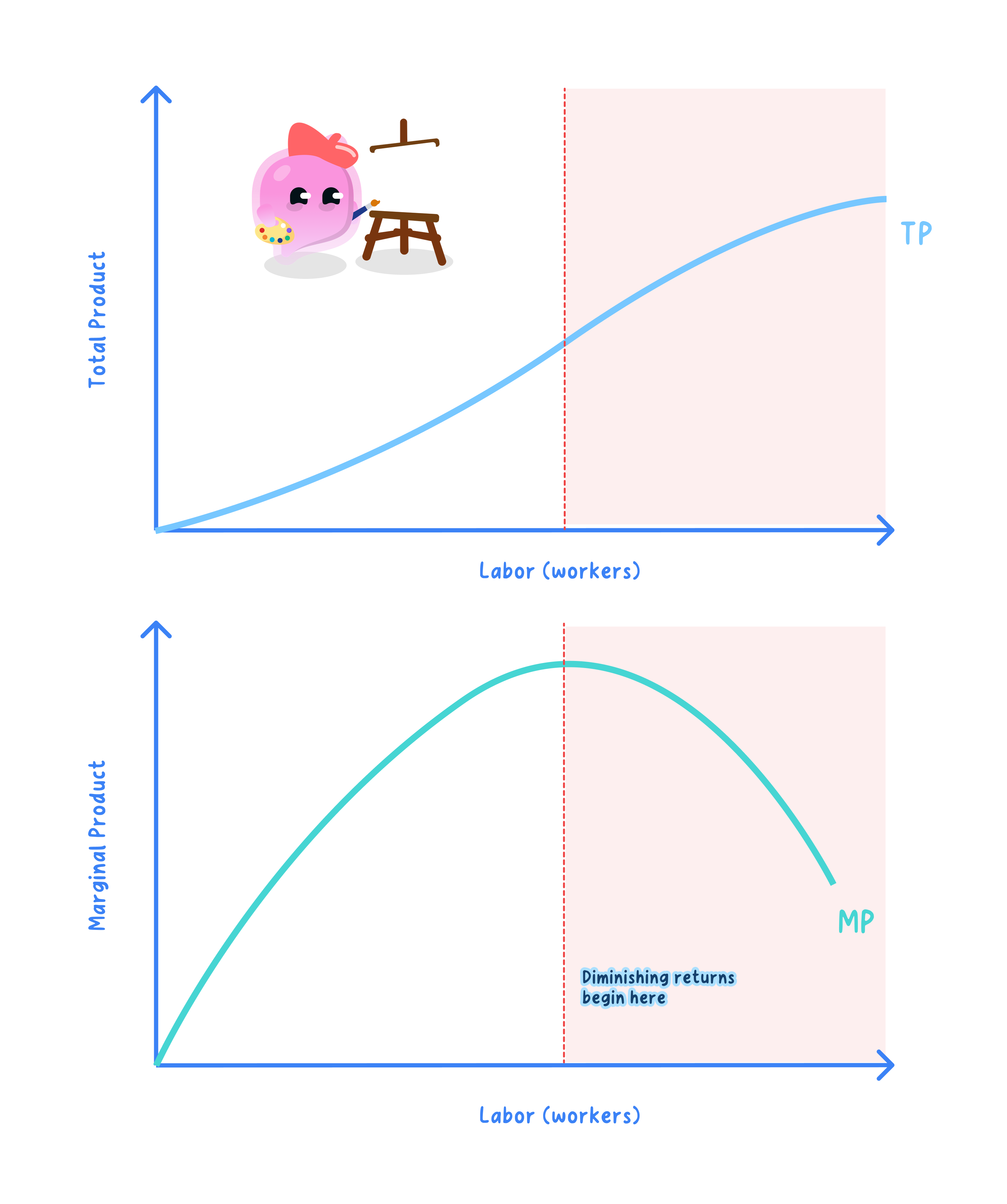
Law of diminishing returns: as successive units of a variable factor are added to a fixed factor in the short run, the marginal returns of the variable factor will eventually fall.
- Add successive units of a variable factor to a fixed factor in the short run.
- Beyond some point, the marginal product of the variable factor falls.
- This is the law of diminishing marginal returns.
Note
- Diminishing returns set in because capital is fixed in the short run.
- As marginal product falls, short-run marginal and average variable costs rise.
Why Returns Diminish as Workers Are Added
- With capital fixed, each extra worker has less capital to work with.
- The first few workers add a lot, while later ones add less.
- Eventually the extra output per worker declines.
Example
- Take a kitchen with a single oven. As cooks rise from 1 to 5, total meals run 10, 24, 36, 44, 48.
- The marginal product of each extra cook is therefore 10, 14, 12, 8, 4, so diminishing marginal returns begin with the 3rd cook, once they start queuing for the same oven.
- Note that total product still rises throughout; it is the extra output per cook that shrinks, which is the essence of the law.
How Diminishing Returns Raise Marginal Cost
- Falling marginal product means each extra unit of output needs more labour.
- So marginal cost rises as output expands in the short run.
- This is why short-run cost curves turn upward.
Separate It from Diseconomies of Scale
Exam technique
- Stress that diminishing returns is a short-run effect with a fixed factor.
- Contrast it with diseconomies of scale, a long-run effect on average cost.
Common Mistake
- Do not confuse diminishing returns with diseconomies of scale.
- Diminishing returns is short-run with a fixed factor, while diseconomies are long-run.
Returns to Scale: Changing All Inputs at Once
- Returns to scale relate a change in all inputs to the change in output.
- This is a long-run idea, since all factors vary.
- Returns can be increasing, constant or decreasing.
Note
- Increasing returns mean output rises more than in proportion to inputs.
- Decreasing returns mean output rises less than in proportion.
Increasing, Constant and Decreasing Returns
- Increasing returns to scale
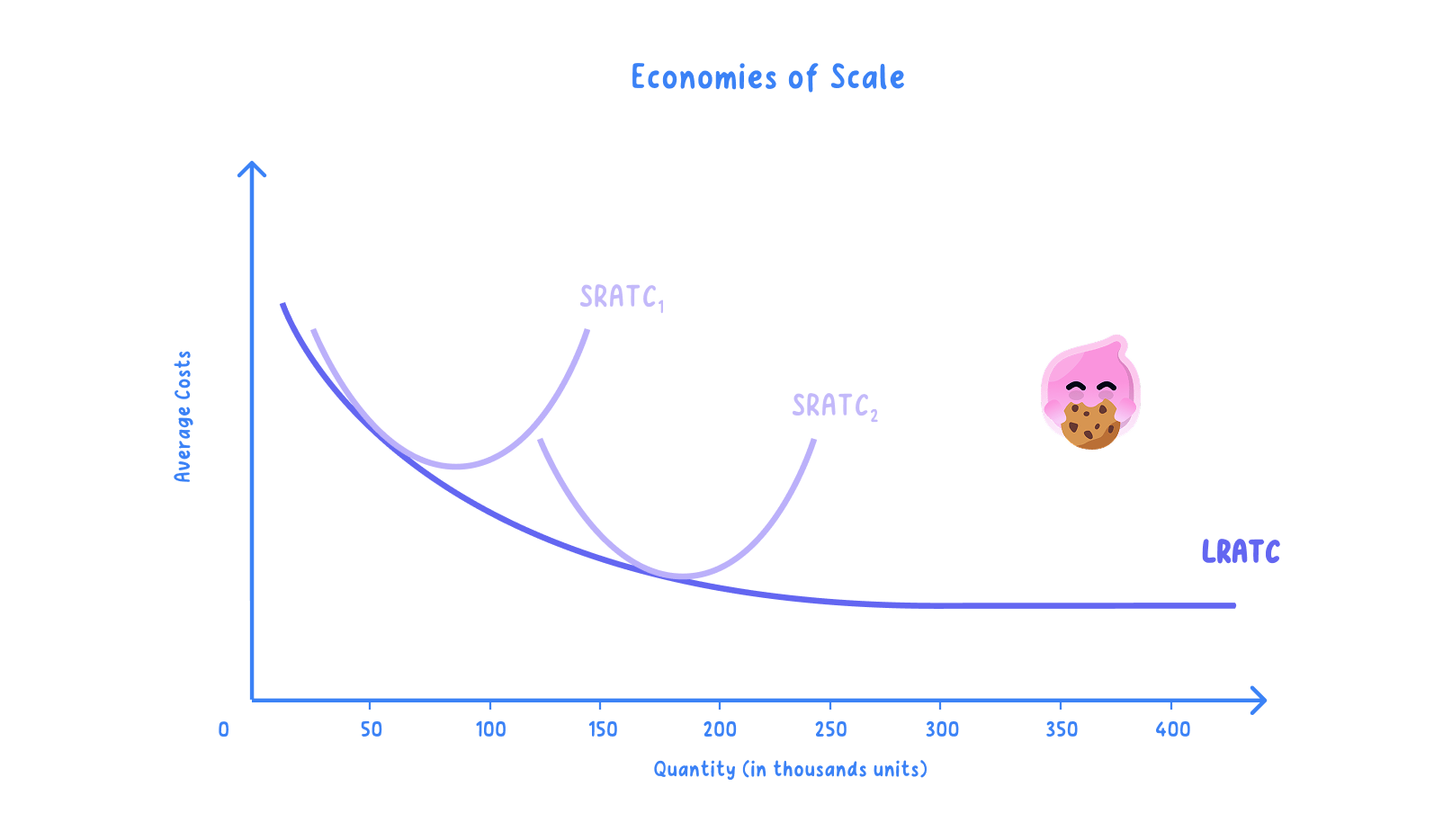
- Doubling all inputs more than doubles output, so LRAC falls.
- Constant returns to scale
- Doubling all inputs exactly doubles output, so LRAC is flat.
- Decreasing returns to scale
- Doubling all inputs less than doubles output, so LRAC rises.
Example
- A plant using 10 workers and 4 machines makes 100 units. Doubling both inputs to 20 workers and 8 machines lifts output to 250, more than double, so this stretch shows increasing returns and falling LRAC.
- Doubling the inputs again to 40 workers and 16 machines raises output only from 250 to 400, less than double, so coordination problems have brought in decreasing returns and rising LRAC.
How Returns to Scale Shape Long-Run Costs
- Increasing returns underlie falling LRAC and economies of scale.
- Decreasing returns underlie rising LRAC and diseconomies of scale.
- The long-run average cost curve reflects these effects.
Keep Returns to Scale Long-Run
Exam technique
- Stress that all factors vary, so returns to scale is a long-run idea.
- Link each case directly to the slope of the LRAC curve.
Common Mistake
- Do not treat returns to scale as a short-run idea.
- In the long run, all factors vary at once.
Self review
- State the law of diminishing marginal returns and explain why it is a short-run effect.
- How does diminishing returns affect short-run marginal cost?
- Define returns to scale and name the three types.
- Why is returns to scale a long-run concept?
- How do increasing returns affect LRAC, and how does diminishing returns differ from diseconomies of scale?
- If output runs 10, 24, 36, 44, 48 for 1 to 5 cooks, at which cook do diminishing marginal returns begin?
