1.6.1a Derived demand and marginal productivity theory
Demand for Labour Is a Derived Demand
Definition
Marginal revenue product: the addition to a firm's total revenue when one more worker is employed, equal to the marginal physical product of labour multiplied by the marginal revenue of the output.
- The demand for labour is a derived demand.
- Firms hire workers not for their own sake but for what they produce.
- So labour demand depends on the demand for the final product.
Note
- Labour demand is derived from demand for the good it makes.
- The labour demand curve slopes downward against the wage rate.
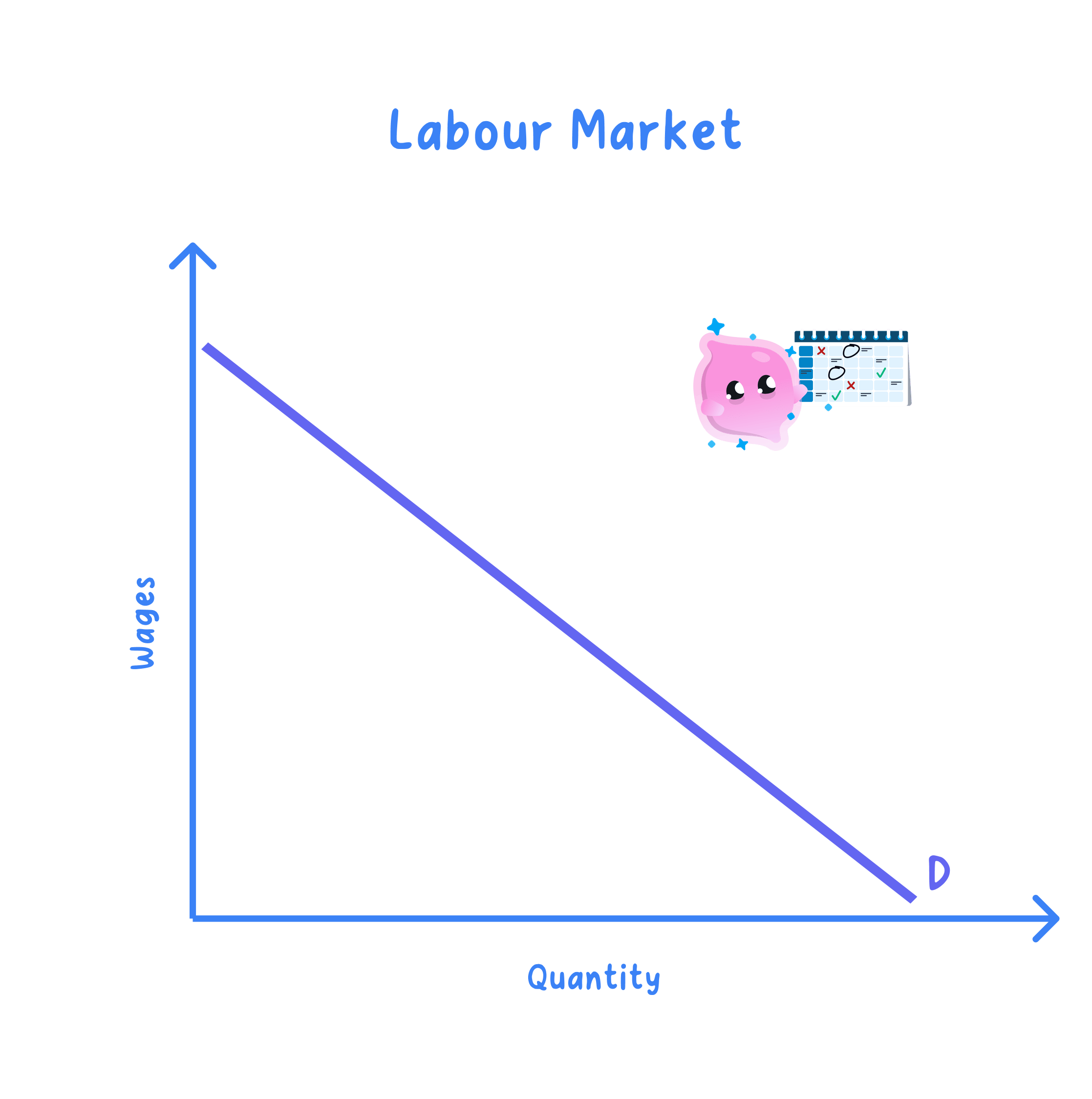
A Higher Wage Raises Costs, so Firms Hire Fewer Workers
- A higher wage raises the cost of employing each worker.
- So firms wish to employ fewer workers as the wage rises.
- The curve plots the wage rate against the quantity of labour.
Example
- If demand for new cars falls, carmakers need fewer assembly workers.
- A boom in housebuilding raises the demand for bricklayers.
A Fall in Product Demand Feeds Straight Through to Jobs
- Labour demand rises and falls with product demand.
- A slump in a product market feeds straight through to jobs.
- So changes in final demand drive changes in employment.
State the Derived Link
Exam technique
- Define derived demand and tie labour demand to product demand.
- Label the axes wage rate and quantity of labour.
Common Mistake
- Do not treat labour demand like ordinary product demand.
- Always explain that it is derived from demand for the final product.
The Marginal Revenue Product Theory of Labour Demand
- Marginal revenue product is the addition to revenue from one more worker.
- It equals marginal physical product times the marginal revenue of the output (MRP=MPP×MR\text{MRP} = \text{MPP} \times \text{MR}MRP=MPP×MR).
- A profit-maximising firm hires up to where the wage equals MRP.
Note
- MRP is the value a worker adds, not just the units they make.
- The MRP curve is the firm's labour demand curve.
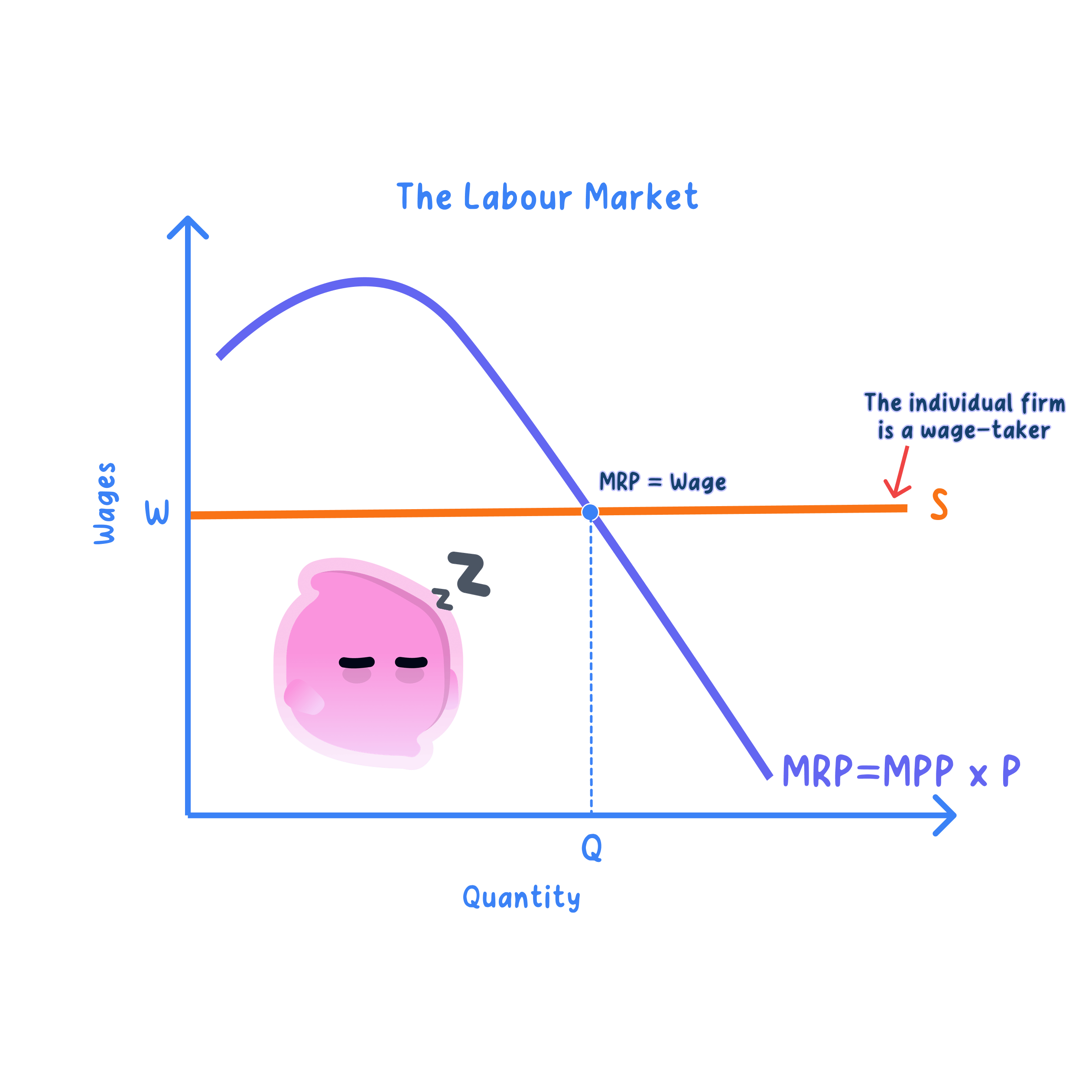
MRP Equals Marginal Physical Product Times Marginal Revenue
- Find the marginal physical product, the extra output from one more worker.
- Multiply it by the price, or marginal revenue, of the output.
- Hire more workers while MRP is above the wage, and stop when they are equal.
Example
- A worker who adds 101010 units, each selling for £5\pounds 5£5, has an MRP of 10×£5=£5010 \times \pounds 5 = \pounds 5010×£5=£50.
- If the wage is £40\pounds 40£40, hiring that worker adds £50\pounds 50£50 and raises profit.
Diminishing Returns Make MRP Fall as Employment Rises
- Diminishing marginal returns set in as more workers are added.
- Each extra worker adds less physical output than the last.
- So MRP falls, giving the labour demand curve its downward slope.
Calculate MRP From a Table
Exam technique
- Multiply marginal physical product by the output price to get MRP.
- State that the firm hires where the wage equals MRP.
Common Mistake
- Do not confuse marginal physical product with marginal revenue product.
- Physical product is units of output, while MRP is the value of that output.
Work Through an MRP Table Step by Step
- Suppose each unit of output sells for a fixed £5\pounds 5£5, so marginal revenue is £5\pounds 5£5.
- The first worker adds 121212 units, the second 101010 units and the third 777 units as returns diminish.
- Multiply each marginal physical product by £5\pounds 5£5 to get MRP of 12×£5=£6012 \times \pounds 5 = \pounds 6012×£5=£60, 10×£5=£5010 \times \pounds 5 = \pounds 5010×£5=£50 and 7×£5=£357 \times \pounds 5 = \pounds 357×£5=£35.
- If the market wage is £45\pounds 45£45, the firm employs the first two workers but not the third.
Example
- The second worker's MRP of £50\pounds 50£50 beats the £45\pounds 45£45 wage, so hiring adds £50−£45=£5\pounds 50 - \pounds 45 = \pounds 5£50−£45=£5 to profit.
- The third worker's MRP of £35\pounds 35£35 is below the £45\pounds 45£45 wage, so hiring them would cut profit by £45−£35=£10\pounds 45 - \pounds 35 = \pounds 10£45−£35=£10.
Self review
- What is a derived demand and why do firms demand labour?
- Why does the labour demand curve slope down?
- Define marginal revenue product and state how it is calculated.
- Work out the MRP of a worker adding 101010 units at £5\pounds 5£5 each.
- Using the table above, explain why the firm stops at two workers when the wage is £45\pounds 45£45.
1.6.1b The labour demand curve and its elasticity
What Shifts the Demand for Labour
Definition
Elasticity of demand for labour: the responsiveness of the quantity of labour demanded to a change in the wage rate, measured as the percentage change in labour demanded divided by the percentage change in the wage.
- Several factors shift the whole labour demand curve.
- They include product demand, labour productivity and the product price.
- The relative price of substitutes like capital also matters.
Note
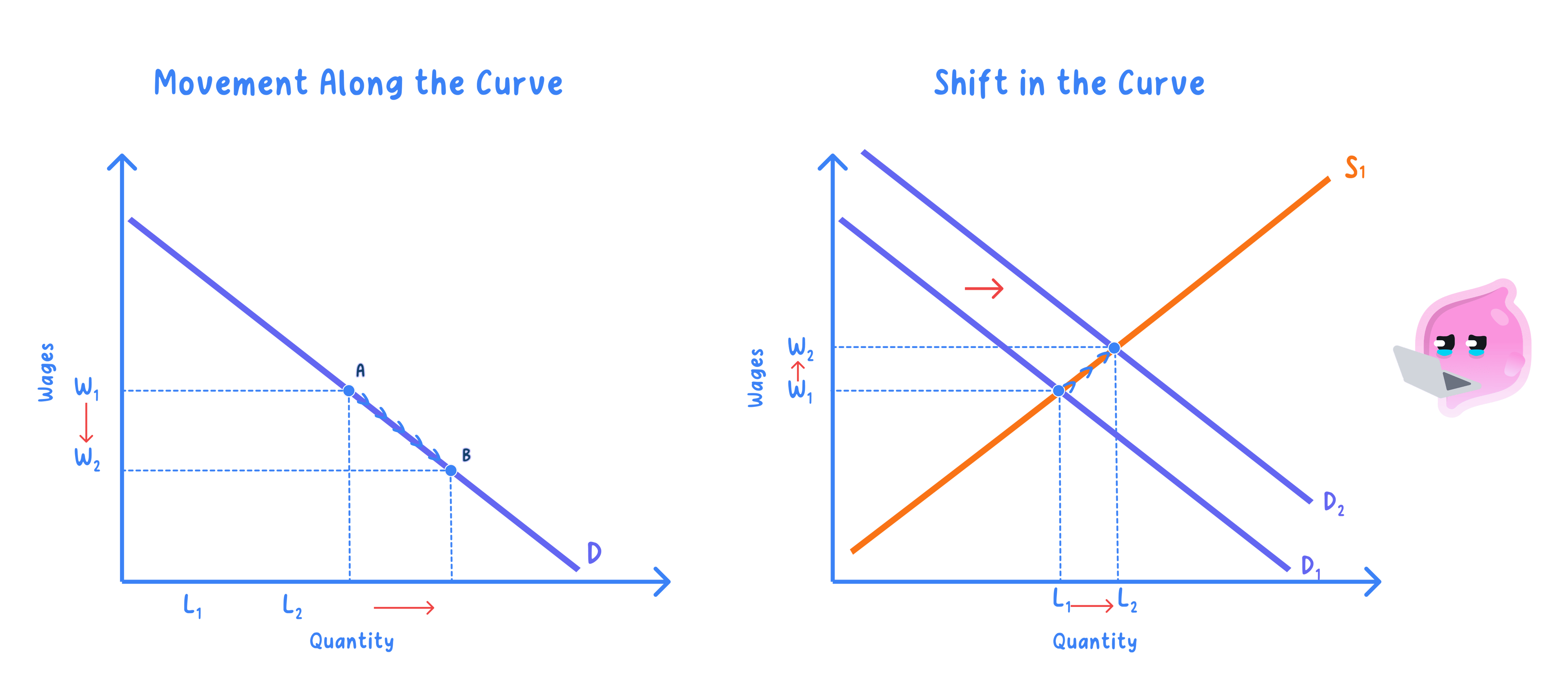
- A shift moves the whole curve, from a change in these determinants.
- A movement along it comes only from a change in the wage.
Product Demand, Productivity and Capital Prices Shift the Curve
- Higher demand for the product raises the demand for labour.
- Rising labour productivity raises each worker's MRP.
- Cheaper capital can lead firms to substitute machines for workers.
Example
- A surge in online orders raises a warehouse's demand for pickers.
- Cheaper robots can lead a factory to replace some assembly workers.
Only a Wage Change Moves Along the Curve
- A change in the wage is a movement along the curve.
- A change in a determinant shifts the whole curve left or right.
- Keeping the two apart is essential for correct diagrams.
Name the Shift Factor
Exam technique
- State which determinant has changed and shift the curve accordingly.
- Keep a wage change as a movement along the curve.
Common Mistake
- Do not confuse a shift of the curve with a movement along it.
- Only a wage change moves along the curve; determinants shift it.
The Elasticity of Demand for Labour
- The wage elasticity of demand for labour measures how quantity demanded responds to a wage change.
- It shows how sensitive hiring is to the wage rate.
- Several factors determine how elastic it is.
Note
- Labour demand is more elastic when labour is a large share of costs.
- It is also more elastic when capital can easily replace workers.
What Determines How Elastic Labour Demand Is
- The share of labour in total costs: a larger share means more elastic demand.
- The ease of substituting capital for labour.
- The price elasticity of demand for the final product, and the time period.
Example
- In a labour-intensive service, a wage rise sharply raises total costs.
- Where machines can easily replace workers, a wage rise cuts jobs faster.
- Elastic labour demand means a wage rise causes a large fall in jobs.
- This shapes how employment responds to a minimum wage or union rise.
- So elasticity links wage policy to its effect on jobs.
Link Elasticity to Job Losses
Exam technique
- Use the determinants to judge whether labour demand is elastic.
- Apply it to how employment reacts to a minimum wage or union rise.
Common Mistake
- Do not assume a wage rise costs the same jobs in every market.
- The job loss depends on how elastic labour demand is.
Worked Example: Calculating Wage Elasticity of Demand for Labour
- A care-home operator raises the hourly wage from £10\pounds 10£10 to £11\pounds 11£11, a 10%10\%10% rise.
- Employment of care assistants falls from 200200200 to 170170170, a 15%15\%15% fall.
- Wage elasticity of demand for labour is %ΔQL%ΔW\dfrac{\%\Delta Q_L}{\%\Delta W}%ΔW%ΔQL, giving −15%10%=−1.5\dfrac{-15\%}{10\%} = -1.510%−15%=−1.5.
- Ignoring the negative sign, 1.51.51.5 is greater than 111, so demand for care assistants is wage elastic here.
Example
- A coefficient of −1.5-1.5−1.5 means a 1%1\%1% wage rise causes a 1.5%1.5\%1.5% fall in employment, a more than proportionate response.
- This fits care work: labour is a large share of costs and, over time, some tasks can be reorganised with fewer staff, so demand is relatively elastic.
- By contrast, a wage elasticity between 000 and −1-1−1 would mean employment falls proportionately less than the wage rises, i.e. inelastic demand.
Describing the Labour Demand Diagram
- The vertical axis measures the wage rate (W) and the horizontal axis measures the quantity of labour demanded (QL).
- The labour demand curve, D, slopes downward from left to right because it is the firm's marginal revenue product (MRP) curve, which falls as diminishing marginal returns set in.
- A rise in a shift factor, such as higher product demand or higher productivity, shifts D rightward (outward), so more workers are hired at every wage.
- A flatter (shallower) D curve represents more elastic demand, and a steeper D curve represents more inelastic demand; a change in the wage rate is a movement along the labour demand curve, not a shift of it.
Case study
- The UK Low Pay Commission considers wage elasticity of demand when recommending the National Living Wage, since raising pay in sectors with elastic demand (e.g. retail, hospitality) risks larger job losses than in sectors with inelastic demand (e.g. specialist healthcare roles).
- Evidence on the National Living Wage since 2016 has generally found only small employment effects, suggesting UK labour demand in most low-paid sectors is closer to inelastic than economists once feared.
Self review
- Name three factors that shift labour demand.
- What causes a movement along the labour demand curve?
- Define the wage elasticity of demand for labour.
- Why does a large labour cost share make demand more elastic?
- Why does elasticity matter for the minimum wage?
- In the care-home worked example, recalculate the wage elasticity if employment had only fallen from 200200200 to 190190190 instead of 170170170, and say whether demand is now elastic or inelastic.
- Describe, in words, why the labour demand curve slopes downward and what makes it flatter or steeper.
