Normal Profit Is a Cost; Supernormal Profit Is the Surplus Above It
Definition
Normal profit: the minimum reward needed to keep an entrepreneur supplying their enterprise in the long run, earned when total revenue equals total cost, and treated as a cost of production.
- Profit is the difference between total revenue and total cost.
- Normal profit is the minimum return needed to keep a firm in the industry.
- Abnormal (supernormal) profit is any profit above normal profit, while a loss is revenue below total cost.
Note
- Normal profit is treated as a cost, since it is the opportunity-cost return, and is earned when AR equals AC.
- Supernormal profit is what remains once normal profit is covered.
Reading Profit and Loss on the Diagram
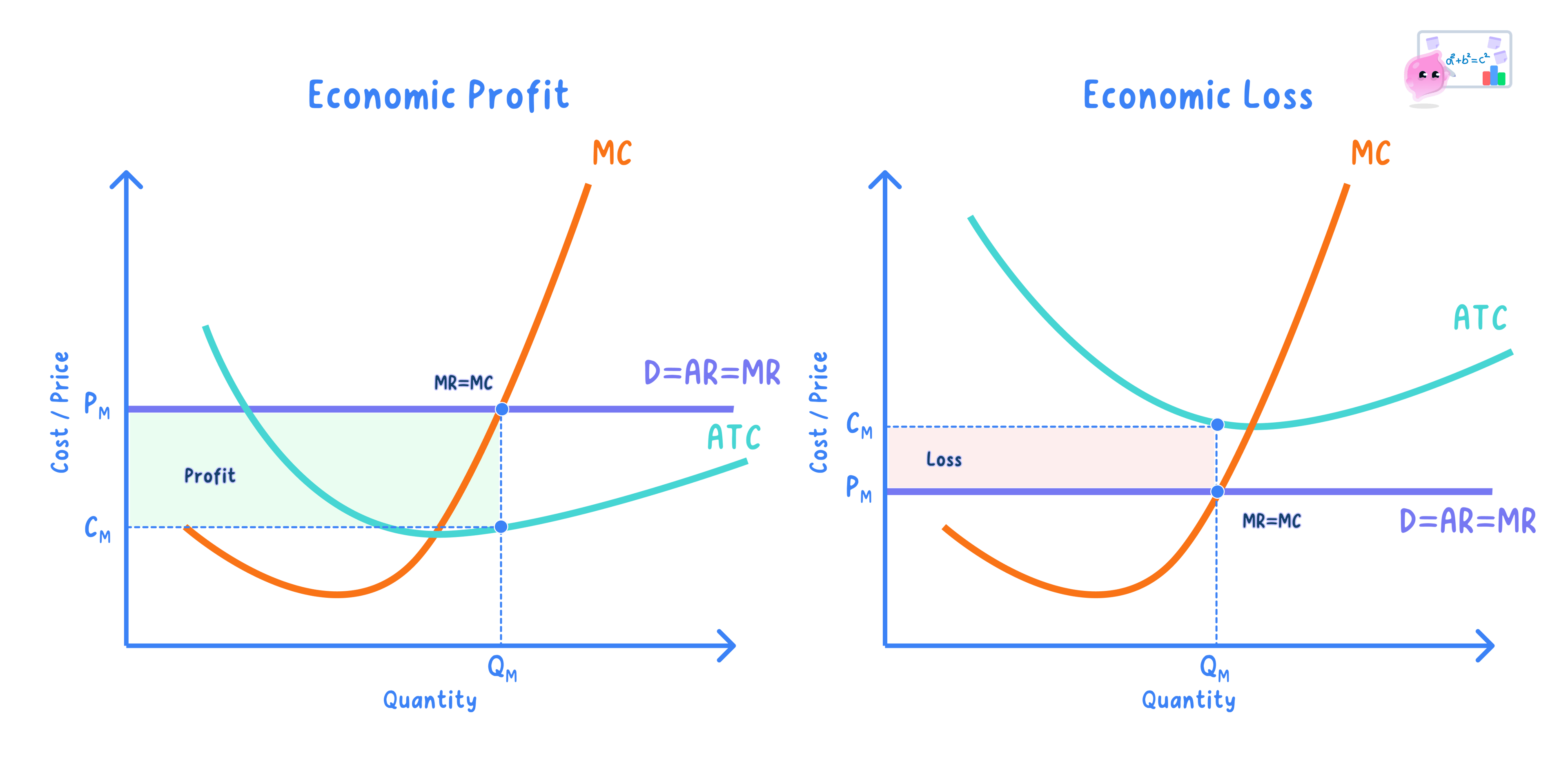
- At the profit-maximising output, compare average revenue with average cost.
- If AR is above AC, the firm earns supernormal profit.
- If AR equals AC, it earns only normal profit, and if AR is below AC, it makes a loss.
Example
- A firm sells 100 units at £12\pounds 12£12 each, so total revenue is TR=100×£12=£1,200\text{TR} = 100 \times \pounds 12 = \pounds 1{,}200TR=100×£12=£1,200. If total cost (which already includes normal profit) is £900\pounds 900£900, supernormal profit is £1,200−£900=£300\pounds 1{,}200 - \pounds 900 = \pounds 300£1,200−£900=£300.
- On the diagram this is the profit rectangle (AR−AC)×Q(\text{AR} - \text{AC}) \times Q(AR−AC)×Q: (£12−£9)×100=£300(\pounds 12 - \pounds 9) \times 100 = \pounds 300(£12−£9)×100=£300, since average cost is AC=£900100=£9\text{AC} = \dfrac{\pounds 900}{100} = \pounds 9AC=100£900=£9.
- If the price were only £9\pounds 9£9, total revenue of £900\pounds 900£900 would exactly equal total cost, so the firm earns just normal profit, which is not zero profit but the return that keeps it in the industry.
- At a price of £8\pounds 8£8, total revenue is £800\pounds 800£800 against £900\pounds 900£900 of cost, a loss of £900−£800=£100\pounds 900 - \pounds 800 = \pounds 100£900−£800=£100, shown as a rectangle with AC above AR.
Why Profit Is a Signal
- Supernormal profit attracts new firms into a market.
- Losses drive firms out towards more valued uses of resources.
- Normal profit is just enough to keep a firm where it is, and supernormal profit also funds investment and innovation.
Is Profit Always a Good Thing?
- Profit gives vital signals and incentives, rewarding efficient firms and steering resources towards the goods consumers value most.
- Retained supernormal profit can fund investment and research, raising dynamic efficiency and improving products over time.
- But persistent supernormal profit can instead signal monopoly power, where higher prices and restricted output transfer welfare from consumers to producers.
- Its wider value also depends on how the profit is used, since profit reinvested benefits the economy far more than profit simply extracted by owners.
- On balance profit is essential to a market economy, but whether a particular firm's profit is beneficial depends on whether it reflects genuine efficiency and is reinvested, or reflects market power exploited at consumers' expense.
Anchor Normal Profit in Costs
Exam technique
- Treat normal profit as part of costs, not as a separate reward.
- Measure supernormal profit as the AR-minus-AC gap times quantity.
Common Mistake
- Do not treat normal profit as zero profit.
- It is the opportunity-cost return already included in the firm's costs.
Self review
- Define normal profit, abnormal (supernormal) profit and loss.
- Why is normal profit treated as a cost?
- How is supernormal profit shown on the diagram?
- What role does profit play as a signal in a market economy?
- A firm sells 200 units at £7\pounds 7£7 with total cost of £1,200\pounds 1{,}200£1,200. Find total revenue, its profit or loss, and state whether it is above or below normal profit.
