Macroeconomic Objectives Often Conflict, so Improving One Can Worsen Another
Definition
Phillips curve: a curve showing the inverse relationship between the rate of unemployment and the rate of inflation in the short run.
- Governments pursue several macroeconomic objectives at once: strong and sustainable economic growth, low and stable inflation, low unemployment, a satisfactory position on the current account of the balance of payments, and increasingly an environmentally sustainable economy.
- These goals cannot always be met together.
- Using demand-side policy to advance one objective frequently sets back another, which is why policymakers must weigh trade-offs and decide which target to prioritise.
Output Gaps Link Unemployment to Inflationary Pressure
- A negative output gap occurs when real output is below the productive potential of the economy.
- Spare capacity means cyclical unemployment is high and there is little upward pressure on wages and prices, so inflationary pressure is weak.
- A positive output gap occurs when real output is pushed above its sustainable trend.
- The economy is stretched, unemployment is low, and firms bid for scarce labour and materials, so demand-pull and cost-push inflationary pressure builds.
- This relationship between the output gap, unemployment and inflation is the foundation of the Phillips curve.
The Short-Run Phillips Curve Shows a Trade-Off Between Inflation and Unemployment
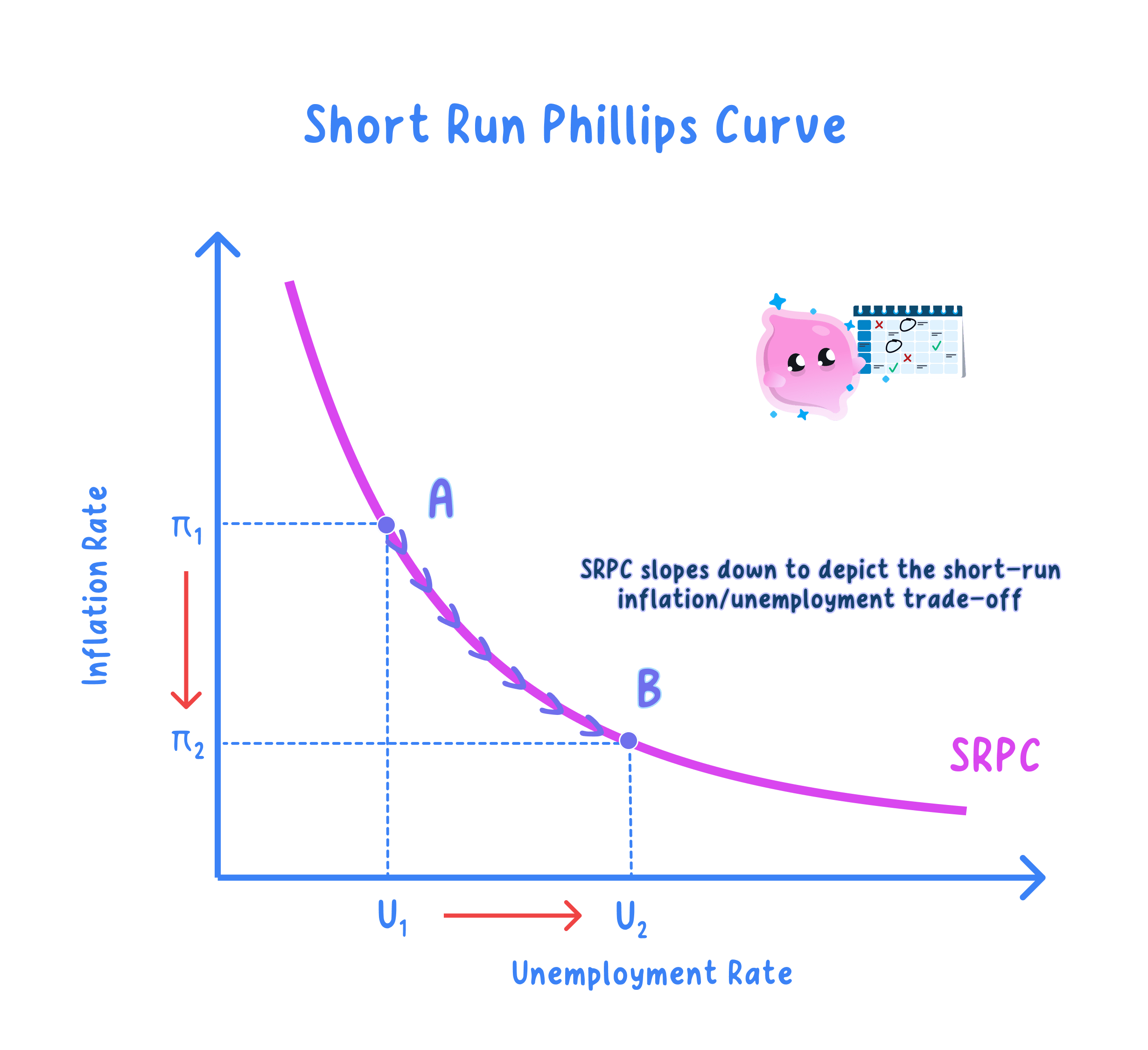
- The short-run Phillips curve plots the rate of unemployment on the horizontal axis against the rate of inflation on the vertical axis.
- It slopes downward, so lower unemployment tends to coincide with higher inflation, and vice versa.
- The relationship reflects the pressure of aggregate demand on wages and prices: as rising demand pulls unemployment down towards full capacity, inflation accelerates.
Note
- The short-run Phillips curve captures the demand-side trade-off between inflation and unemployment.
- Lower unemployment is associated with higher inflation, and higher unemployment with lower inflation.
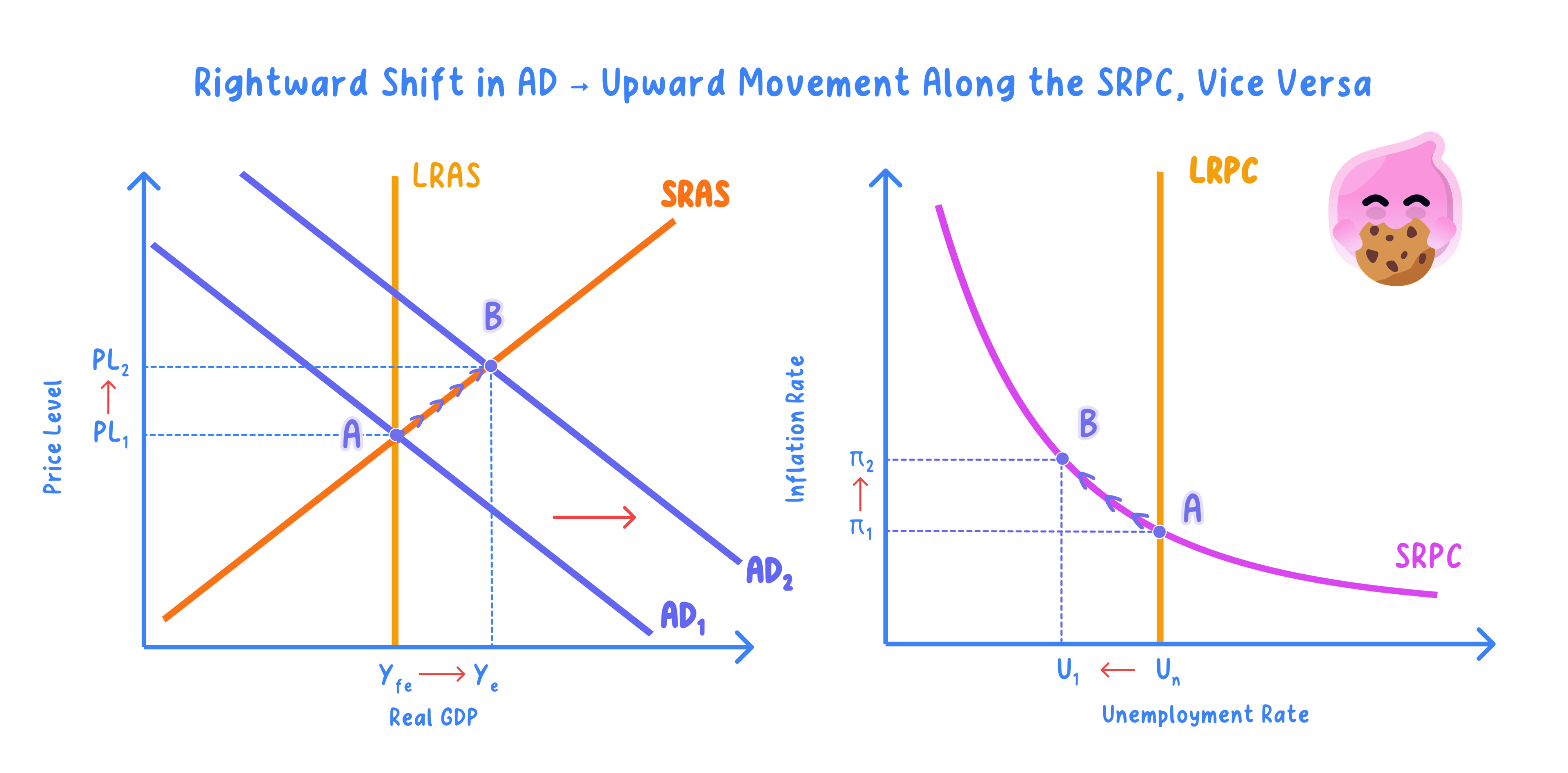
- It mirrors the position of the economy in the AD-AS model and the size of the output gap.
Example
- Suppose unemployment of 5 per cent sits alongside inflation of 2 per cent.
- A demand boom that cuts unemployment to 3 per cent might raise inflation to 4 per cent.
- A downturn that raises unemployment eases inflation back down.
The Long-Run Phillips Curve Is Vertical, so There Is No Lasting Trade-Off
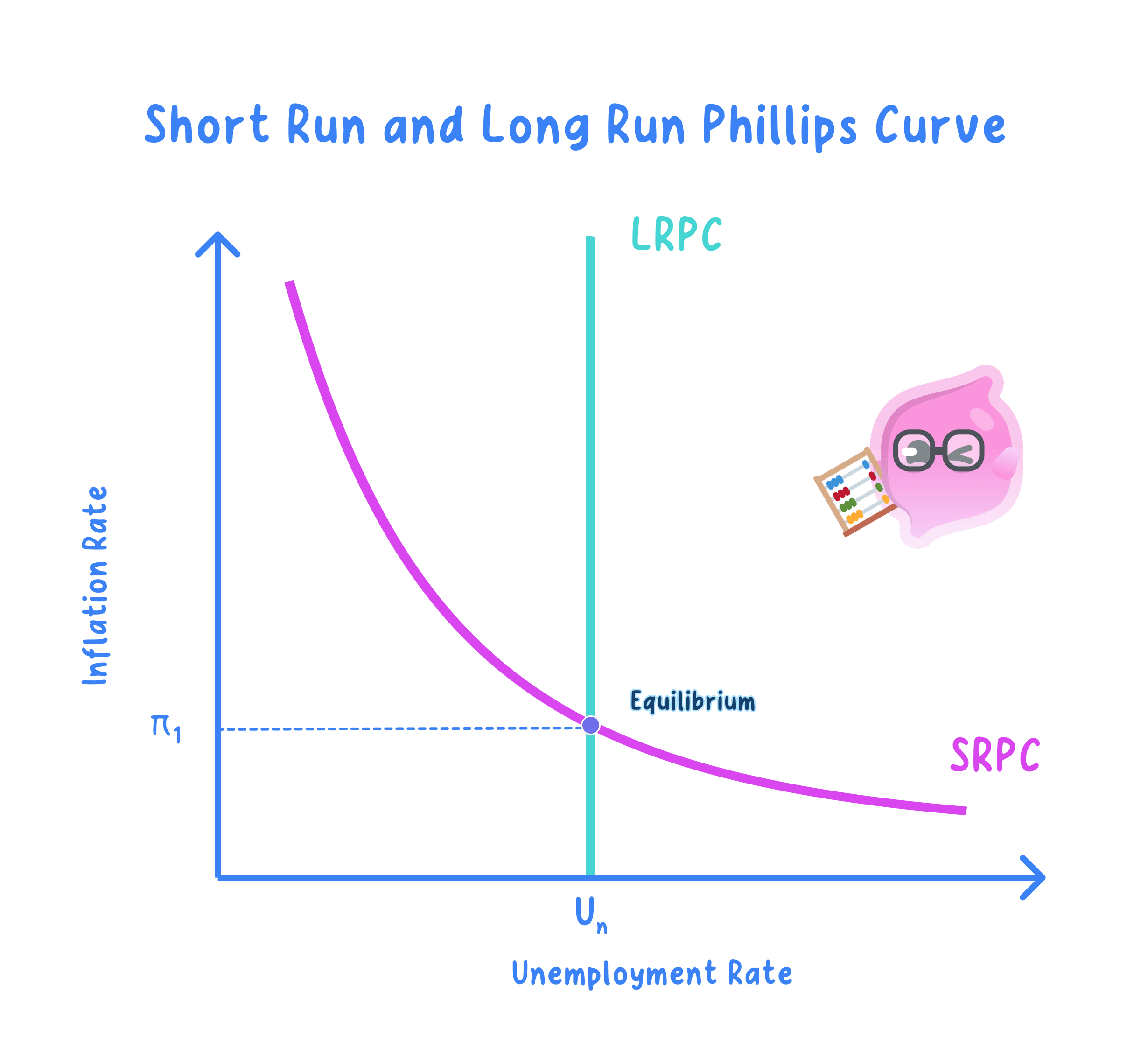
- In the long run the Phillips curve is vertical at the natural rate of unemployment, the NAIRU or non-accelerating inflation rate of unemployment (AQA also describes it as the long-run, L-shaped Phillips curve).
- Because it is vertical, there is no long-run trade-off between inflation and unemployment: the economy settles at the natural rate whatever the rate of inflation.
- The natural rate is a supply-side equilibrium, not zero unemployment, because frictional and structural unemployment always remain.
- If demand-side policy holds unemployment below the natural rate, inflation first rises.
- Workers then come to expect higher inflation and bargain for higher wages, raising firms' costs.
- Unemployment drifts back to the natural rate, but now with permanently higher inflation.
- Attempts to exploit the short-run trade-off therefore only ratchet inflation upwards over time.
Note
- The NAIRU is the unemployment rate at which inflation is stable.
- Inflation expectations drive the economy's return to the natural rate.
- Only supply-side improvements move the natural rate itself.
Common Mistake
- Do not present the short-run trade-off as permanent or exploitable in the long run.
- Do not confuse the natural rate with zero unemployment; it is a supply-side equilibrium that still includes frictional and structural unemployment.
Policy Can Reconcile Conflicts Differently in the Short Run and the Long Run
- In the short run, demand-management policy moves the economy along the short-run Phillips curve.
- A government can accept slightly higher inflation to bring unemployment down, or tighten policy to reduce inflation at the cost of higher unemployment.
- The choice depends on which objective is given priority, and the trade-off, though real, is only temporary.
- In the long run, the conflict between low unemployment and low inflation can only be eased by supply-side policy.
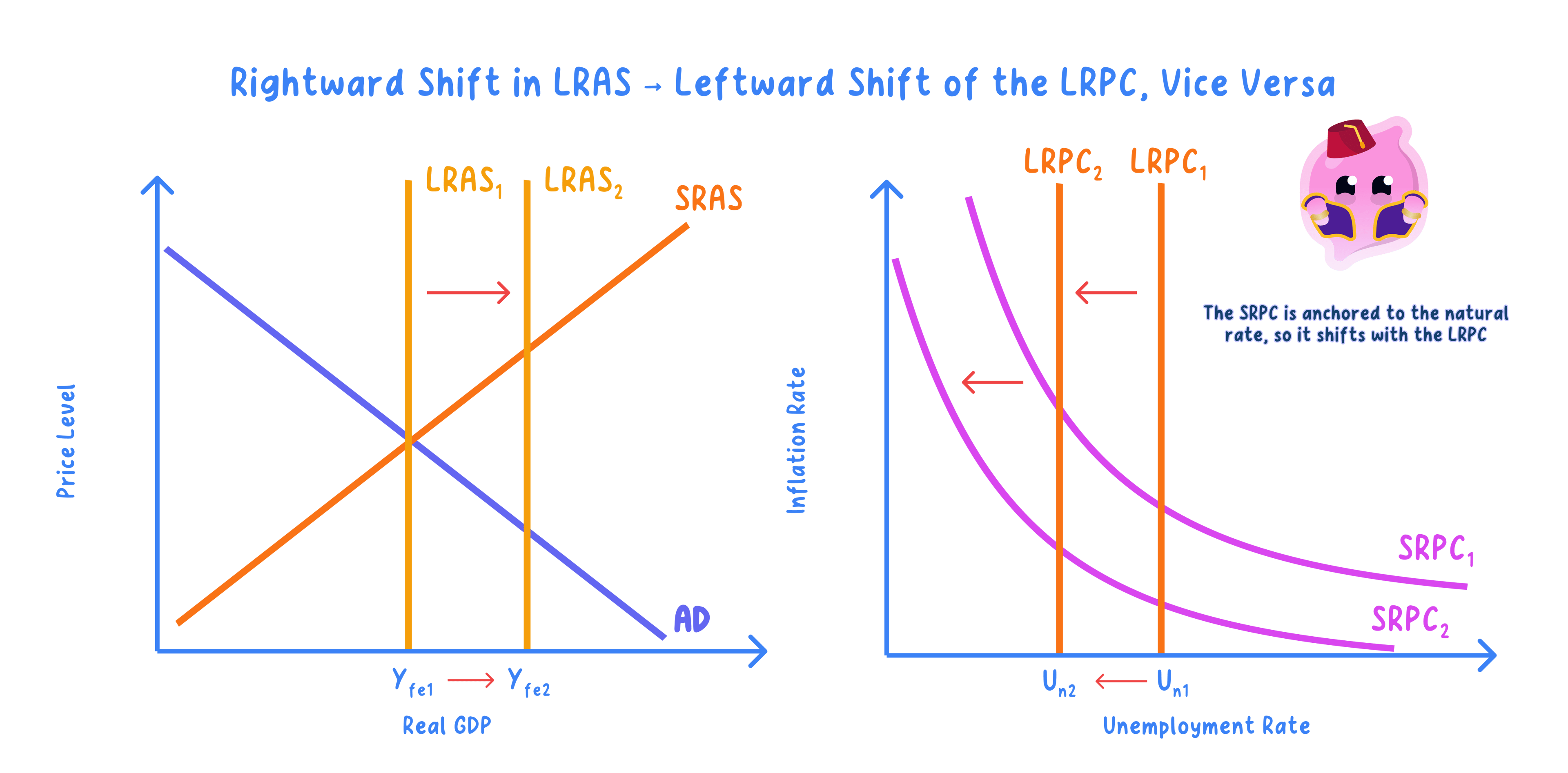
- Better education and training, stronger job-search support and a more flexible labour market lower the natural rate of unemployment and shift the long-run Phillips curve to the left.
- This allows lower unemployment to coexist with stable inflation, reconciling the two objectives rather than simply raising inflation.
Case study
- UK labour market reforms since the 1980s aimed to lower the natural rate of unemployment.
- Training and job-search support target frictional and structural unemployment.
- A lower NAIRU lets lower unemployment coexist with stable inflation.
Exam technique
- Put unemployment on the horizontal axis and inflation on the vertical axis.
- Show a movement along the short-run curve for a demand change, and draw the long-run curve vertical at the natural rate.
- Link a leftward shift of the long-run curve to supply-side improvements.
Faster Economic Growth Can Conflict With Low Inflation
- Demand-led growth raises aggregate demand.
- As the economy approaches full capacity and a positive output gap opens, demand-pull inflation builds and firms face rising input costs.
- Rapid growth driven by consumer and government spending therefore tends to conflict with the objective of low and stable inflation, which is why a central bank may raise interest rates to cool an overheating economy even though this slows growth.
Faster Growth Can Worsen the Current Account of the Balance of Payments
- When incomes rise during a period of strong growth, households spend more, and a large share of that extra spending goes on imported goods and services.
- If import spending rises faster than exports, the current account deficit widens.
- Strong domestic growth can therefore conflict with the objective of a satisfactory balance of payments, particularly where the marginal propensity to import is high.
Growth Can Conflict With Environmental Sustainability and a Fairer Income Distribution
- Higher output usually means greater use of energy and raw materials and more pollution.
- These negative externalities, including carbon emissions and resource depletion, mean rapid growth can conflict with environmental objectives and long-run sustainability.
- Growth can also widen income inequality if its gains flow mainly to owners of capital and to highly skilled workers, so a government pursuing faster growth may need green or redistributive policies to limit these side effects.
The Phillips Curve Is a Useful but Limited Guide for Policy
- In favour of the model, there is a genuine short-run demand-side trade-off: lower unemployment does tend to come with higher inflation.
- The curve links neatly to the AD-AS model and the output gap, giving policymakers a clear way to picture the tension between the two objectives.
- Against it, the stable relationship broke down in the 1970s, when high inflation and high unemployment, or stagflation, occurred together.
- Because inflation expectations shift the short-run curve, and because the economy returns to the natural rate in the long run, the trade-off is unstable and cannot be relied on to deliver a lasting fall in unemployment.
- On balance, the Phillips curve is a useful short-run guide, but shifting expectations and the vertical long-run curve mean demand policy alone cannot secure lower unemployment without accelerating inflation.
- Lasting improvement requires supply-side reform.
Case study
- The 1970s oil shocks brought stagflation to the UK and elsewhere.
- That experience led to the expectations-augmented Phillips curve.
- It reshaped how central banks think about inflation and expectations.
Self review
- How do positive and negative output gaps relate to unemployment and inflationary pressure?
- What does the short-run Phillips curve show, and what are its axes?
- Why is the long-run Phillips curve vertical at the NAIRU?
- How can supply-side policy reconcile low unemployment with low inflation in the long run?
- Give two conflicts between faster economic growth and other macroeconomic objectives.
