1.5.10a Static, dynamic and allocative efficiency (A-level only)
Allocative and Productive Efficiency Are the Two Static Conditions
Definition
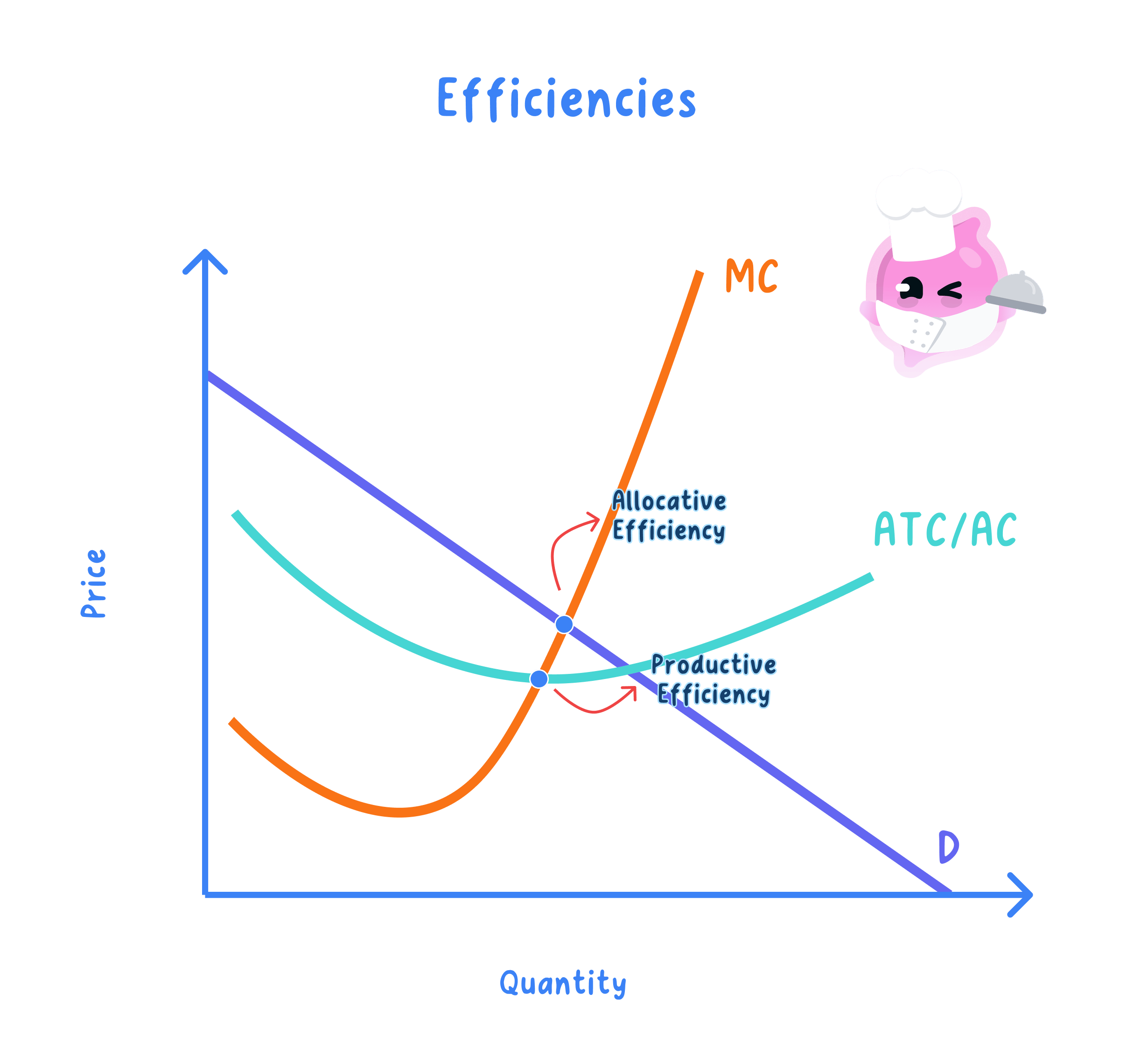
Allocative efficiency: achieved when resources are allocated so that price equals marginal cost (P=MCP = \text{MC}P=MC), so that no one can be made better off without making someone else worse off.
- Allocative efficiency means producing the mix of goods consumers most want.
- It is reached where price equals marginal cost.
- Productive efficiency means producing at the lowest average total cost.
Note
- Allocative efficiency is about the right mix of output.
- Productive efficiency is about least-cost production.
Spot Allocative Where P=MC and Productive at the Bottom of Average Cost
- Allocative
- Price equals marginal cost, so the value of the last unit equals its cost.
- Productive
- Output sits at the bottom of the average cost curve, and on the PPF.
Example
- If price is £5 and marginal cost is £5, the market is allocatively efficient.
- A firm at the lowest point of its average cost curve is productively efficient.
Static Efficiency Is About Now; Dynamic Efficiency Is About Improvement over Time
- Static efficiency is the best use of resources at a point in time, covering both allocative and productive efficiency.
- Dynamic efficiency is the improvement in efficiency over time.
- It is driven by investment, research and development, and technological change.
Note
- A market can be statically efficient today yet dynamically inefficient if it fails to innovate.
- Supernormal profit can provide the funds that raise dynamic efficiency.
State the Condition, Not Just the Word
Exam technique
- Write price equals marginal cost for allocative efficiency.
- Write lowest average cost for productive efficiency, and treat dynamic efficiency as improvement over time.
Common Mistake
- Do not confuse allocative with productive efficiency, or static with dynamic efficiency.
- Allocative is the right mix of output, productive is least-cost production, and dynamic is improvement over time.
Self review
- What is the difference between static and dynamic efficiency?
- Define allocative efficiency and give its condition.
- Define productive efficiency and give its condition.
- What drives dynamic efficiency?
- Can a market meet one static condition but not the other?
1.5.10b Determinants of dynamic efficiency (A-level only)
Dynamic Efficiency Is Efficiency Achieved over Time Through Investment and Innovation
Definition
Dynamic efficiency: efficiency over time, achieved through innovation, investment and technological change that lower costs and improve products.
- Dynamic efficiency is efficiency achieved over time, not at one moment.
- It comes from reinvesting profit in research, innovation and new technology.
- Over the long run costs fall and quality and variety improve.
Note
- Static efficiency is a snapshot, while dynamic efficiency is about change over time.
- Supernormal profit, though a static welfare loss, can fund dynamic gains.
R&D, Investment in Capital and Technological Change Drive Dynamic Efficiency
- Spending on research and development lowers future costs.
- Investment in human and non-human capital raises productivity.
- Technological change improves products and processes.
Example
- A pharmaceutical firm reinvests profit to develop better drugs.
- A supermarket invests in technology that cuts its costs over time.
A Firm Can Be Statically Inefficient yet Dynamically Efficient
- A monopoly may be statically inefficient yet dynamically efficient.
- Its supernormal profit can fund innovation a small firm cannot afford.
- This is a key evaluation line when judging monopoly and oligopoly.
Use Dynamic Efficiency to Balance the Static Case
Exam technique
- Set static welfare losses against possible dynamic gains.
- Link supernormal profit to funds for research and development.
Common Mistake
- Do not treat efficiency as purely static.
- Ignoring long-run innovation misses the dynamic efficiency argument.
Self review
- Define dynamic efficiency.
- How does it differ from static efficiency?
- Name two drivers of dynamic efficiency.
- Why can supernormal profit aid dynamic efficiency?
