2.4.3a Functions of a central bank and monetary policy
A Central Bank Runs Monetary Policy, Using Interest Rates, the Money Supply and Credit, and the Exchange Rate to Meet the Government's Inflation Target
Definition
Monetary policy: the actions taken by a central bank to influence interest rates, the supply of money and credit, and the exchange rate in order to achieve the government's macroeconomic objectives, chiefly the inflation target.
A Central Bank Is Banker to the State and the Banks and Guardian of Financial Stability
- A central bank oversees monetary policy and the stability of the financial system.
- It is banker to the government and to the commercial banks.
- As lender of last resort, it provides emergency liquidity to solvent but illiquid banks.
- It also manages the issue of currency and oversees the payment system.
Note
- The lender-of-last-resort role helps prevent contagion across the banking system.
- But rescuing banks creates a moral-hazard tension.
- Its financial-stability role is distinct from its interest-rate policy role.
The Core Functions Span Policy, Banking, Crisis Support and Stability
- It implements monetary policy to meet the inflation target.
- It acts as banker to the government and to the banks.
- It acts as lender of last resort in a crisis.
- It oversees the stability of the financial system.
Example
- The Bank of England sets Bank Rate to meet the 2 per cent inflation target.
- It lent emergency support to banks during the 2008 financial crisis.
- It issues banknotes and oversees the payment system.
Monetary Policy Steers Aggregate Demand by Changing the Cost and Availability of Borrowing
- Monetary policy is the central bank's use of interest rates, the supply of money and credit and the exchange rate to influence aggregate demand.
- It aims to meet objectives such as low and stable inflation.
Note
- Monetary policy is a key demand-management tool.
- It works mainly by changing interest rates, but also the money supply and the exchange rate.
Its Instruments Are Interest Rates, the Money Supply and the Availability of Credit
- Bank Rate sets the cost of borrowing across the economy.
- Tools such as quantitative easing change how much money circulates.
- Rules and guidance can make banks lend more or less freely, influencing the supply of credit.
Example
- In the UK, monetary policy is run by the Bank of England, independent of the government.
- Its Monetary Policy Committee sets Bank Rate to meet the inflation target.
Lower Rates Lift Demand While Higher Rates Cool It
- Lower interest rates make borrowing cheaper, raising consumption and investment.
- This lifts aggregate demand and real output, and near full capacity the price level.
- Higher rates do the reverse, cooling demand to control inflation.
Expansionary Policy Loosens the Reins While Contractionary Policy Tightens Them
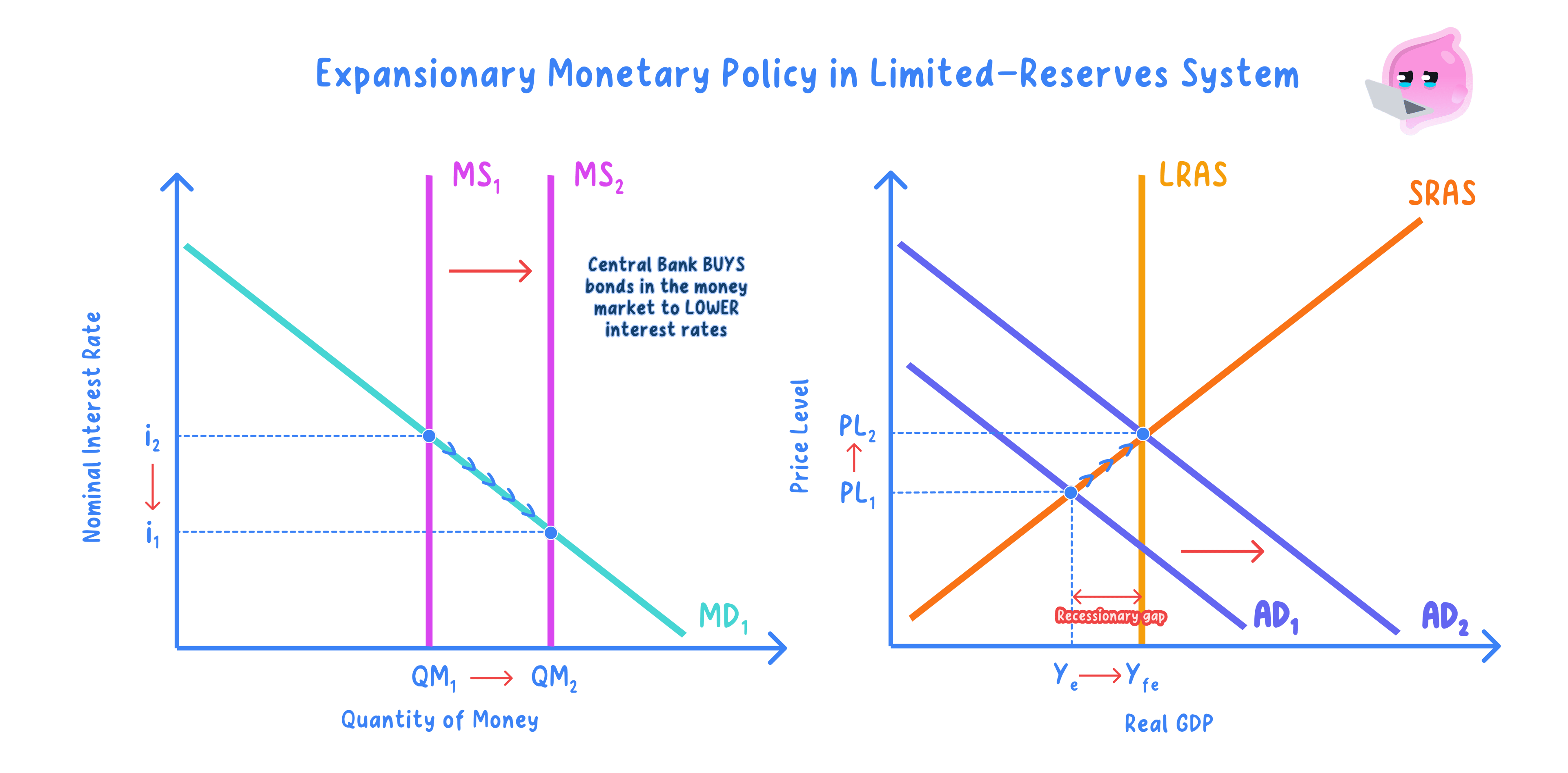
- Expansionary policy cuts rates or expands the money supply to boost demand, suiting a recession with a negative output gap and low inflation.
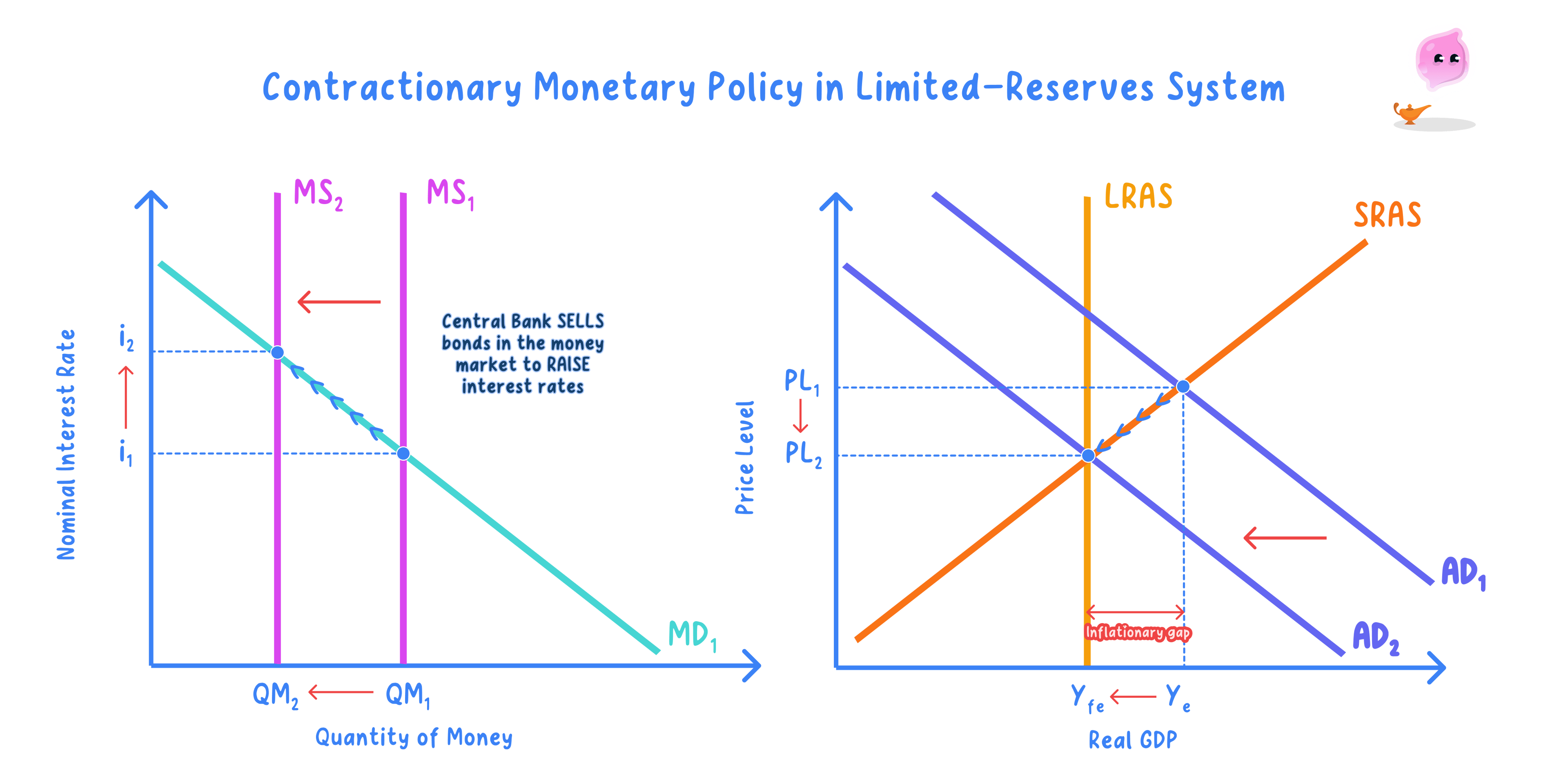
- Contractionary policy raises rates or reduces the money supply to curb inflation, suiting a boom with above-target inflation.
Common Mistake
- Do not confuse monetary policy with fiscal policy: monetary policy is rates and the money supply, while fiscal policy is tax and spending.
- Do not assume lower rates always raise spending: in a liquidity trap, or when confidence is weak, they may have little effect.
Beyond Interest Rates, the Central Bank Can Act Directly on Money and Credit
- Authorities can intervene directly in the banking system, beyond setting interest rates.
- The tools include funding schemes, capital and liquidity requirements, and controls or guidance on lending.
Note
- These tools influence the flow of credit in the economy.
- They also support financial stability, and became prominent after the 2008 crisis.
Monetary Policy Also Works Through the Exchange Rate
- Lower interest rates tend to weaken the currency, making exports cheaper and imports dearer, which raises net exports and aggregate demand.
- Differences in interest rates move capital between countries and so move the exchange rate.
Note
- Monetary policy affects the economy through several channels, including the exchange rate.
- In an open economy, its effects also spill over to other countries.
The Government Sets the Objective: A Symmetric 2 per Cent Inflation Target
- The current objective of UK monetary policy, set by the government, is 2 per cent consumer price inflation.
- The target is symmetric, so both too-high and too-low inflation are treated as problems.
- If inflation is above target the bank tends to raise rates; if below, it tends to cut them, aiming to return inflation to target over time.
Note
- A symmetric target treats overshooting and undershooting as problems, not just a ceiling.
- A credible target anchors inflation expectations, making inflation easier to control.
Self review
- Name four main functions of a central bank.
- What is the main conventional instrument of monetary policy?
- How can the central bank influence the supply of money and credit?
- How does a change in interest rates affect the exchange rate and aggregate demand?
- What is the current objective of UK monetary policy set by the government?
2.4.3b The MPC and bank rate
The MPC Sets Bank Rate to Try to Meet the Government's Inflation Target
Definition
Bank rate: the interest rate set by the Bank of England's Monetary Policy Committee, which influences the wider structure of interest rates in the economy.
- The central bank's Monetary Policy Committee (MPC) sets bank rate.
- It weighs a range of factors before raising, cutting or holding rates.
- The overriding guide is the inflation target.
Note
- The MPC sets bank rate mainly to hit the inflation target.
- It also watches growth, unemployment, the output gap and global conditions.
The MPC Weighs Several Factors When Setting Bank Rate
- Inflation
- The current and forecast rate against the target is the key input.
- The output gap and growth
- A positive gap or fast growth points to higher rates.
- Unemployment
- High unemployment argues for lower rates to support demand.
- The exchange rate and global conditions
- A weak currency or a global shock can change the picture.
Note
- The Bank of England targets 2% CPI inflation.
- The MPC looks at forecasts because bank rate changes act with a long time lag.
The MPC Acts on Forecast Inflation Because Rate Changes Work With a Lag
- Bank rate changes take many months to affect the economy.
- So the MPC must act on forecast inflation, not just today's figure.
- This makes accurate forecasting central to good monetary policy.
Lead With the Inflation Target
Exam technique
- State that the inflation target is the primary guide.
- List the other inputs, such as the output gap, unemployment and the exchange rate.
- Explain why the MPC acts on forecasts, given time lags.
- Judge whether a bank rate change is justified in the scenario.
Common Mistake
- Do not say the government sets UK bank rate.
- The independent MPC does.
- Do not treat bank rate as based only on current inflation.
- The MPC acts on forecasts because of time lags.
A Change in Bank Rate Also Redistributes Between Savers and Borrowers
- A rise in bank rate raises the return on savings, rewarding savers and encouraging households to save rather than spend.
- A cut in bank rate lowers the return on savings, hurting savers such as pensioners who rely on interest income.
- It encourages them to spend or to move into higher-yielding assets.
- So a bank rate change redistributes real income between borrowers and savers, and the MPC must weigh both when it moves rates.
Note
- A rate rise helps savers but squeezes borrowers; a rate cut does the reverse.
Self review
- Who sets bank rate in the UK?
- What is the primary factor guiding bank rate?
- Name two other factors the MPC considers.
- Why does the MPC rely on forecasts?
- What is the UK's inflation target?
- How does a change in bank rate affect savers?
2.4.3c Transmission mechanism and money supply
A Change in Bank Rate Reaches Demand and Inflation Through a Chain of Channels, Including the Exchange Rate
Definition
Monetary policy transmission mechanism: the process by which a change in bank rate feeds through several channels, such as market interest rates, asset prices, expectations and the exchange rate, to affect aggregate demand and ultimately the rate of inflation.
- The transmission mechanism is how a change in bank rate reaches spending, output and inflation.
- It works through several channels at once: market interest rates, credit, asset prices, expectations and the exchange rate.
Note
- A rate change feeds through many channels, not just borrowing costs.
- The full effect arrives with a time lag.
A Cut in Bank Rate Eases Credit, Lifts Asset Prices and Can Weaken the Pound
- A cut in bank rate lowers market interest rates and eases credit.
- It can raise asset prices and lift confidence.
- It can also weaken the exchange rate, raising net exports.
Example
- Cheaper borrowing supports consumption and investment.
- A weaker pound raises net exports through the exchange-rate channel.
The Mechanism Is Broad and Slow-Acting, Not Just About Borrowing Costs
- The saving and borrowing channel is only one route.
- Wealth, expectations and the exchange rate also matter.
- So the full mechanism is broad and slow-acting.
Higher Interest Rates Tend to Strengthen the Pound, While Lower Rates or QE Weaken It
- Monetary policy can influence the exchange rate.
- Higher interest rates attract capital inflows and raise demand for the currency, causing an appreciation.
- Lower rates or quantitative easing tend to weaken it.
Capital Flows Explain How Rate Changes Move the Currency
- Higher rates: capital flows in seeking returns, demand for the currency rises and it appreciates.
- Lower rates: capital flows out and the currency depreciates.
- Quantitative easing: raising the money supply tends to weaken the currency.
Example
- This is the exchange-rate channel of monetary policy.
- A stronger currency cools inflation but hurts exporters.
A Change in the Exchange Rate Feeds Through to Net Exports, Aggregate Demand and Inflation
- A lower exchange rate makes exports cheaper and imports dearer, which can raise net exports, aggregate demand and employment and improve the current account.
- A higher exchange rate makes imports cheaper, which eases inflation but can weaken competitiveness and the current account.
Example
- Worked example: suppose the pound stands at £1=$1.50\pounds 1 = {\char36}1.50£1=$1.50 and a UK firm exports a machine priced at £10,000\pounds 10{,}000£10,000, so a US buyer pays £10,000×1.50=$15,000\pounds 10{,}000 \times 1.50 = {\char36}15{,}000£10,000×1.50=$15,000.
- If the pound depreciates to £1=$1.20\pounds 1 = {\char36}1.20£1=$1.20, that same £10,000\pounds 10{,}000£10,000 machine now costs the US buyer only £10,000×1.20=$12,000\pounds 10{,}000 \times 1.20 = {\char36}12{,}000£10,000×1.20=$12,000, so UK exports become cheaper and more competitive abroad.
- At the same time a US component priced at $3,000{\char36}3{,}000$3,000 rises from $3,0001.50=£2,000\dfrac{{\char36}3{,}000}{1.50}=\pounds 2{,}0001.50$3,000=£2,000 to $3,0001.20=£2,500\dfrac{{\char36}3{,}000}{1.20}=\pounds 2{,}5001.20$3,000=£2,500 for UK importers, so imports become dearer; net exports improve only if demand is sufficiently price elastic, the Marshall-Lerner condition.
Note
- A lower exchange rate can raise net exports and aggregate demand.
- A higher exchange rate can ease inflation by lowering import prices.
A Depreciation Is Not Unambiguously Beneficial
- A weaker currency raises import prices and can add to inflation.
- Net exports improve only if the Marshall-Lerner condition holds.
- So a depreciation is not unambiguously beneficial.
The Bank of England Can Expand the Money Supply Through Quantitative Easing and Other Direct Tools
- Quantitative easing is the central bank creating new money to buy financial assets, mainly government bonds.
- It is used when bank rate is already very low.
Note
- QE aims to raise asset prices and lower longer-term interest rates.
- It expands the money supply through asset purchases.
Buying Bonds Lowers Long-Term Yields and Encourages Spending
- Buying bonds raises their price and lowers their yield.
- Lower long-term rates encourage lending and spending.
- Higher asset prices can lift wealth and confidence.
Example
- The Bank of England used QE after the 2008 financial crisis.
- It bought government bonds to support demand.
QE Can Support Demand but Risks Inflation and Wider Inequality
- QE can support demand when rate cuts are exhausted.
- But it carries an inflation risk if overdone.
- It can also widen wealth inequality by raising asset prices.
Case study
- The Bank of England began quantitative easing in March 2009 during the financial crisis and expanded it in later rounds, including during the 2020 pandemic, to a peak stock of around £895 billion of asset purchases.
- Most of this was used to buy UK government bonds, lowering long-term yields to support demand at a time when bank rate was as low as 0.1%.
The Bank Can Also Use Funding Schemes, Forward Guidance and Credit Guidance Beyond Bank Rate
- Quantitative easing buys assets to lower long-term rates.
- Funding schemes, such as the Funding for Lending Scheme, give banks cheap finance to lend on.
- Direct controls or guidance can steer the flow of credit.
- Forward guidance signals the likely future path of bank rate, shaping expectations so that households and firms adjust their borrowing and spending today.
Example
- Funding schemes can encourage banks to lend to firms and households.
- These tools were used when conventional rate cuts were exhausted.
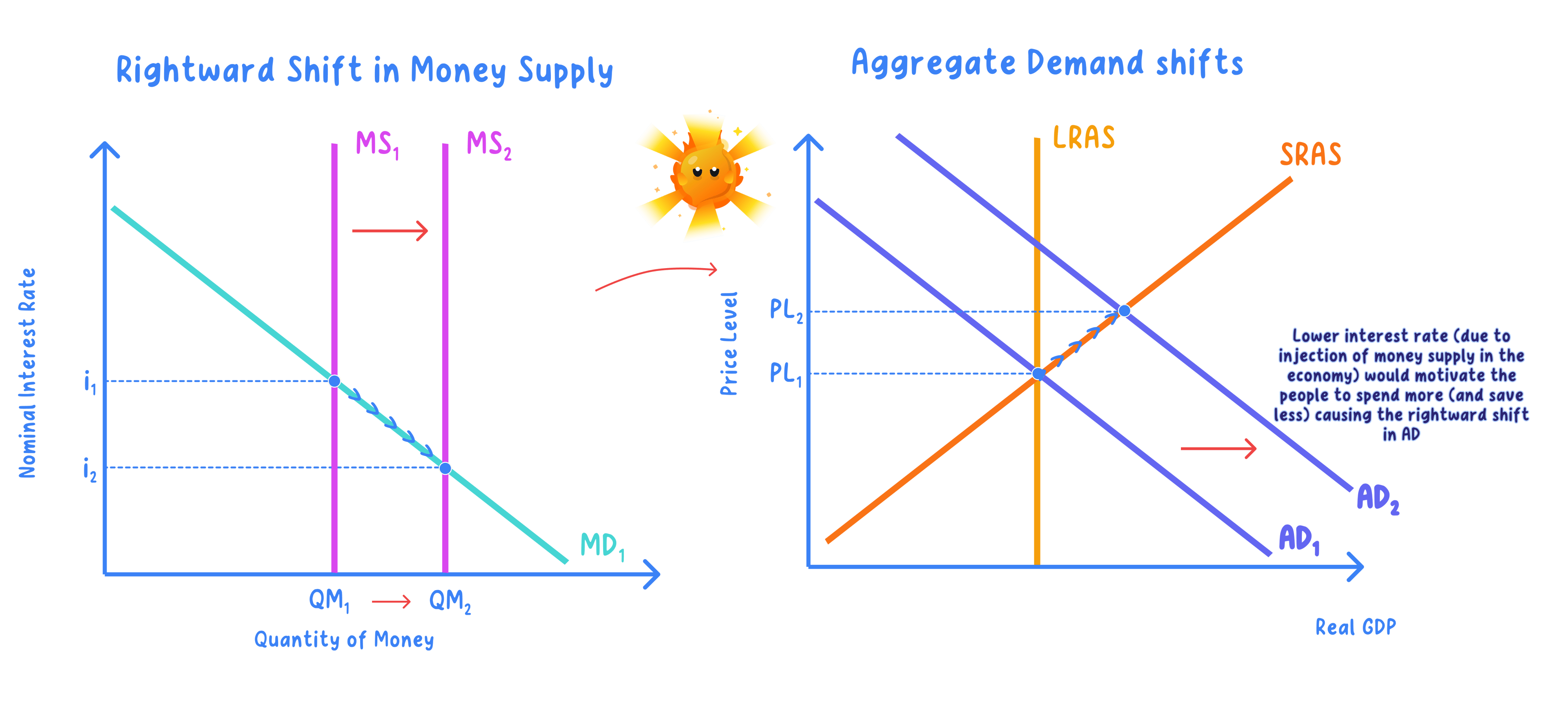
Monetary Policy Is Shown on an AD-AS Diagram as a Shift in Aggregate Demand
- Monetary policy can be shown on an AD-AS diagram, with the average price level and real output on the axes.
- A cut in bank rate or QE shifts aggregate demand to the right, raising real output and the price level.
- Tighter policy shifts aggregate demand to the left, lowering output and easing inflation.
- The transmission mechanism links the policy change to the shift.
Common Mistake
- Do not shift aggregate supply for a change in interest rates.
- Monetary policy works through aggregate demand.
Exam technique
- Trace the full chain from the rate change to consumption, investment and net trade, and include the exchange-rate channel.
- Do not treat bank rate as the only monetary tool; the Bank can also use QE and other direct measures.
- Remember the time lags before the full effect appears.
Self review
- What is the monetary policy transmission mechanism, and which channels does it work through?
- How does a change in bank rate affect the exchange rate?
- How does a change in the exchange rate affect net exports, aggregate demand and inflation?
- How can the Bank of England influence the growth of the money supply?
- Why is a depreciation not always beneficial?
