

What you'll learn
- Why the modern Periodic Table is ordered by protons, not by mass.
- How electron arrangements decide an element’s group, period and block.
- How trends explain Group 1, Group 2 and Group 7 reactions.
- How to identify ions and analyse salts using precipitation and mass measurements.
The modern Periodic Table: order from atomic structure
Atomic number
The atomic number is the number of protons in the nucleus of an atom. In the modern Periodic Table, elements are arranged in order of increasing atomic number.
A period is a horizontal row. A group is a vertical column. Elements in the same group usually have similar chemical properties because they have the same number of outer-shell electrons.
Historically, Mendeleev arranged elements mainly by relative atomic mass and chemical properties, leaving gaps for undiscovered elements. Later, Moseley’s work showed that atomic number is the better ordering principle. This is a good example of scientific models improving as new evidence appears.
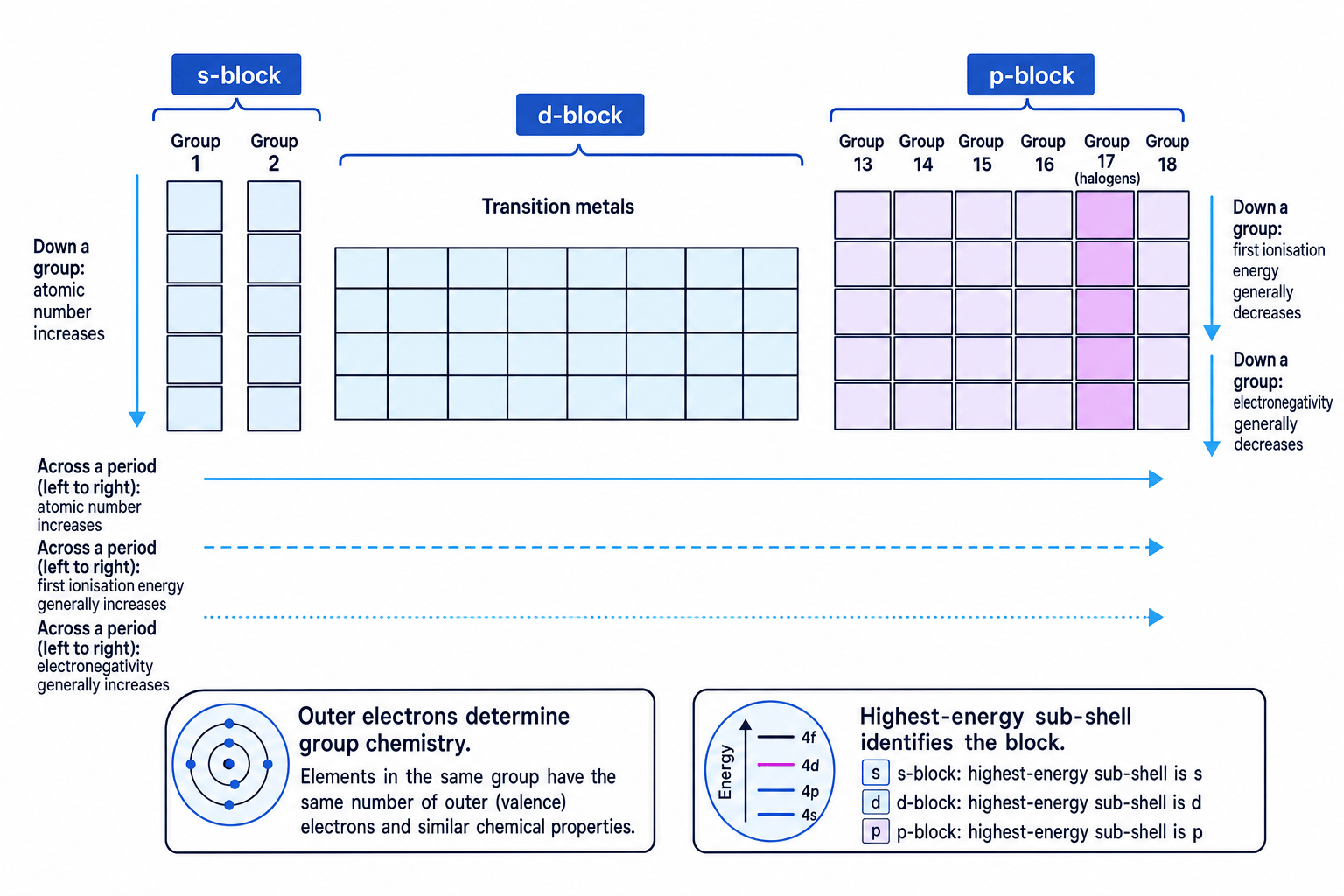
The diagram below links table position, blocks and the main periodic trends.
Electron structure and blocks
An electron shell is an energy level around the nucleus. A sub-shell is a region within a shell, labelled s, p or d at this level.
The block of an element tells you which type of sub-shell is being filled by its outer or highest-energy electrons:
- s-block: Groups 1 and 2, plus helium.
- p-block: Groups 13 to 18, including the halogens and noble gases.
- d-block: transition metals, where electrons are added to a d sub-shell.
For main-group elements, the period number usually tells you the highest occupied shell. The group is strongly linked to the number of outer-shell electrons.
Position comes from electron structure
The Periodic Table is not just a list: it is a map of electron arrangements. Similar outer-shell structures give similar chemistry.
Finding an element’s position from its electron configuration
Bromine has the electron configuration 1s2 2s2 2p6 3s2 3p6 3d10 4s2 4p5.
- The highest shell number present is 4, so bromine is in Period 4.
- The final electrons are in a p sub-shell, so bromine is in the p-block.
- The outer shell is 4s2 4p5, giving seven outer electrons, so bromine is in Group 7, also called Group 17, the halogens.
Confusing period and group
The period is linked to the highest occupied shell. The group is linked to outer-shell electrons, not the total number of electrons.
Redox: electron transfer across the table
Oxidation and reduction
Oxidation is loss of electrons. Reduction is gain of electrons. An oxidising agent accepts electrons and is reduced; a reducing agent donates electrons and is oxidised.
This electron-transfer language works for s-, p- and d-block chemistry.
Group 1 and Group 2 metals are in the s-block and tend to lose electrons:
Na → Na+ + e−
Mg → Mg2+ + 2e−
Halogens are p-block elements and tend to gain electrons:
Cl2 + 2e− → 2Cl−
Many d-block ions can change oxidation state. An oxidation state is a bookkeeping charge used to track electron transfer. For example, Fe2+ can be oxidised to Fe3+:
Fe2+ → Fe3+ + e−
Identifying redox in a halogen displacement
Chlorine reacts with bromide ions:
Cl2(aq) + 2Br−(aq) → 2Cl−(aq) + Br2(aq)
- Compare bromine before and after: Br− becomes Br2, so bromide ions have lost electrons and have been oxidised.
- Compare chlorine before and after: Cl2 becomes Cl−, so chlorine has gained electrons and has been reduced.
- Chlorine is therefore the oxidising agent, and bromide ions are the reducing agent.
General periodic trends
Ionisation energy and electronegativity
- First ionisation energy is the energy needed to remove one electron from each atom in one mole of gaseous atoms, forming one mole of gaseous 1+ ions.
- Electronegativity is the ability of an atom in a covalent bond to attract the bonding pair of electrons.
Across a period, nuclear charge increases while shielding changes only slightly. The outer electrons are attracted more strongly, so first ionisation energy and electronegativity generally increase.
Down a group, atoms have more shells. The outer electrons are further from the nucleus and more shielded, so first ionisation energy and electronegativity generally decrease.
Melting temperature is less simple:
- Across Period 3, melting temperature rises from sodium to silicon, then falls sharply for phosphorus, sulfur, chlorine and argon.
- Giant metallic and giant covalent structures have higher melting temperatures than simple molecular substances.
- Down Group 1, melting temperatures generally decrease.
- Down Group 7, melting and boiling temperatures increase, so volatility decreases.
Comparing first ionisation energies
Compare magnesium and calcium.
- Magnesium and calcium are both in Group 2, so each loses an outer s electron when forming a 1+ ion.
- Calcium is below magnesium, so calcium’s outer electron is in a higher shell and is more shielded from the nucleus.
- The attraction between calcium’s nucleus and its outer electron is weaker, so calcium has the lower first ionisation energy.
Assuming melting temperature has one simple trend
Ionisation energy and electronegativity have clear broad patterns. Melting temperature depends strongly on structure and bonding, so always think about whether the substance is metallic, giant covalent or simple molecular.
Group 2: reactions, tests and trends
Group 2 metals react with oxygen to form basic metal oxides:
2Mg(s) + O2(g) → 2MgO(s)
In water or steam, reactivity increases down the group. Magnesium reacts very slowly with cold water but reacts with steam:
Mg(s) + H2O(g) → MgO(s) + H2(g)
Calcium, strontium and barium react more readily with cold water to form hydroxides and hydrogen:
Ca(s) + 2H2O(l) → Ca(OH)2(aq/s) + H2(g)
The increasing reactivity down Group 2 is due to decreasing ionisation energy. The two outer electrons are lost more easily because they are further from the nucleus and more shielded.
Group 1 metals are generally more reactive than Group 2 metals in the same period because Group 1 atoms need to lose only one outer electron to form stable 1+ ions.
Basic oxides and hydroxides
Group 1 and Group 2 metal oxides and hydroxides are basic. Where they dissolve, they form alkaline solutions containing OH− ions. For example:
Na2O(s) + H2O(l) → 2NaOH(aq)
CaO(s) + H2O(l) → Ca(OH)2(aq/s)
They neutralise acids to form salts and water.
Thermal stability
Group 2 carbonates and hydroxides become more thermally stable down the group.
Carbonates decompose on heating:
MCO3(s) → MO(s) + CO2(g)
Hydroxides decompose on heating:
M(OH)2(s) → MO(s) + H2O(g)
Smaller Group 2 ions, such as Mg2+, have a higher charge density and polarise nearby ions more strongly. This makes compounds like MgCO3 less thermally stable than BaCO3.
Solubility and qualitative tests
Down Group 2:
- Hydroxides become more soluble.
- Sulfates become less soluble.
- Carbonates are generally insoluble.
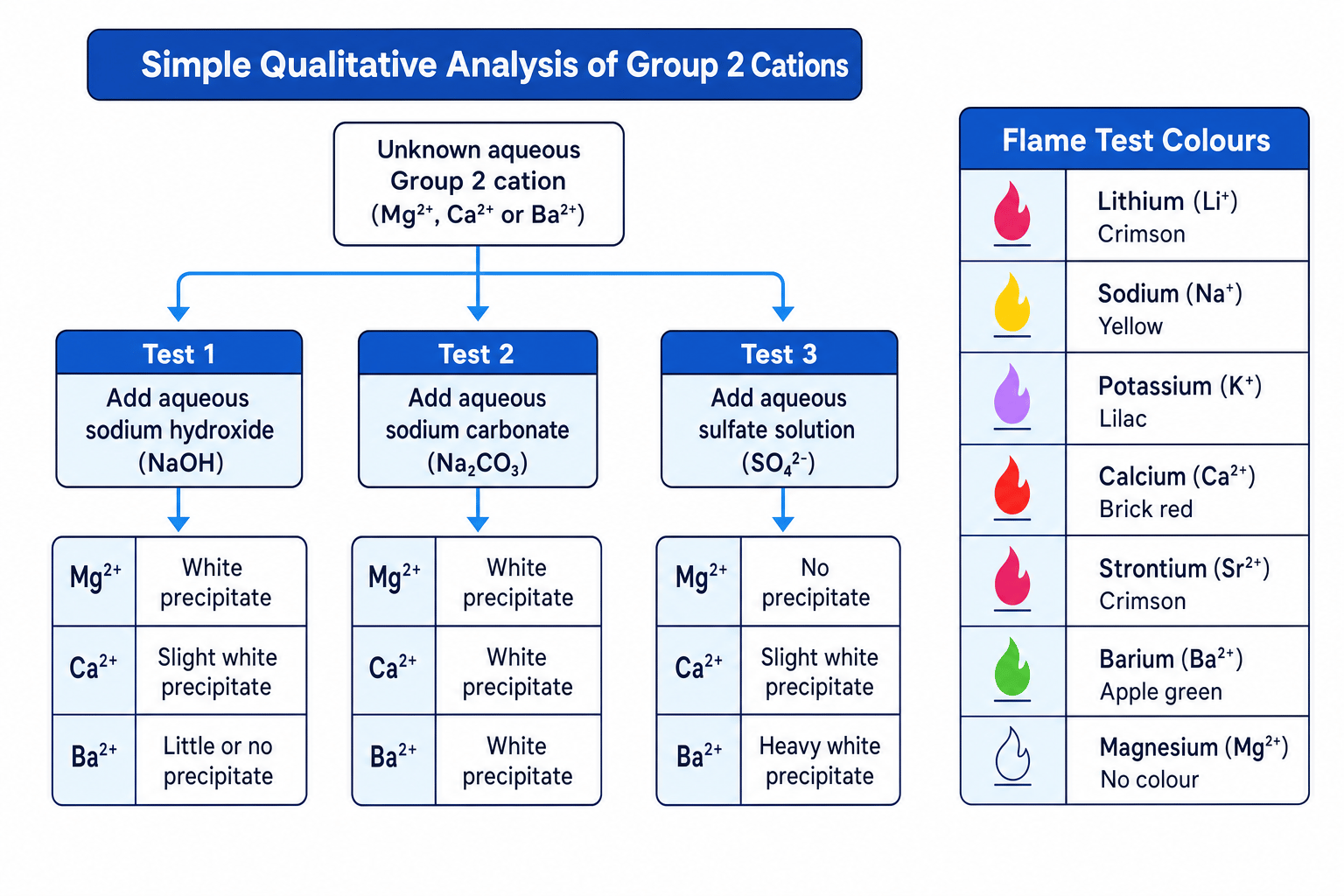
Aqueous Mg2+, Ca2+ and Ba2+ can be tested using OH−, CO32− and SO42− ions. The flame colours you need are: lithium crimson, sodium yellow, potassium lilac, calcium brick red, strontium crimson, barium apple green, and magnesium no colour.
Identifying a Group 2 cation
An unknown solution gives little or no precipitate with aqueous sodium hydroxide, a white precipitate with aqueous sodium carbonate, and a heavy white precipitate with sulfate ions.
- Little or no precipitate with OH− suggests the hydroxide is relatively soluble, so Mg2+ is unlikely.
- A heavy white precipitate with SO42− suggests an insoluble sulfate.
- Barium sulfate is very insoluble, so the unknown cation is Ba2+.
Group 7: halogens
Volatility
Volatility is how easily a substance vaporises. A more volatile substance has a lower boiling temperature and forms a gas more readily.
The halogens are Group 7 elements. Down the group, volatility decreases:
- Fluorine and chlorine are gases at room temperature.
- Bromine is a liquid.
- Iodine is a solid.
This happens because the molecules get larger, have more electrons, and experience stronger London forces between molecules. More energy is needed to separate the molecules.
Halogens with metals
Halogens react with metals to form ionic halides:
2Na(s) + Cl2(g) → 2NaCl(s)
Mg(s) + Br2(l) → MgBr2(s)
The metal is oxidised because it loses electrons. The halogen is reduced because it gains electrons to form halide ions.
Reactivity and oxidising power
Halogen reactivity decreases down the group. Fluorine is the strongest oxidising agent; iodine is much weaker.
A more reactive halogen displaces a less reactive halide ion from solution:
Cl2(aq) + 2I−(aq) → 2Cl−(aq) + I2(aq)
This is a redox reaction: iodide ions are oxidised to iodine, and chlorine is reduced to chloride ions.
Testing halide ions with silver ions
For halide tests, acidify with dilute nitric acid first to remove interfering carbonate ions, then add aqueous silver nitrate.
- Chloride ions give white AgCl, which dissolves in dilute aqueous ammonia.
- Bromide ions give cream AgBr, which does not dissolve in dilute ammonia.
- Iodide ions give yellow AgI, which does not dissolve in dilute ammonia.
Using ammonia after silver nitrate
With dilute aqueous ammonia, only the white chloride precipitate dissolves. Concentrated ammonia is a different confirmatory test and is not the same observation.
Chlorine and fluoride ions in water treatment
Chlorine is added to water to kill microorganisms. In water, chlorine forms chloric(I) acid, HClO, which is an effective disinfectant:
Cl2(aq) + H2O(l) ⇌ HCl(aq) + HClO(aq)
Benefits include reducing water-borne diseases such as cholera and typhoid. Risks include chlorine toxicity at high concentrations, unpleasant taste, and possible formation of chlorinated organic by-products.
Fluoride ions are added in some areas to reduce tooth decay. The ethical issue is balance: fluoridation can improve public health, especially for children and low-income communities, but some people object because it affects everyone’s water supply and requires careful dose monitoring to avoid fluorosis.
Making salts and gravimetric analysis
Soluble salts by crystallisation
To prepare a soluble salt from an acid and an insoluble base, oxide or carbonate:
- Warm the acid gently.
- Add the solid reagent in excess until no more reacts.
- Filter off the excess solid.
- Evaporate some water from the filtrate.
- Leave to cool so crystals form.
- Filter and dry the crystals.
If both reactants are soluble, such as an acid and an alkali, use titration to find the exact neutralising volumes before crystallisation.
Insoluble salts by precipitation
An insoluble salt can be made by mixing two soluble solutions that contain the required ions. For example:
BaCl2(aq) + Na2SO4(aq) → BaSO4(s) + 2NaCl(aq)
The precipitate is filtered, washed with distilled water, and dried.
Gravimetric analysis
Gravimetric analysis is a quantitative method where an ion is converted into an insoluble precipitate, which is filtered, dried and weighed to calculate the amount of the original substance.
For reliable results, the precipitating reagent must be in excess, the precipitate must be washed to remove soluble impurities, and it must be dried to constant mass.
Calculating concentration from a precipitate mass
A 25.0 cm3 sample of barium chloride solution is reacted with excess sodium carbonate. The dried barium carbonate precipitate has a mass of 0.985 g. Find the concentration of BaCl2(aq). Use MrM_rMr of BaCO3 = 197.3.
- Calculate the amount of BaCO3 formed using n=mMn = \frac{m}{M}n=Mm:
- Use the mole ratio. Ba2+ forms BaCO3 in a 1:1 ratio, so:
- Convert the volume into dm3 and calculate concentration using c=nVc = \frac{n}{V}c=Vn:
Gravimetry depends on good technique
Incomplete precipitation gives a mass that is too low. Incomplete drying gives a mass that is too high. Loss of solid during transfer or filtration gives a mass that is too low.
In the exam
- For trends, explain using nuclear charge, shielding and distance from the nucleus; do not just say “it is lower down the group”.
- For redox, write or imagine the electron transfer, then identify which species is oxidised, reduced, the oxidising agent and the reducing agent.
- For practical analysis, combine observations: precipitate colour, solubility in ammonia, flame colour, mass of dry precipitate, and correct mole ratios.
Check yourself
- Why does barium react more readily with water than magnesium?
- What would you observe when aqueous silver nitrate is added to iodide ions, followed by dilute ammonia?
- In gravimetric analysis, why must the precipitate be washed and dried before weighing?
