Alcohols
This question is about alcohols and related organic compounds.
An unsaturated alcohol has 5 carbon atoms and contains one C=C\text{C}=\text{C}C=C bond.
Construct a balanced equation for the complete combustion of this alcohol.
Compound E, shown below, is refluxed with excess acidified potassium dichromate(VI) to form a single organic product and one other product.
Complete the equation for this reaction by writing the structural formula or drawing the skeletal/displayed formula of the organic product, and balancing the equation.
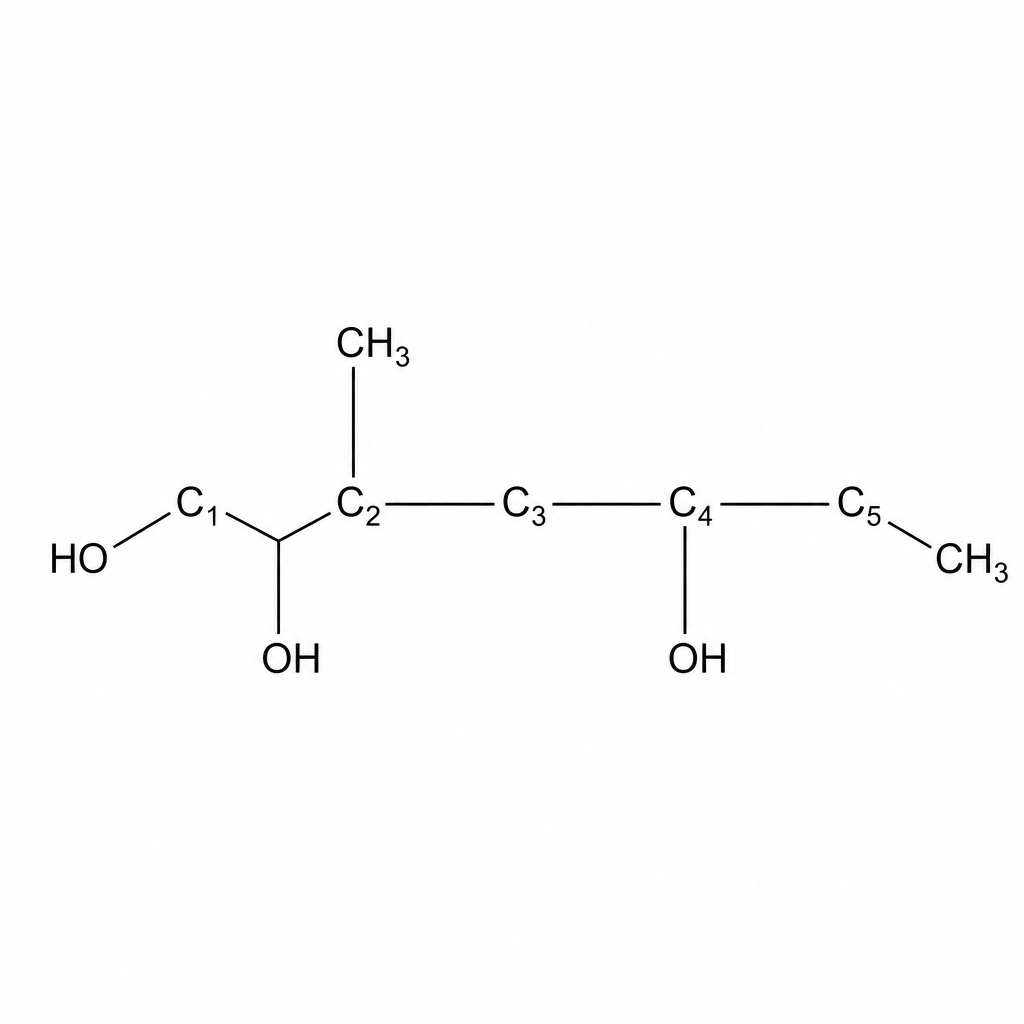
Compound E+……[O]⟶…⋯+……H2O\text{Compound E} + \dots\dots [\text{O}] \longrightarrow \dots\dots + \dots\dots \text{H}_2\text{O}Compound E+……[O]⟶…⋯+……H2O
Compound F, shown below, is refluxed with H2SO4\text{H}_2\text{SO}_4H2SO4, as an acid catalyst, to form a mixture of three isomers with the molecular formula C6H8\text{C}_6\text{H}_8C6H8.
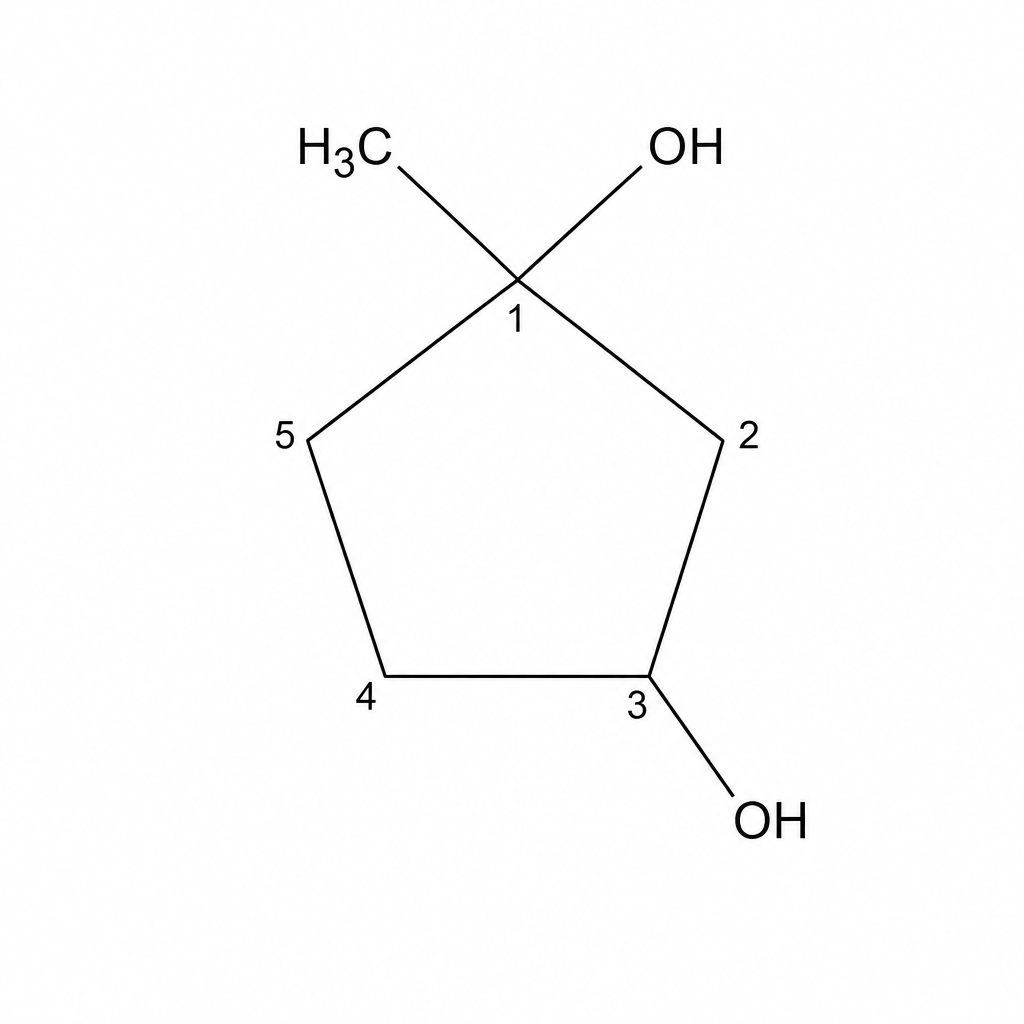
Draw or describe the structures of the three isomers of C6H8\text{C}_6\text{H}_8C6H8 formed from the double dehydration of compound F.
A student converts compound F into a diiodoalkane. Suggest suitable reagents for this reaction.
There are 3 structural isomers of C4H10O\text{C}_4\text{H}_{10}\text{O}C4H10O that are ethers.
A student predicts that these structural isomers could be distinguished using carbon-13 NMR spectroscopy.
Explain whether the student is correct.
In your answer, show how the peaks in the carbon-13 NMR spectra are linked to the structure of each ether isomer.