This question is about haloalkanes, their preparation, and their reactions in synthetic pathways.
Haloalkanes can be synthesised by reacting alkanes with halogens in the presence of ultraviolet radiation. An alkane reacts with bromine to form 2-bromopropane.
Write the equation for this reaction, using structural or condensed formulas for the organic compounds. State the name of the reaction mechanism and the type of bond fission that occurs during the initiation step.
Describe two limitations of utilizing this reaction to synthesise a pure sample of 2-bromopropane.
Haloalkanes are useful intermediates in organic synthesis. Identify the reagents (1 to 5) and the structural formulas of the organic products (A to E) in the following chemical transformations starting with 1-bromobutane, CH3CH2CH2CH2Br\text{CH}_3\text{CH}_2\text{CH}_2\text{CH}_2\text{Br}CH3CH2CH2CH2Br:
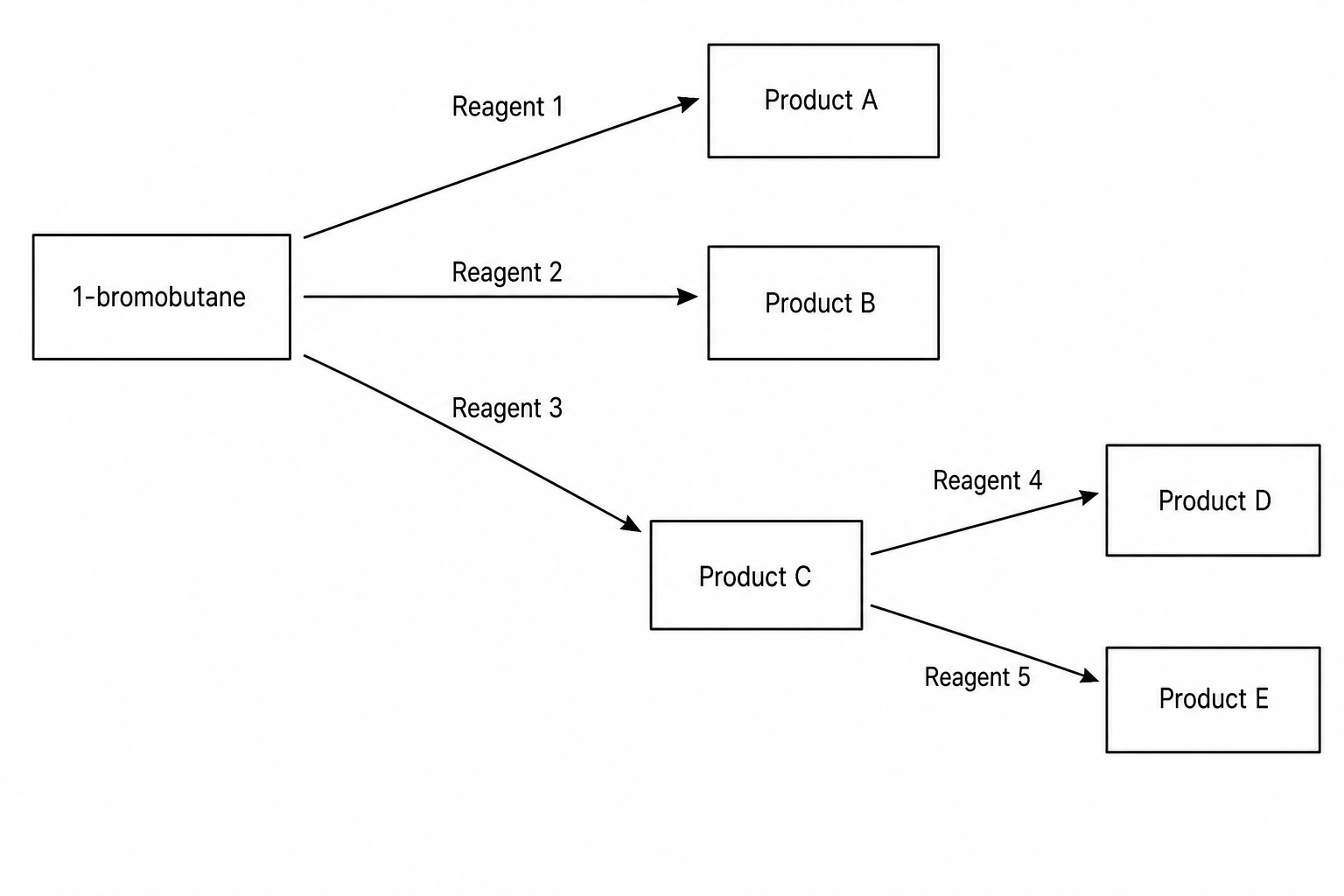
- 1-bromobutane reacts with reagent 1 to form an amine, product A.
1-bromobutane reacts with reagent 2 to form an alcohol, product B.
1-bromobutane reacts with reagent 3 to form a nitrile, product C.
Product C reacts with reagent 4 to form a carboxylic acid, product D.
Product C reacts with reagent 5 to form an amine, product E.