What you'll learn
- How to write formulae for common compounds and ionic compounds.
- How to assign oxidation numbers in compounds and ions.
- How to balance chemical equations using conservation of atoms.
- How to write equations with state symbols and simplify them into ionic equations.
Why formulae and equations matter
Chemistry has its own language. A formula tells you what particles are present, and an equation tells you what changes during a reaction.
A chemical equation is not just a sentence in symbols: it must obey conservation of mass, meaning atoms are not created or destroyed during a chemical reaction. You rearrange atoms into new combinations.
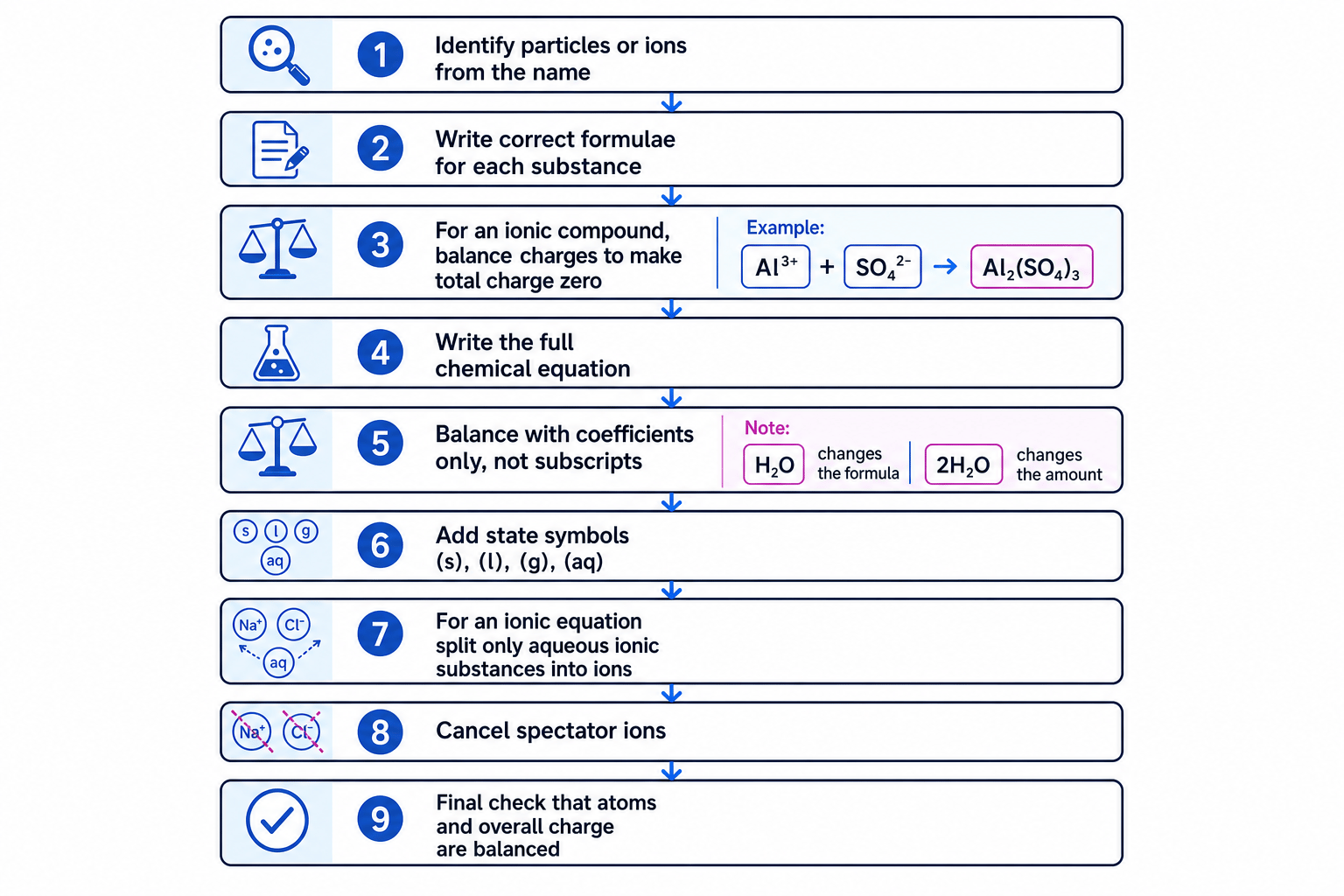
Here is the overall workflow for this topic.
Chemical formulae: the basics
A chemical formula shows the elements present in a substance and the ratio of their atoms or ions.
For example, H2O\text{H}_2\text{O}H2O means each water molecule contains two hydrogen atoms and one oxygen atom. MgCl2\text{MgCl}_2MgCl2 means magnesium chloride contains magnesium ions and chloride ions in a 1:2 ratio.
A subscript is the small number written low and to the right of a symbol, such as the 2 in CO2\text{CO}_2CO2. It belongs to the formula and must not be changed when balancing equations.
Ion
An ion is a particle with an electrical charge. A cation is a positive ion, such as Na+\text{Na}^+Na+. An anion is a negative ion, such as Cl−\text{Cl}^-Cl−.
Common ions you need to recognise
You are not expected to work everything out from scratch every time. Some ions are part of the basic language of chemistry.
Common positive ions
- Group 1 metal ions: Li+\text{Li}^+Li+, Na+\text{Na}^+Na+, K+\text{K}^+K+
- Hydrogen ion: H+\text{H}^+H+
- Ammonium ion: NH4+\text{NH}_4^+NH4+
- Group 2 metal ions: Mg2+\text{Mg}^{2+}Mg2+, Ca2+\text{Ca}^{2+}Ca2+, Ba2+\text{Ba}^{2+}Ba2+
- Zinc ion: Zn2+\text{Zn}^{2+}Zn2+
- Copper(II) ion: Cu2+\text{Cu}^{2+}Cu2+
- Iron(II) ion: Fe2+\text{Fe}^{2+}Fe2+
- Iron(III) ion: Fe3+\text{Fe}^{3+}Fe3+
- Aluminium ion: Al3+\text{Al}^{3+}Al3+
Common negative ions
- Halide ions: F−\text{F}^-F−, Cl−\text{Cl}^-Cl−, Br−\text{Br}^-Br−, I−\text{I}^-I−
- Hydroxide ion: OH−\text{OH}^-OH−
- Nitrate ion: NO3−\text{NO}_3^-NO3−
- Oxide ion: O2−\text{O}^{2-}O2−
- Sulfide ion: S2−\text{S}^{2-}S2−
- Sulfate ion: SO42−\text{SO}_4^{2-}SO42−
- Carbonate ion: CO32−\text{CO}_3^{2-}CO32−
- Dichromate(VI) ion: Cr2O72−\text{Cr}_2\text{O}_7^{2-}Cr2O72−
- Phosphate ion: PO43−\text{PO}_4^{3-}PO43−
Common compound formulae
Some covalent compounds and acids are best learned directly:
- Water: H2O\text{H}_2\text{O}H2O
- Ammonia: NH3\text{NH}_3NH3
- Methane: CH4\text{CH}_4CH4
- Carbon dioxide: CO2\text{CO}_2CO2
- Sulfuric acid: H2SO4\text{H}_2\text{SO}_4H2SO4
- Nitric acid: HNO3\text{HNO}_3HNO3
- Hydrochloric acid: HCl\text{HCl}HCl
- Sodium hydroxide: NaOH\text{NaOH}NaOH
- Calcium carbonate: CaCO3\text{CaCO}_3CaCO3
Charge balancing is for ionic formulae
The “make the total charge zero” method works for ionic compounds. It is not how you find formulae such as H2O\text{H}_2\text{O}H2O, NH3\text{NH}_3NH3 or CH4\text{CH}_4CH4, which are covalent molecules.
Writing formulae for ionic compounds
An ionic compound contains positive and negative ions. Overall, the compound must be electrically neutral, so the total positive charge must equal the total negative charge.
Ionic formula rule
Choose the smallest whole-number ratio of ions that gives zero overall charge.
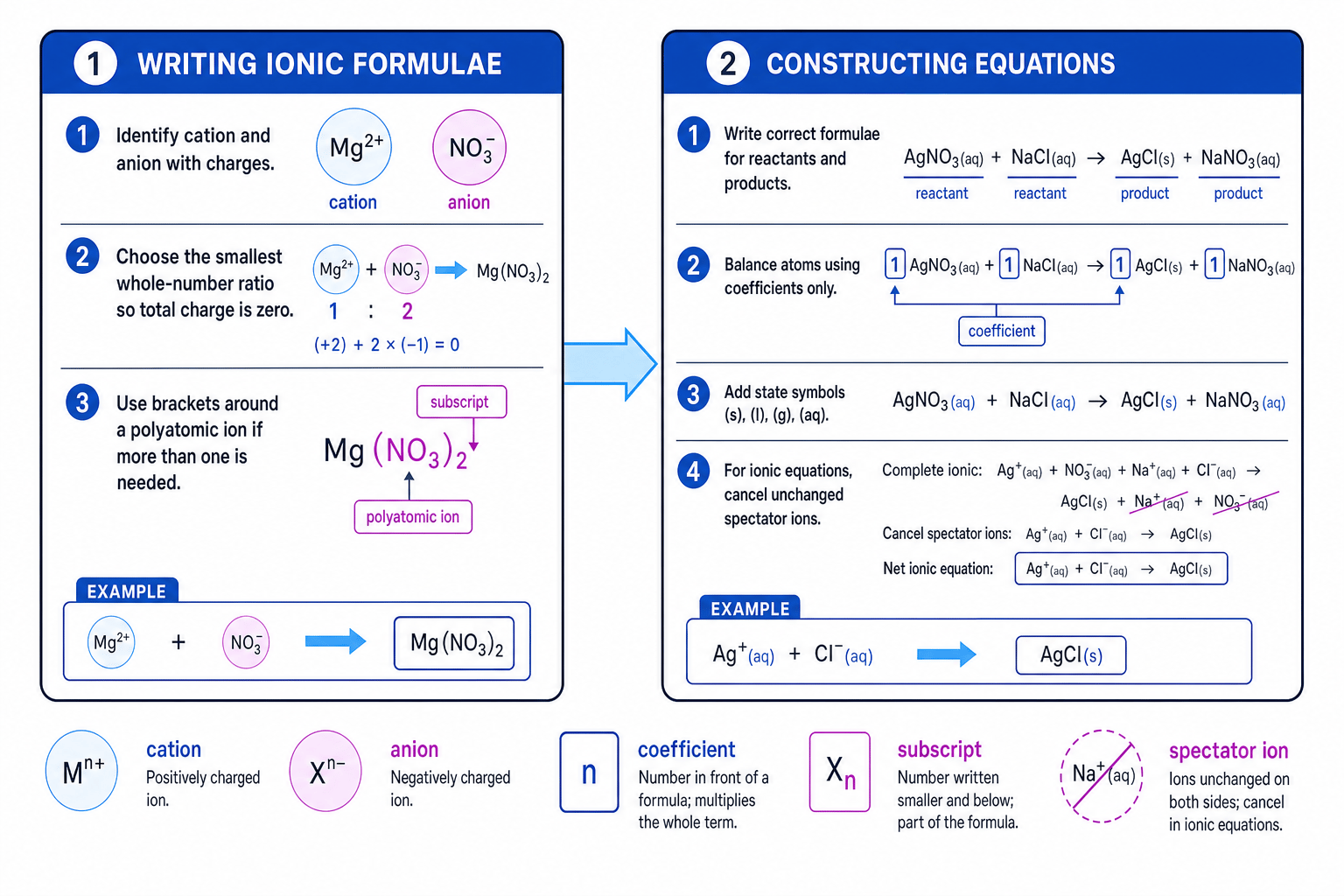
If an ion contains more than one atom, such as nitrate, NO3−\text{NO}_3^-NO3−, or sulfate, SO42−\text{SO}_4^{2-}SO42−, it is called a polyatomic ion. Keep it together as a unit. Use brackets if you need more than one of it.
Writing aluminium sulfate
-
Identify the ions. Aluminium forms Al3+\text{Al}^{3+}Al3+ and sulfate is SO42−\text{SO}_4^{2-}SO42−.
-
Find the smallest charges that cancel. The lowest common multiple of 3 and 2 is 6, so you need two aluminium ions for a total charge of +6+6+6 and three sulfate ions for a total charge of −6-6−6.
-
Write the formula using brackets around sulfate because more than one sulfate ion is needed: Al2(SO4)3\text{Al}_2(\text{SO}_4)_3Al2(SO4)3.
Changing the ion instead of using brackets
Do not write something like Al2S3O12\text{Al}_2\text{S}_3\text{O}_{12}Al2S3O12 for aluminium sulfate. The sulfate ion stays as SO42−\text{SO}_4^{2-}SO42−, so the correct formula is Al2(SO4)3\text{Al}_2(\text{SO}_4)_3Al2(SO4)3.
Oxidation numbers
An oxidation number is a bookkeeping number assigned to an atom in a compound or ion. It helps you track electron transfer, especially in redox chemistry later on.
It is not always the real charge on the atom. For example, atoms in covalent compounds do not usually form actual ions, but we can still assign oxidation numbers.
Core oxidation number rules
- An uncombined element has oxidation number zero. For example, Mg\text{Mg}Mg, O2\text{O}_2O2 and Cl2\text{Cl}_2Cl2 all contain atoms with oxidation number zero.
- A monatomic ion has oxidation number equal to its charge. For example, Na+\text{Na}^+Na+ is +1 and O2−\text{O}^{2-}O2− is -2.
- The sum of oxidation numbers in a neutral compound is zero.
- The sum of oxidation numbers in a polyatomic ion equals the charge on the ion.
- Group 1 metals are usually +1; Group 2 metals are usually +2.
- Oxygen is usually -2.
- Hydrogen is usually +1 when bonded to non-metals.
Useful exceptions
Oxygen is not always -2: in peroxides, such as H2O2\text{H}_2\text{O}_2H2O2, oxygen is -1. Hydrogen is -1 in metal hydrides, such as NaH\text{NaH}NaH.
Finding the oxidation number of manganese in manganate(VII)
-
Write the ion and assign the known oxidation number. In MnO4−\text{MnO}_4^-MnO4−, each oxygen is usually -2, so four oxygens contribute 4×(−2)=−84 \times (-2) = -84×(−2)=−8.
-
Let the oxidation number of manganese be xxx. The total must equal the ion charge, so x+(−8)=−1x + (-8) = -1x+(−8)=−1.
-
Solve the equation: x=+7x = +7x=+7. Manganese has oxidation number +7 in MnO4−\text{MnO}_4^-MnO4−.
Roman numerals in names
A Roman numeral in a compound name tells you the oxidation number of that element. For example, iron(III) oxide contains iron with oxidation number +3.
Constructing balanced chemical equations
A chemical equation shows reactants changing into products. Reactants are the substances you start with, written on the left. Products are the substances formed, written on the right.
A coefficient is the number placed in front of a formula. It multiplies the whole formula. For example, in 2H2O2\text{H}_2\text{O}2H2O, the coefficient 2 means two water molecules.
Balance equations with coefficients, not subscripts
You may change coefficients when balancing an equation. You must not change subscripts inside correct formulae, because that changes the substance.
A reliable balancing method
- Write the correct formulae for all reactants and products.
- Count atoms of each element on both sides.
- Add coefficients to make each atom count equal.
- Check again, including atoms inside brackets.
- Add state symbols if required.
Balancing aluminium reacting with oxygen
-
Write the correct formulae first: aluminium is Al\text{Al}Al, oxygen is diatomic O2\text{O}_2O2, and aluminium oxide is Al2O3\text{Al}_2\text{O}_3Al2O3.
-
Balance oxygen using the lowest common multiple of 2 and 3. Put 3 in front of O2\text{O}_2O2 and 2 in front of Al2O3\text{Al}_2\text{O}_3Al2O3, giving 6 oxygen atoms on each side.
-
Balance aluminium. Two formula units of Al2O3\text{Al}_2\text{O}_3Al2O3 contain four aluminium atoms, so put 4 in front of Al\text{Al}Al.
-
Add state symbols:
State symbols
A state symbol tells you the physical state of a substance in an equation.
- (s)(s)(s) means solid.
- (l)(l)(l) means liquid.
- (g)(g)(g) means gas.
- (aq)(aq)(aq) means aqueous, dissolved in water.
For example, sodium chloride solution is NaCl(aq)\text{NaCl}(aq)NaCl(aq), but solid sodium chloride is NaCl(s)\text{NaCl}(s)NaCl(s).
Confusing aqueous and liquid
(aq)(aq)(aq) means dissolved in water. It does not mean “wet” or “liquid”. Pure water is H2O(l)\text{H}_2\text{O}(l)H2O(l), not H2O(aq)\text{H}_2\text{O}(aq)H2O(aq).
Ionic equations
An ionic equation shows only the particles that actually change during a reaction. Ions that appear unchanged on both sides are called spectator ions.
This is especially useful for precipitation reactions, acid-base reactions and displacement reactions.
How to write an ionic equation
- Write the full balanced equation with state symbols.
- Split aqueous ionic substances into their ions.
- Do not split solids, liquids, gases or covalent molecules.
- Cancel spectator ions that are unchanged on both sides.
- Check that atoms and overall charge are balanced.
Writing a net ionic equation for silver chloride precipitation
- Write the full equation. Silver nitrate and sodium chloride are aqueous; silver chloride is an insoluble precipitate:
- Split the aqueous ionic substances into ions, but keep the solid precipitate together:
-
Cancel the spectator ions, Na+\text{Na}^+Na+ and NO3−\text{NO}_3^-NO3−, because they are unchanged on both sides.
-
Write the net ionic equation and check charge and atoms:
Charge is part of balancing
In ionic equations, both atoms and total charge must balance. If the atoms balance but the charge does not, the ionic equation is wrong.
Linking the ideas together
Formulae, oxidation numbers and equations are closely connected.
- Formulae use ratios of atoms or ions.
- Ionic formulae use charge balance.
- Balanced equations use atom conservation.
- Ionic equations remove spectators to show the real chemical change.
- Oxidation numbers help describe electron transfer in later redox reactions.
The main skill is being disciplined: first get the formulae correct, then balance the equation, then add state symbols, then simplify to an ionic equation if needed.
In the exam
- Write correct formulae before you try to balance; never fix a balancing problem by changing subscripts.
- For ionic formulae, make the total charge zero using the smallest whole-number ratio.
- In ionic equations, split only aqueous ionic substances and cancel only ions that are identical on both sides.
- Always check both atom balance and charge balance before moving on.
Check yourself
- What is the formula of calcium nitrate, and why are brackets needed?
- What is the oxidation number of sulfur in SO42−\text{SO}_4^{2-}SO42−?
- Write the net ionic equation for the reaction between BaCl2(aq)\text{BaCl}_2(aq)BaCl2(aq) and Na2SO4(aq)\text{Na}_2\text{SO}_4(aq)Na2SO4(aq) forming BaSO4(s)\text{BaSO}_4(s)BaSO4(s).