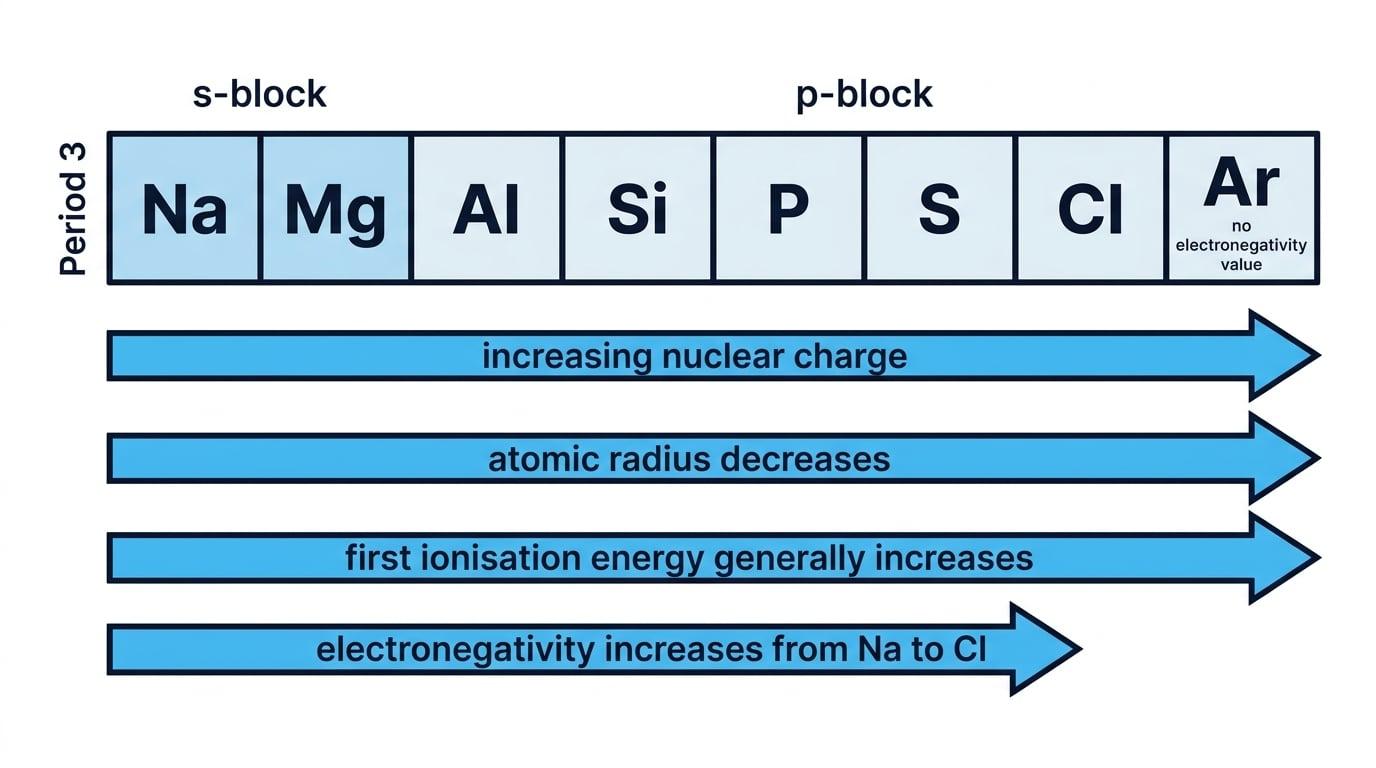
What you'll learn
- How electron configuration links to periods, groups and blocks.
- Why atomic radius, first ionisation energy and electronegativity change across a period.
- How to explain the key exceptions in first ionisation energy trends.
- Why melting points across Period 3 depend on structure and bonding.
The big idea: patterns in the periodic table
The periodic table is arranged in order of increasing atomic number, meaning the number of protons in the nucleus. As atomic number increases, electron configurations change in a regular way. This creates repeating patterns in properties.
Periodicity
Periodicity is the repeating pattern in the physical and chemical properties of elements when they are arranged in order of increasing atomic number.
The key reason periodicity exists is that elements in the same group have the same number of outer-shell electrons, also called valence electrons. These electrons are most involved in chemical reactions.
Electron configuration and position in the periodic table
An electron shell is an energy level around the nucleus. Each shell contains sub-shells, such as s, p and d. An orbital is a region that can hold up to two electrons.
For main-group elements:
- The period tells you the highest occupied electron shell.
- The group tells you the number of outer-shell electrons.
- The block tells you which type of sub-shell is being filled: s-block, p-block or d-block.
For example, sodium has the electron configuration 1s² 2s² 2p⁶ 3s¹. Its outer electron is in the third shell, so it is in Period 3. It has one outer electron, so it is in Group 1. Its outer electron is in an s sub-shell, so it is in the s-block.
Using electron configuration to locate an element
An element has the electron configuration 1s² 2s² 2p⁶ 3s² 3p⁵. Identify its period, group and block.
-
The highest occupied shell is the third shell, because the configuration ends in 3s² 3p⁵. So the element is in Period 3.
-
The outer-shell electrons are 3s² 3p⁵, giving seven outer electrons in total. So, in A-Level group notation, the element is in Group 7.
-
The final electron is in a p sub-shell, so the element is in the p-block. With 17 electrons in total, the element is chlorine.
The forces behind periodic trends
To explain trends properly, you need three key ideas.
Nuclear charge, shielding and atomic radius
Nuclear charge is the positive charge of the nucleus, caused by protons. Shielding is the reduction in attraction between the nucleus and outer electrons because inner-shell electrons repel them. Atomic radius is a measure of the size of an atom, often taken as half the distance between nuclei in a bonded pair of atoms.
Across a period, the number of protons increases. Electrons are added to the same main shell, so shielding does not increase very much. This means the outer electrons feel a stronger attraction to the nucleus.
Across a period
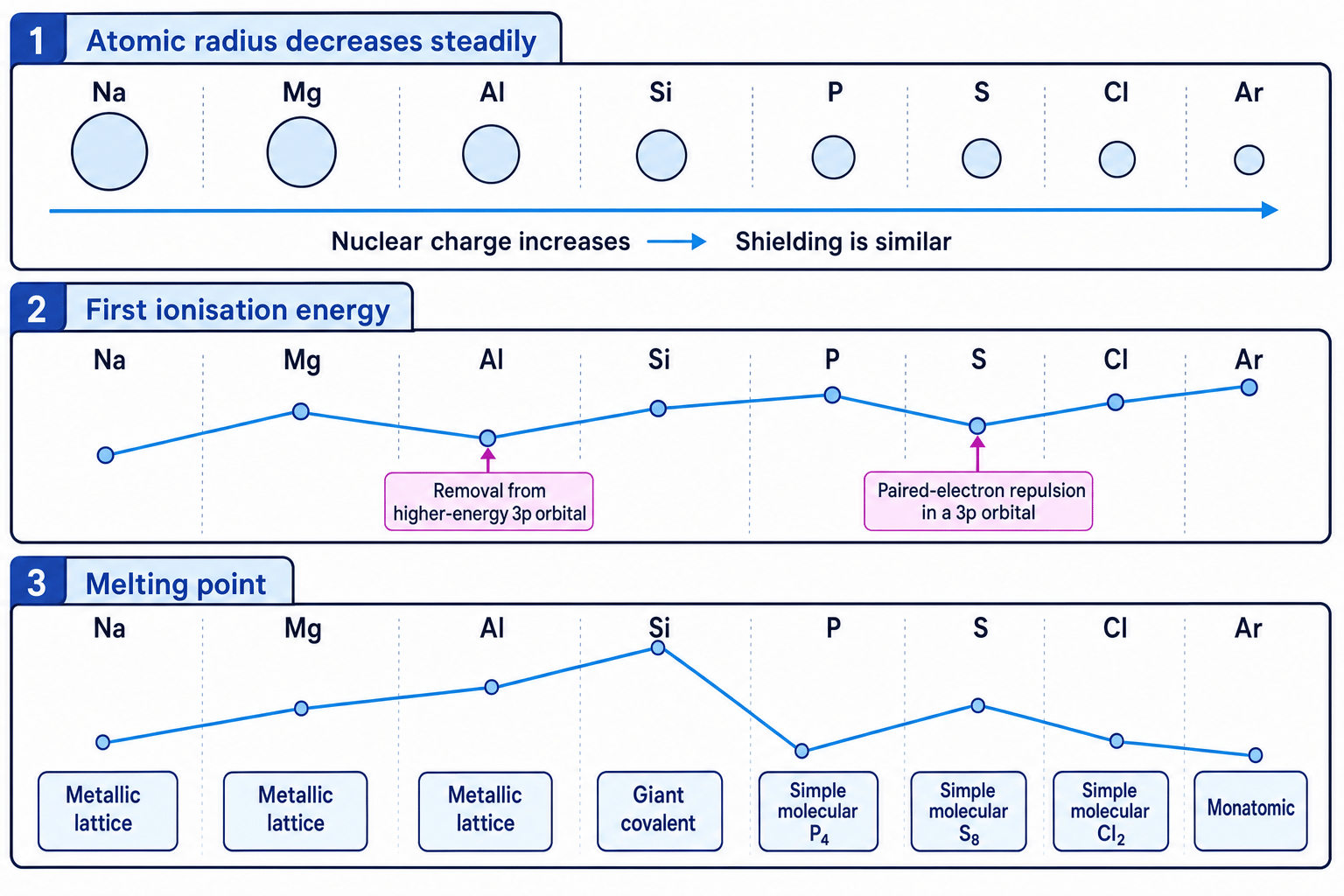
Across a period, atomic radius generally decreases because nuclear charge increases while shielding stays similar.
The diagram below summarises the main Period 3 trends you need to explain.
Explaining the decrease in atomic radius across Period 3
Explain why atomic radius decreases from sodium to chlorine.
-
Sodium has 11 protons, while chlorine has 17 protons, so nuclear charge increases across the period.
-
The extra electrons are added to the same main shell, the third shell, so shielding remains broadly similar.
-
The stronger attraction between the nucleus and the outer electrons pulls the outer shell closer to the nucleus, so atomic radius decreases.
First ionisation energy
First ionisation energy
The first ionisation energy is the energy required to remove one electron from each atom in one mole of gaseous atoms to form one mole of gaseous 1+ ions.
For sodium:
Na(g) → Na⁺(g) + e⁻
Ionisation energies are measured in kJ mol⁻¹.
First ionisation energy is higher when the outer electron is held more strongly by the nucleus. It depends mainly on:
- Nuclear charge: more protons usually means stronger attraction.
- Atomic radius: a smaller radius means the outer electron is closer to the nucleus.
- Shielding: more inner shells reduce the attraction between the nucleus and the outer electron.
- Sub-shell and electron pairing: some electrons are easier to remove because of their orbital arrangement.
Across Period 3, first ionisation energy generally increases, but there are two important dips: aluminium and sulfur.
The aluminium dip
Magnesium has the configuration [Ne] 3s². Aluminium has the configuration [Ne] 3s² 3p¹.
The first electron removed from aluminium is in a 3p orbital. This is slightly higher in energy and less strongly attracted than a 3s electron, so it is easier to remove. Therefore, aluminium has a lower first ionisation energy than magnesium.
The sulfur dip
Phosphorus has the configuration [Ne] 3s² 3p³. Sulfur has the configuration [Ne] 3s² 3p⁴.
In phosphorus, the three 3p electrons occupy separate orbitals. In sulfur, one 3p orbital contains a pair of electrons. The repulsion between paired electrons makes one of them easier to remove.
Explaining why sulfur has a lower first ionisation energy than phosphorus
-
Compare the outer electron configurations: phosphorus is [Ne] 3s² 3p³, while sulfur is [Ne] 3s² 3p⁴.
-
In phosphorus, the three 3p electrons are unpaired in separate orbitals. In sulfur, two electrons are paired in one 3p orbital.
-
The paired electrons in sulfur repel each other, so less energy is needed to remove one of them. This outweighs the increase in nuclear charge, so sulfur has a lower first ionisation energy than phosphorus.
Forgetting the state symbols
For first ionisation energy equations, always use gaseous atoms and gaseous ions. For example, write Na(g) → Na⁺(g) + e⁻, not Na(s) → Na⁺(g) + e⁻.
Successive ionisation energies
Successive ionisation energies remove electrons one at a time from the same atom or ion. The second ionisation energy removes an electron from a 1+ ion, the third from a 2+ ion, and so on.
A large jump in successive ionisation energies shows that an electron is being removed from a shell closer to the nucleus. This can be used to identify the group of an element.
Identifying a group from successive ionisation energies
The first six ionisation energies of an element are 738, 1451, 7733, 10540, 13630 and 17995 kJ mol⁻¹. Identify the group.
-
Compare the jumps between values. The biggest jump is between the second and third ionisation energies: from 1451 to 7733 kJ mol⁻¹.
-
This means the first two electrons are removed relatively easily from the outer shell, but the third electron is removed from an inner shell.
-
The atom therefore has two outer-shell electrons, so the element is in Group 2.
Electronegativity
Electronegativity
Electronegativity is the ability of an atom to attract the shared pair of electrons in a covalent bond.
Across a period, electronegativity generally increases. This is because atomic radius decreases and nuclear charge increases, so the nucleus attracts bonding electrons more strongly.
Down a group, electronegativity generally decreases. Even though nuclear charge increases, there are more electron shells, so shielding and distance from the nucleus increase. The shared pair of electrons is attracted less strongly.
Trend explanation shortcut
For many periodicity questions, use this structure: nuclear charge and shielding → attraction to outer or bonding electrons → effect on the property.
Melting points across Period 3
Melting point trends cannot be explained just by nuclear charge. You must identify the type of structure and the forces or bonds being overcome.
From sodium to aluminium, the elements have metallic structures. Metallic bonding becomes stronger because there are more delocalised electrons and smaller, more highly charged positive ions. So melting point increases.
Silicon has a giant covalent structure. Many strong covalent bonds must be broken to melt it, so silicon has a very high melting point.
Phosphorus, sulfur and chlorine are simple molecular substances. Melting only overcomes weak intermolecular forces, not the covalent bonds inside the molecules. Argon is monatomic, so only very weak forces between atoms are overcome.
Sulfur has a higher melting point than phosphorus because S₈ molecules have more electrons than P₄ molecules. This gives stronger London forces between sulfur molecules.
Explaining why silicon has a higher melting point than phosphorus
-
Identify the structures: silicon has a giant covalent structure, while phosphorus exists as simple P₄ molecules.
-
Melting silicon requires many strong covalent bonds to be broken throughout the giant structure.
-
Melting phosphorus only overcomes weak intermolecular forces between P₄ molecules. Therefore, silicon has a much higher melting point.
Breaking the wrong bonds
When simple molecular substances melt, the covalent bonds inside the molecules are not broken. Only intermolecular forces between molecules are overcome.
In the exam
-
State the trend first, then explain it using nuclear charge, shielding, distance from the nucleus, or structure and bonding as appropriate.
-
For first ionisation energy, use gaseous state symbols and be ready to explain the aluminium and sulfur dips.
-
For melting point questions, identify the structure before explaining what bonds or forces are overcome.
-
Avoid vague phrases like “it is more reactive” unless you link them clearly to electron loss, electron gain or attraction to bonding electrons.
Check yourself
- Why does atomic radius decrease across Period 3 from sodium to chlorine?
- Why is the first ionisation energy of aluminium lower than that of magnesium?
- Why does silicon have a much higher melting point than phosphorus?