

What you'll learn
- How ionic, covalent and metallic bonding are all based on electrostatic attraction.
- How to draw and interpret dot-and-cross diagrams, including dative covalent bonds.
- How electron-pair repulsion predicts molecular shapes and bond angles.
- How electronegativity leads to polar bonds and polar molecules.
The big idea: bonding is attraction
Atoms bond because bonded particles are usually at a lower energy than separate particles. At A-Level, you should explain bonding in terms of attractions involving charged particles: positive nuclei or ions, and negative electrons.
Chemical bond
A chemical bond is a strong electrostatic attraction that holds atoms or ions together.
The outer-shell electrons of an atom are called valence electrons. These are the electrons involved in bonding. Many main-group atoms form bonds so that their outer shell becomes like a noble gas arrangement: this is often called the octet rule.
The octet rule is a guide
Hydrogen only needs two electrons in its outer shell. Some molecules, such as BF₃ and BeCl₂, have electron-deficient central atoms, and some Period 3 elements can have expanded outer shells.
The three main bonding models
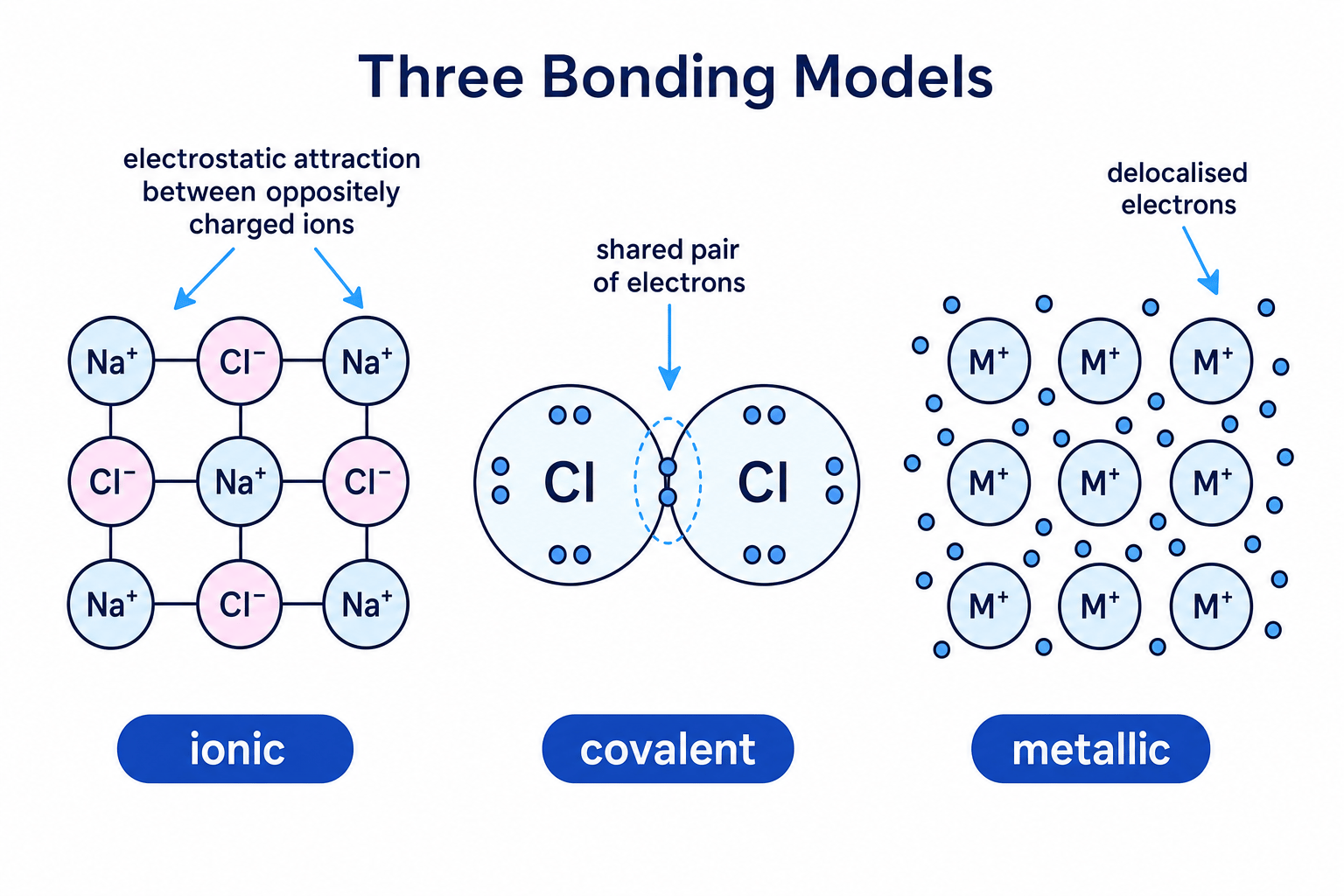
The three bonding types you need to recognise are ionic, covalent and metallic. They differ in what is attracting what.
One sentence for each bond type
Ionic bonding is attraction between oppositely charged ions; covalent bonding is attraction between a shared pair of electrons and two nuclei; metallic bonding is attraction between positive metal ions and delocalised electrons.
Ionic bonding
Ionic bond
An ionic bond is the electrostatic attraction between oppositely charged ions.
Ionic bonding usually happens between a metal and a non-metal. The metal atom loses electrons to form a cation: a positive ion. The non-metal atom gains electrons to form an anion: a negative ion.
For example, sodium chloride contains Na⁺ and Cl⁻ ions. In the solid, these ions form a giant ionic lattice: a regular three-dimensional arrangement of alternating positive and negative ions.
Working out the formula of magnesium chloride
-
Magnesium is in Group 2, so a magnesium atom loses two outer-shell electrons to form Mg²⁺.
-
Chlorine is in Group 7, so each chlorine atom gains one electron to form Cl⁻.
-
One Mg²⁺ ion needs two Cl⁻ ions to balance the charges overall, giving MgCl₂.
-
In a dot-and-cross diagram, show Mg²⁺ in brackets with its charge, and show two chloride ions, each in brackets with a full outer shell and a negative charge.
Calling ionic compounds molecules
NaCl, MgO and CaCl₂ do not contain separate molecules. They are giant ionic lattices made from many ions.
Covalent bonding
Covalent bond
A covalent bond is the electrostatic attraction between a shared pair of electrons and the nuclei of the bonded atoms.
Covalent bonding usually happens between non-metal atoms. Each covalent bond contains one shared pair of electrons:
- A single bond has one shared pair.
- A double bond has two shared pairs.
- A triple bond has three shared pairs.
In a dot-and-cross diagram, dots and crosses show which atom the outer-shell electrons originally came from. The electrons are not actually different after the bond forms.
Drawing the dot-and-cross structure of carbon dioxide
-
Count the outer-shell electrons: carbon has 4, and two oxygen atoms contribute 2×6=122 \times 6 = 122×6=12, so there are 16 outer-shell electrons in total.
-
Put carbon in the centre because it can form four covalent bonds. Oxygen atoms go on either side.
-
To give carbon and both oxygen atoms full outer shells, form two C=O double bonds.
-
Add the remaining electrons as lone pairs on the oxygen atoms. The final structure is O=C=O, with two lone pairs on each oxygen.
Dot-and-cross diagrams
For ionic diagrams, use brackets and charges. For covalent molecules, do not add brackets or charges unless the whole species is an ion, such as NH₄⁺.
Dative covalent bonding
Dative covalent bond
A dative covalent bond, also called a coordinate bond, is a covalent bond where both electrons in the shared pair are donated by the same atom.
A dative bond forms when one species has a lone pair and another species can accept that pair. A lone pair is a pair of outer-shell electrons not used in bonding.
Once formed, a dative covalent bond is just like any other covalent bond.
Forming the ammonium ion
-
Ammonia, NH₃, has a nitrogen atom with one lone pair after forming three N-H bonds.
-
A hydrogen ion, H⁺, has no electrons and can accept a pair of electrons.
-
Nitrogen donates its lone pair to H⁺, forming a dative covalent bond: NH₃ + H⁺ → NH₄⁺.
-
In NH₄⁺, all four N-H bonds are equivalent, and the whole ion has a 1+ charge.
Metallic bonding
Metallic bond
A metallic bond is the electrostatic attraction between positive metal ions and delocalised electrons.
Metal atoms lose their outer-shell electrons into a shared pool. These electrons are delocalised, meaning they are not attached to one particular atom and can move through the structure.
This model explains key metallic properties:
- Metals conduct electricity because delocalised electrons can move and carry charge.
- Metals are malleable because layers of positive ions can slide while attraction to delocalised electrons remains.
- Metals often have high melting temperatures because metallic bonding can be very strong.
Comparing the melting temperatures of sodium and magnesium
-
Sodium forms Na⁺ ions and contributes one delocalised electron per atom.
-
Magnesium forms Mg²⁺ ions and contributes two delocalised electrons per atom.
-
Mg²⁺ ions have a greater charge than Na⁺ ions, and magnesium has more delocalised electrons available for attraction.
-
The metallic bonding in magnesium is stronger, so more energy is needed to overcome it. Magnesium has a higher melting temperature than sodium.
Shapes of covalent molecules: electron-pair repulsion
Electron-pair repulsion theory
Electron-pair repulsion theory states that pairs of electrons around a central atom repel each other and arrange themselves as far apart as possible.
This is often called VSEPR: valence shell electron pair repulsion. You count the regions of electron density around the central atom. A single, double or triple bond each counts as one region for shape purposes.
Lone pairs repel more strongly than bonding pairs:
lone pair-lone pair repulsion > lone pair-bonding pair repulsion > bonding pair-bonding pair repulsion
This is why lone pairs reduce bond angles slightly.
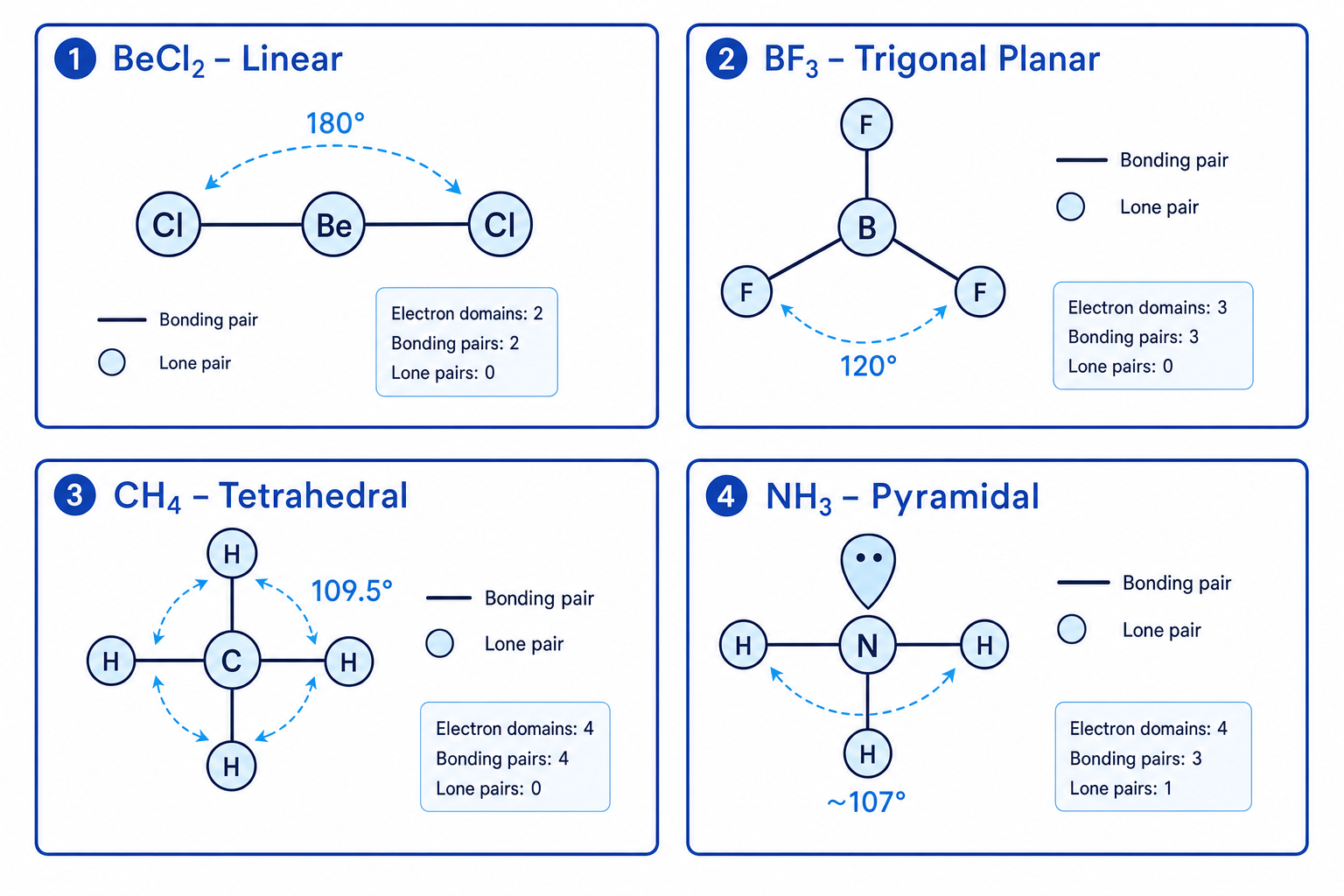
Common shapes you should know:
- 2 bonding regions, 0 lone pairs: linear, 180°.
- 3 bonding regions, 0 lone pairs: trigonal planar, 120°.
- 4 bonding regions, 0 lone pairs: tetrahedral, 109.5°.
- 3 bonding regions, 1 lone pair: pyramidal, about 107°.
- 2 bonding regions, 2 lone pairs: non-linear, about 104.5°.
Predicting the shape of ammonia
-
Nitrogen has five outer-shell electrons and forms three N-H bonds in NH₃.
-
After forming three bonding pairs, nitrogen has one lone pair remaining, so there are four electron pairs around the central atom.
-
Four electron pairs arrange themselves roughly tetrahedrally to minimise repulsion.
-
Because one of these pairs is a lone pair, the molecular shape is pyramidal, and the H-N-H bond angle is about 107° rather than 109.5°.
Counting atoms instead of electron pairs
For shape, count electron-pair regions around the central atom, not just the number of atoms attached to it. A double bond still counts as one region.
Electronegativity and bond polarity
Electronegativity
Electronegativity is the ability of an atom to attract the bonding pair of electrons in a covalent bond.
If two bonded atoms have different electronegativities, the bonding electrons are pulled closer to the more electronegative atom. This creates a polar bond.
For example, in H-Cl, chlorine is more electronegative than hydrogen. The chlorine end is slightly negative, δ⁻, and the hydrogen end is slightly positive, δ⁺.
A molecule is polar overall only if its bond dipoles do not cancel.
Deciding whether carbon dioxide and water are polar
-
In CO₂, each C=O bond is polar because oxygen is more electronegative than carbon.
-
CO₂ is linear and symmetrical, so the two equal bond dipoles point in opposite directions and cancel. CO₂ is non-polar overall.
-
In H₂O, each O-H bond is polar because oxygen is more electronegative than hydrogen.
-
H₂O is non-linear because oxygen has two lone pairs. The bond dipoles do not cancel, so H₂O is polar overall.
Polar molecule test
Ask two questions: are there polar bonds, and is the shape unsymmetrical enough that the dipoles do not cancel?
In the exam
-
Use the exact attraction in definitions: for example, “electrostatic attraction between oppositely charged ions” for ionic bonding.
-
In dot-and-cross diagrams, include only outer-shell electrons unless the question asks otherwise, and always add brackets and charges for ions.
-
For shapes, count electron-pair regions around the central atom first, then state the shape and bond angle, then explain any reduction due to lone pairs.
Check yourself
- Why does MgCl₂ contain two chloride ions for every magnesium ion?
- What is the difference between a normal covalent bond and a dative covalent bond?
- Why is CO₂ non-polar overall but H₂O is polar overall?
