

What you'll learn
- How protons, neutrons and electrons make up atoms and ions.
- How to use atomic number, mass number and charge to count subatomic particles.
- What isotopes are, and why relative atomic masses are often decimals.
- How simple mass spectra are used to calculate relative atomic mass.
1. The basic structure of an atom
An atom is the smallest particle of an element that can take part in chemical reactions while still being that element.
Atoms are made from three subatomic particles: protons, neutrons and electrons. Protons and neutrons are found in the nucleus, the tiny, dense centre of the atom. Electrons are found outside the nucleus in regions often described at this stage as shells or energy levels.
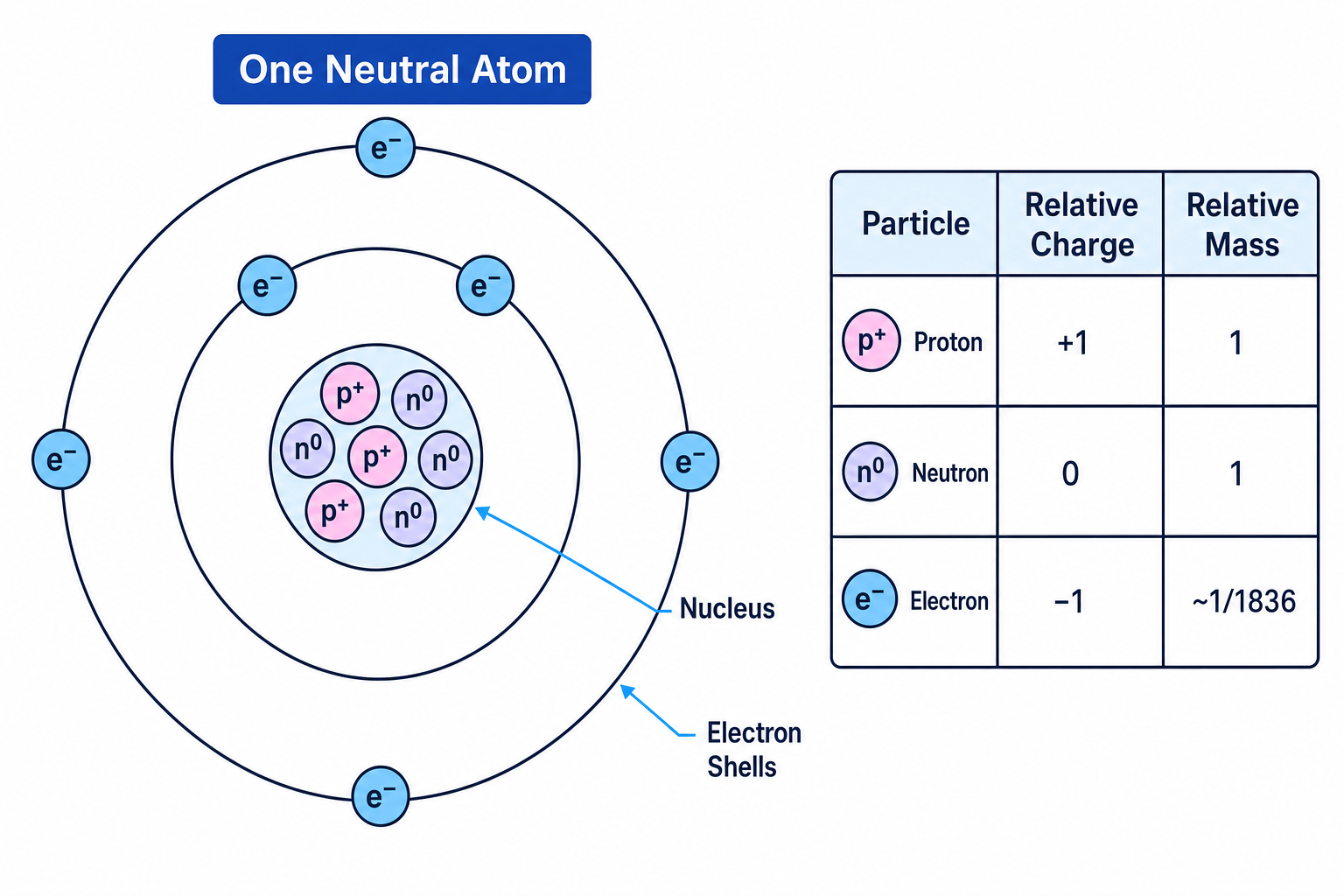
Subatomic particles
- A proton has relative charge +1 and relative mass 1.
- A neutron has relative charge 0 and relative mass 1.
- An electron has relative charge -1 and relative mass about 1/1836.
The nucleus contains almost all the mass of the atom because electrons are so much lighter than protons and neutrons. However, electrons are extremely important in chemistry because they control bonding and reactions.
Where the mass and charge are
The mass of an atom is concentrated in the nucleus, but the chemical behaviour of an atom depends mainly on its electrons.
2. Atomic number and mass number
To describe a particular atom, you need two numbers.
Atomic number and mass number
- The atomic number, also called the proton number, is the number of protons in the nucleus. Its symbol is ZZZ.
- The mass number, also called the nucleon number, is the total number of protons and neutrons in the nucleus. Its symbol is AAA.
- A nucleon is a proton or a neutron.
The atomic number identifies the element. For example, every atom with 6 protons is carbon. If the number of protons changes, the element changes.
The mass number tells you the total number of particles in the nucleus:
A=number of protons+number of neutronsA = \text{number of protons} + \text{number of neutrons}A=number of protons+number of neutronsSo:
number of neutrons=A−Z\text{number of neutrons} = A - Znumber of neutrons=A−ZA common notation is:
ZAX^{A}_{Z}\text{X}ZAXwhere X is the chemical symbol of the element.
Neutral atoms
A neutral atom has no overall charge. That means the number of positive protons equals the number of negative electrons.
So, in a neutral atom:
number of electrons=Z\text{number of electrons} = Znumber of electrons=Z3. Ions
An ion is a particle with an overall electrical charge because it has lost or gained electrons.
A positive ion, also called a cation, has lost electrons. A negative ion, also called an anion, has gained electrons.
The key point is that ion formation changes the number of electrons, not the number of protons or neutrons.
Changing protons instead of electrons
Do not change the number of protons when working out the charge of an ion. The number of protons defines the element; ions form by losing or gaining electrons.
Counting particles in atoms and ions
For 1327Al3+^{27}_{13}\text{Al}^{3+}1327Al3+ and 1632S2−^{32}_{16}\text{S}^{2-}1632S2−, find the numbers of protons, neutrons and electrons.
-
For 1327Al3+^{27}_{13}\text{Al}^{3+}1327Al3+, read Z=13Z=13Z=13 and A=27A=27A=27. Aluminium therefore has 13 protons, and the number of neutrons is 27−13=1427-13=1427−13=14.
-
A neutral aluminium atom would have 13 electrons. The 3+3+3+ charge means it has lost 3 electrons, so the ion has 13−3=1013-3=1013−3=10 electrons.
-
For 1632S2−^{32}_{16}\text{S}^{2-}1632S2−, read Z=16Z=16Z=16 and A=32A=32A=32. Sulfur therefore has 16 protons and 32−16=1632-16=1632−16=16 neutrons.
-
A neutral sulfur atom would have 16 electrons. The 2−2-2− charge means it has gained 2 electrons, so the ion has 16+2=1816+2=1816+2=18 electrons.
4. Isotopes
Atoms of the same element always have the same number of protons, but they do not always have the same number of neutrons.
Isotopes
Isotopes are atoms of the same element with the same number of protons but different numbers of neutrons.
For example, chlorine has isotopes chlorine-35 and chlorine-37. Both have 17 protons, so both are chlorine. Chlorine-35 has 18 neutrons, while chlorine-37 has 20 neutrons.
Isotopes of the same element have very similar chemical properties because they have the same number of electrons. Their physical properties can differ slightly because their masses are different.
What isotopes have in common
Isotopes of an element have the same atomic number but different mass numbers.
5. Relative isotopic mass and relative atomic mass
At A-Level, atomic masses are measured relative to carbon-12.
Relative isotopic mass
The relative isotopic mass is the mass of an atom of an isotope compared with one-twelfth of the mass of an atom of carbon-12.
Carbon-12 is assigned a relative isotopic mass of exactly 12. Relative isotopic mass has no units because it is a ratio.
Relative atomic mass
The relative atomic mass, ArA_rAr, is the weighted mean mass of the atoms of an element compared with one-twelfth of the mass of an atom of carbon-12.
The phrase weighted mean matters. It means common isotopes affect the average more than rare isotopes.
For isotope abundance calculations:
Ar=∑(isotopic mass×relative abundance)∑(relative abundance)A_r = \frac{\sum(\text{isotopic mass} \times \text{relative abundance})}{\sum(\text{relative abundance})}Ar=∑(relative abundance)∑(isotopic mass×relative abundance)If the abundances are percentages, the denominator is 100.
Calculating relative atomic mass
Chlorine contains 75.8% chlorine-35 and 24.2% chlorine-37. Calculate the relative atomic mass of chlorine.
-
Since chlorine-35 is more abundant than chlorine-37, the answer should be closer to 35 than to 37.
-
Substitute the isotopic masses and percentage abundances into the weighted mean formula:
Ar=(35.0×75.8)+(37.0×24.2)100A_r = \frac{(35.0 \times 75.8) + (37.0 \times 24.2)}{100}Ar=100(35.0×75.8)+(37.0×24.2) -
Calculate the numerator and divide by 100:
Ar=2653+895.4100=35.484A_r = \frac{2653 + 895.4}{100} = 35.484Ar=1002653+895.4=35.484 -
Round sensibly, so the relative atomic mass of chlorine is 35.5. This is not a whole number because it is an average of different isotopes.
Averaging isotopes equally
Do not simply average the mass numbers unless the isotopes are equally abundant. Relative atomic mass is a weighted mean, not usually a simple mean.
6. Simple mass spectra
A mass spectrometer is an instrument that separates ions according to their mass-to-charge ratio, written as m/zm/zm/z, and measures their relative abundance.
For simple isotope questions, ions are usually singly charged, so the value of m/zm/zm/z is numerically equal to the relative isotopic mass.
A simplified mass spectrometry process is:
-
The sample is ionised, often by removing an electron:
X(g)→X+(g)+e−\text{X(g)} \to \text{X}^{+}\text{(g)} + \text{e}^{-}X(g)→X+(g)+e− -
The positive ions are accelerated.
-
The ions are separated according to m/zm/zm/z.
-
The detector records the abundance of each ion.
A mass spectrum usually has m/zm/zm/z on the horizontal axis and relative abundance on the vertical axis. The peak positions tell you the isotope masses, and the peak heights or areas tell you their abundances.
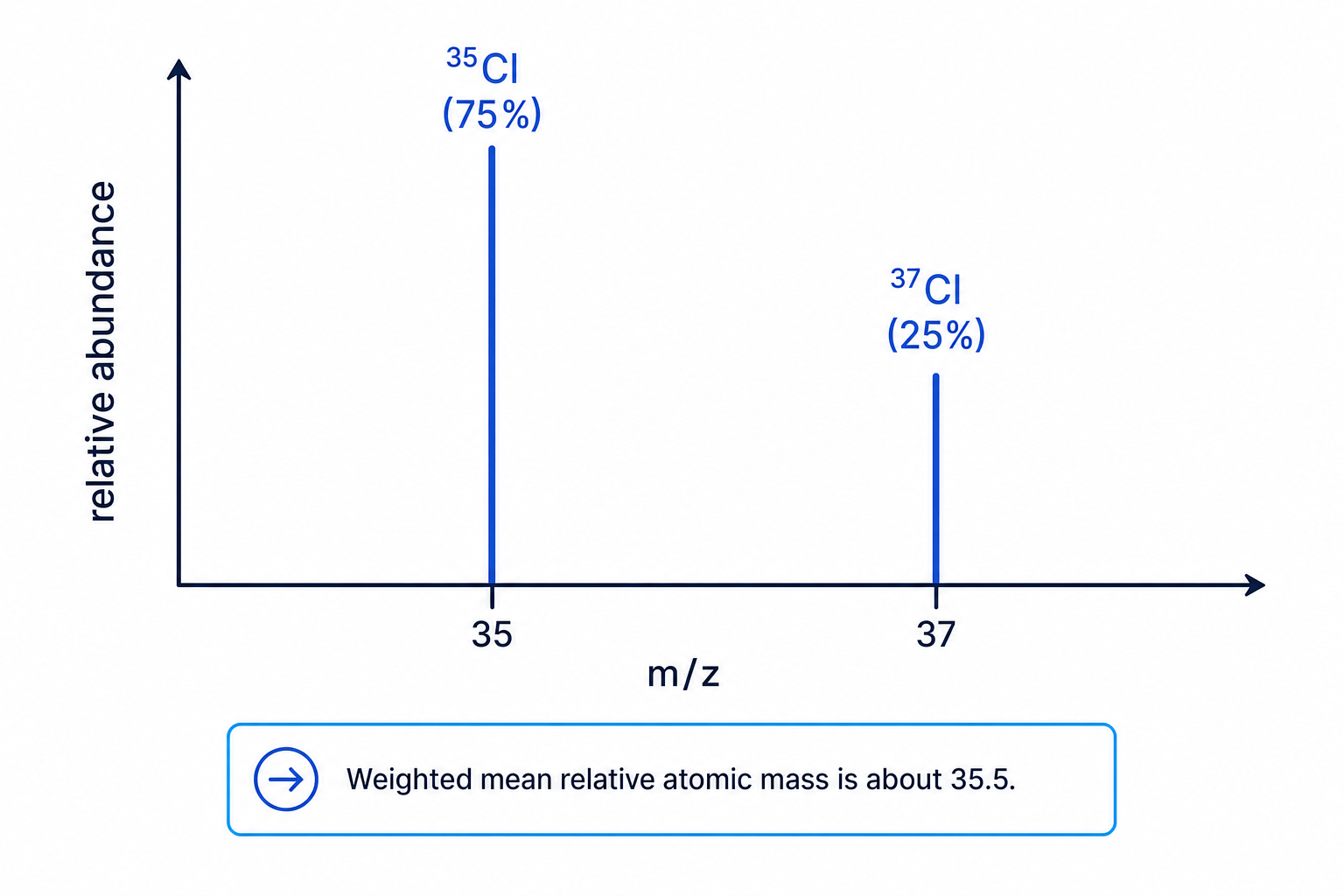
When m/z is not the mass
The shortcut “m/zm/zm/z equals mass” only works for singly charged ions. If an ion has a 2+ charge, its m/zm/zm/z value is half its mass number.
Using mass-spectrum peak data
A mass spectrum of magnesium shows peaks at m/z values 24, 25 and 26 with relative abundances 78.6, 10.1 and 11.3. Calculate ArA_rAr for magnesium.
-
The ions are singly charged, so use the m/z values as the isotope masses: 24, 25 and 26.
-
Use the relative abundances as the weighting values:
Ar=(24×78.6)+(25×10.1)+(26×11.3)78.6+10.1+11.3A_r = \frac{(24 \times 78.6) + (25 \times 10.1) + (26 \times 11.3)}{78.6+10.1+11.3}Ar=78.6+10.1+11.3(24×78.6)+(25×10.1)+(26×11.3) -
The denominator is 100.0, and the numerator is:
1886.4+252.5+293.8=2432.71886.4 + 252.5 + 293.8 = 2432.71886.4+252.5+293.8=2432.7 -
Divide to find the weighted mean:
Ar=2432.7100.0=24.327A_r = \frac{2432.7}{100.0} = 24.327Ar=100.02432.7=24.327 -
To three significant figures, Ar=24.3A_r = 24.3Ar=24.3. This is close to 24 because magnesium-24 is by far the most abundant isotope.
If peak heights are not percentages
If the spectrum gives relative peak heights such as 100, 25 and 5, do not divide by 100 automatically. Add the relative abundances and divide by that total.
7. Bringing it together
Atomic structure questions often combine particle counting with isotope ideas. Keep these ideas separate:
- Atomic number tells you protons.
- Mass number tells you protons plus neutrons.
- Charge tells you the electron change.
- Isotope abundance tells you how much each isotope contributes to ArA_rAr.
In the exam
-
For particle-counting questions, identify AAA, ZZZ and the charge first; only the charge changes the number of electrons.
-
For ArA_rAr calculations, use a weighted mean: multiply each isotopic mass by its abundance, add the results, then divide by the total abundance.
-
For mass spectra, use the horizontal position for m/zm/zm/z and the vertical height or area for abundance; check whether the ions are singly charged.
Check yourself
- For 2963Cu2+^{63}_{29}\text{Cu}^{2+}2963Cu2+, how many protons, neutrons and electrons are present?
- Why is the relative atomic mass of chlorine about 35.5 rather than exactly 35 or 37?
- An element has isotopes at m/z 10 and 11 with relative abundances 1 and 4. What is its relative atomic mass?
