

What you'll learn
- How chemists count tiny particles using the mole.
- How to convert between particles, mass, concentration, gas measurements and amount.
- How to use balanced equations to link reacting substances.
- How to tackle limiting reagent and empirical formula calculations.
Why amount of substance matters
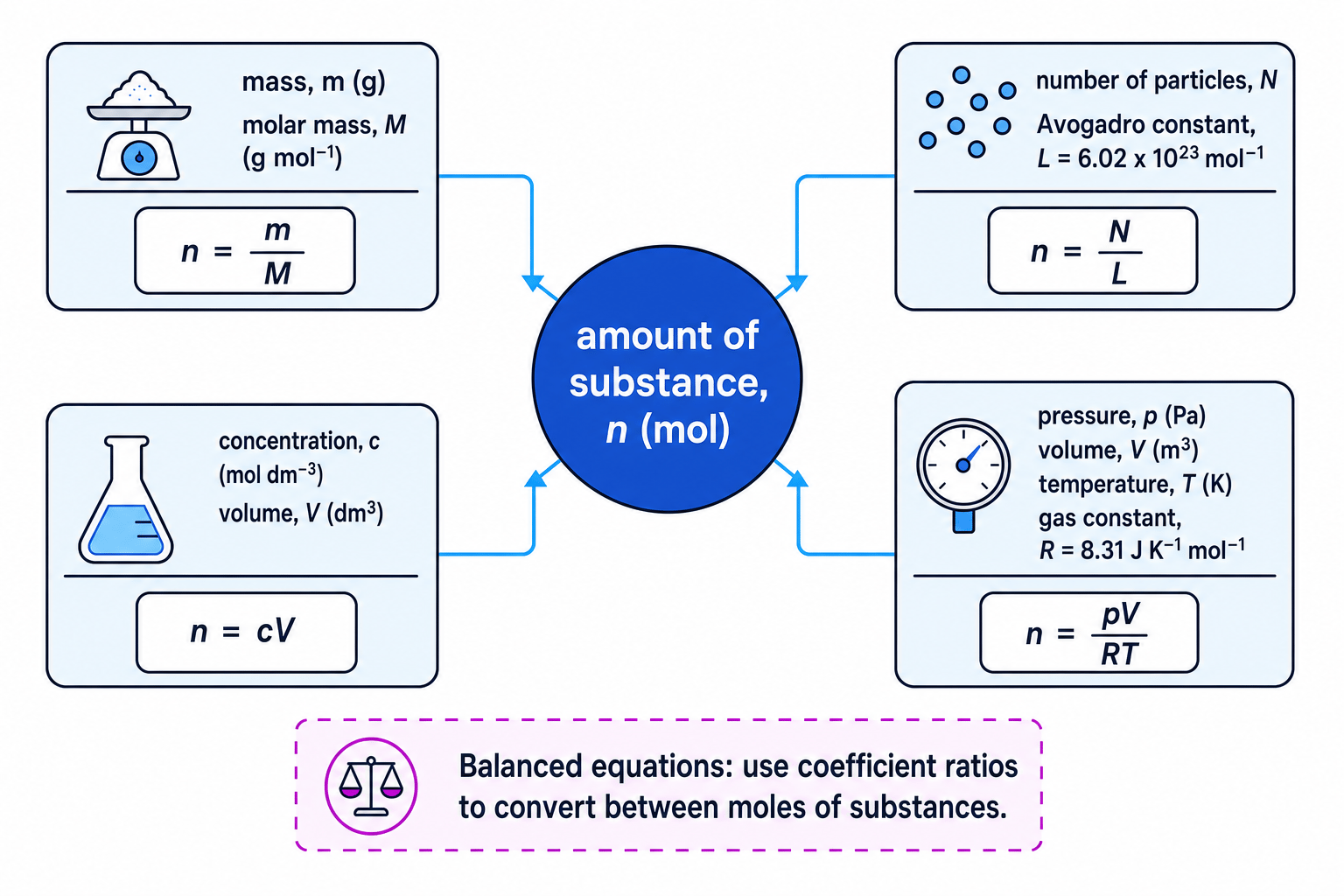
In a reaction, particles react in whole-number ratios. You cannot count individual atoms directly, so you measure something practical — mass, volume, pressure or concentration — and convert it into an amount of substance in mol.
Amount of substance and the mole
Amount of substance, symbol nnn, is a measure of how many specified entities are present. An entity is the particle being counted, such as an atom, molecule, ion or electron. One mole is the amount containing 6.02×10236.02 \times 10^{23}6.02×10²³ entities; this number per mole is the Avogadro constant, L=6.02×10²³ mol−1L = 6.02 \times 10^{23}\ \text{mol}^{-1}L=6.02×10²³ mol−1.
Converting particles to amount
How much CO₂ is present in 1.204×10241.204 \times 10^{24}1.204×1024 CO₂ molecules?
- The counted entity is a CO₂ molecule, so use n=NLn = \frac{N}{L}n=LN.
- Substitute N=1.204×1024N = 1.204 \times 10^{24}N=1.204×1024 and L=6.02×10²³ mol−1L = 6.02 \times 10^{23}\ \text{mol}^{-1}L=6.02×10²³ mol−1: n=1.204×10246.02×1023 mol−1n = \frac{1.204 \times 10^{24}}{6.02 \times 10^{23}\ \text{mol}^{-1}}n=6.02×10²³ mol−11.204×1024.
- Calculate n=2.00 moln = 2.00\ \text{mol}n=2.00 mol, so the sample contains 2.00 mol of CO₂ molecules.
Most amount calculations are about choosing the correct route to nnn, then using a balanced equation if another substance is involved.
Relative mass and molar mass
Before converting mass to amount, you need the mass of one mole of the substance.
Relative masses and molar mass
The relative atomic mass, ArA_rAr, is the weighted mean mass of an atom of an element compared with one-twelfth of the mass of a carbon-12 atom. “Weighted” means more abundant isotopes contribute more to the mean. The relative molecular mass or relative formula mass, MrM_rMr, is the sum of the ArA_rAr values in the formula. The molar mass, MMM, is the mass of one mole of a substance, usually in g mol⁻¹.
For A-Level calculations, the molar mass in g mol⁻¹ is numerically equal to the relative formula mass.
Using mass
The key relationship is:
n=mMn = \frac{m}{M}n=Mmwhere mmm is mass and MMM is molar mass.
Finding a molar mass and an amount
Calculate the amount in 3.70 g of Ca(OH)₂.
- Find the molar mass: M(Ca(OH)2)=40.1+2(16.0+1.0)=74.1 g mol−1M(\text{Ca(OH)}_2) = 40.1 + 2(16.0 + 1.0) = 74.1\ \text{g mol}^{-1}M(Ca(OH)2)=40.1+2(16.0+1.0)=74.1 g mol−1.
- Use n=mMn = \frac{m}{M}n=Mm: n=3.70 g74.1 g mol−1=0.0499 moln = \frac{3.70\ \text{g}}{74.1\ \text{g mol}^{-1}} = 0.0499\ \text{mol}n=74.1 g mol−13.70 g=0.0499 mol.
- Check the units: g divided by g mol⁻¹ leaves mol, so 3.70 g of Ca(OH)₂ is 0.0499 mol.
Mixing mass units
If MMM is in g mol⁻¹, the mass must be in g. Do not put kg into n=mMn = \frac{m}{M}n=Mm unless you have also converted the molar mass into kg mol⁻¹.
Solutions: concentration and volume
A solute is the substance dissolved. A solvent is the liquid it dissolves in. A solution is the mixture formed.
Concentration
Concentration, symbol ccc, is the amount of solute per unit volume of solution. In this topic it is usually measured in mol dm⁻³, so c=nVc = \frac{n}{V}c=Vn and n=cVn = cVn=cV, where VVV must be in dm³.
Volumes in chemistry are often measured in cm³ in the lab, but concentration is usually in mol dm⁻³. Convert cm³ to dm³ by dividing by 1000.
Calculating amount in a solution
Calculate the amount of NaOH in 25.0 cm³ of 0.150 mol dm⁻³ NaOH(aq).
- Convert the volume: 25.0 cm3=0.0250 dm325.0\ \text{cm}^3 = 0.0250\ \text{dm}^325.0 cm3=0.0250 dm3.
- Use n=cVn = cVn=cV: n=0.150 mol dm−3×0.0250 dm3=0.00375 moln = 0.150\ \text{mol dm}^{-3} \times 0.0250\ \text{dm}^3 = 0.00375\ \text{mol}n=0.150 mol dm−3×0.0250 dm3=0.00375 mol.
- The dm³ units cancel, leaving 0.00375 mol of NaOH.
Titration volumes
In titrations, the titre is the volume delivered from the burette. Use the mean of concordant titres — closely agreeing titres — and do not include the rough titre. Always convert cm³ to dm³ before using n=cVn = cVn=cV.
Gases: pressure, volume and temperature
For gases, amount can be found using the ideal gas equation. An ideal gas is a model gas whose particles have negligible volume and no intermolecular attractions; real gases often behave closely enough under ordinary A-Level conditions.
pV=nRTpV = nRTpV=nRTUse ppp in Pa, VVV in m³, nnn in mol, TTT in K, and R=8.31 J K−1 mol−1R = 8.31\ \text{J K}^{-1}\ \text{mol}^{-1}R=8.31 J K−1 mol−1.
Using the ideal gas equation
Calculate the amount of gas in 250 cm³ at 100 kPa and 25 °C.
- Convert the units to match RRR: p=100000 Pap = 100000\ \text{Pa}p=100000 Pa, V=250 cm3=2.50×10⁻⁴ m3V = 250\ \text{cm}^3 = 2.50 \times 10^{-4}\ \text{m}^3V=250 cm3=2.50×10⁻⁴ m3, and T=25+273=298 KT = 25 + 273 = 298\ \text{K}T=25+273=298 K.
- Rearrange the ideal gas equation: n=pVRTn = \frac{pV}{RT}n=RTpV.
- Substitute: n=100000×2.50×10−48.31×298=1.01×10⁻² moln = \frac{100000 \times 2.50 \times 10^{-4}}{8.31 \times 298} = 1.01 \times 10^{-2}\ \text{mol}n=8.31×298100000×2.50×10−4=1.01×10⁻² mol.
Gas equation units
The ideal gas equation only works cleanly with the units that match RRR: pressure in Pa, volume in m³ and temperature in K. Using kPa or dm³ without conversion changes the answer by factors of 1000.
Balanced equations and mole ratios
A balanced equation has the same number of each type of atom on both sides. The numbers in front of formulae are called coefficients, and they give the reacting ratio in moles.
Stoichiometry means using these balanced-equation ratios to calculate amounts of reactants and products.
The mole ratio is in the coefficients
A balanced equation gives mole ratios, not mass ratios. Convert the known information into mol first, use the coefficient ratio, then convert into the unit asked for.
Finding a solution volume from a reacting mass
What volume of 0.200 mol dm⁻³ HCl(aq) reacts exactly with 1.00 g of CaCO₃(s)?
CaCO₃(s) + 2HCl(aq) → CaCl₂(aq) + CO₂(g) + H₂O(l)
- Convert the known mass into amount: M(CaCO3)=40.1+12.0+3(16.0)=100.1 g mol−1M(\text{CaCO}_3) = 40.1 + 12.0 + 3(16.0) = 100.1\ \text{g mol}^{-1}M(CaCO3)=40.1+12.0+3(16.0)=100.1 g mol−1, so n(CaCO3)=1.00100.1=0.00999 moln(\text{CaCO}_3) = \frac{1.00}{100.1} = 0.00999\ \text{mol}n(CaCO3)=100.11.00=0.00999 mol.
- Use the equation ratio. One mol CaCO₃ reacts with two mol HCl, so n(HCl)=2×0.00999=0.01998 moln(\text{HCl}) = 2 \times 0.00999 = 0.01998\ \text{mol}n(HCl)=2×0.00999=0.01998 mol.
- Convert amount of HCl to volume: V=nc=0.019980.200=0.0999 dm3V = \frac{n}{c} = \frac{0.01998}{0.200} = 0.0999\ \text{dm}^3V=cn=0.2000.01998=0.0999 dm3, which is 99.9 cm³.
Limiting reagents
Sometimes you are given amounts of more than one reactant. The reaction stops when one reactant runs out.
Limiting reagent
The limiting reagent is the reactant that is completely used up first. It determines the maximum amount of product. A reactant in excess is left over after the reaction.
Identifying the limiting reagent
Nitrogen and hydrogen react as follows:
N₂(g) + 3H₂(g) → 2NH₃(g)
If 0.500 mol N₂ reacts with 1.20 mol H₂, find the limiting reagent and the amount of NH₃ formed.
- Work out how much H₂ would be needed to use all the N₂: 3×0.500=1.50 mol3 \times 0.500 = 1.50\ \text{mol}3×0.500=1.50 mol H₂.
- Compare with what is available. Only 1.20 mol H₂ is present, so H₂ is the limiting reagent.
- Use the limiting reagent to find product: n(NH3)=23×1.20=0.800 moln(\text{NH}_3) = \frac{2}{3} \times 1.20 = 0.800\ \text{mol}n(NH3)=32×1.20=0.800 mol.
Choosing the smaller amount automatically
The limiting reagent is not always the reactant with the smaller number of moles. You must compare the available amounts after applying the balanced-equation ratio.
Empirical and molecular formulae
Amount of substance is also used to turn composition data into formulae.
Empirical and molecular formulae
The empirical formula is the simplest whole-number ratio of atoms of each element in a compound. The molecular formula gives the actual number of atoms of each element in one molecule.
Finding empirical and molecular formulae
A compound has percentage composition by mass: 40.0% C, 6.7% H and 53.3% O. Its relative molecular mass is 60.0. Find its empirical and molecular formulae.
- Assume 100 g of compound, so the masses are 40.0 g C, 6.7 g H and 53.3 g O.
- Convert each mass to amount: C is 40.0÷12.0=3.3340.0 \div 12.0 = 3.3340.0÷12.0=3.33 mol, H is 6.7÷1.0=6.76.7 \div 1.0 = 6.76.7÷1.0=6.7 mol, and O is 53.3÷16.0=3.3353.3 \div 16.0 = 3.3353.3÷16.0=3.33 mol.
- Divide by the smallest amount: the ratio C:H:O is 1:2:11:2:11:2:1, so the empirical formula is CH₂O.
- Find the empirical formula mass: Mr(CH2O)=12.0+2(1.0)+16.0=30.0M_r(\text{CH}_2\text{O}) = 12.0 + 2(1.0) + 16.0 = 30.0Mr(CH2O)=12.0+2(1.0)+16.0=30.0. Since 60.0÷30.0=260.0 \div 30.0 = 260.0÷30.0=2, the molecular formula is C₂H₄O₂.
In the exam
- Start by converting the information you are given into amount in mol.
- Check units before substituting: cm³ to dm³ for solutions; kPa to Pa, cm³ or dm³ to m³, and °C to K for gases.
- Use balanced-equation coefficients only with moles, then convert to the final unit requested.
- Keep sensible significant figures, usually matching the data in the question.
Check yourself
- What is the difference between MrM_rMr and molar mass?
- Why must volume be in dm³ when using concentration in mol dm⁻³?
- In a limiting reagent question, why is the smaller amount in mol not always the limiting reagent?
