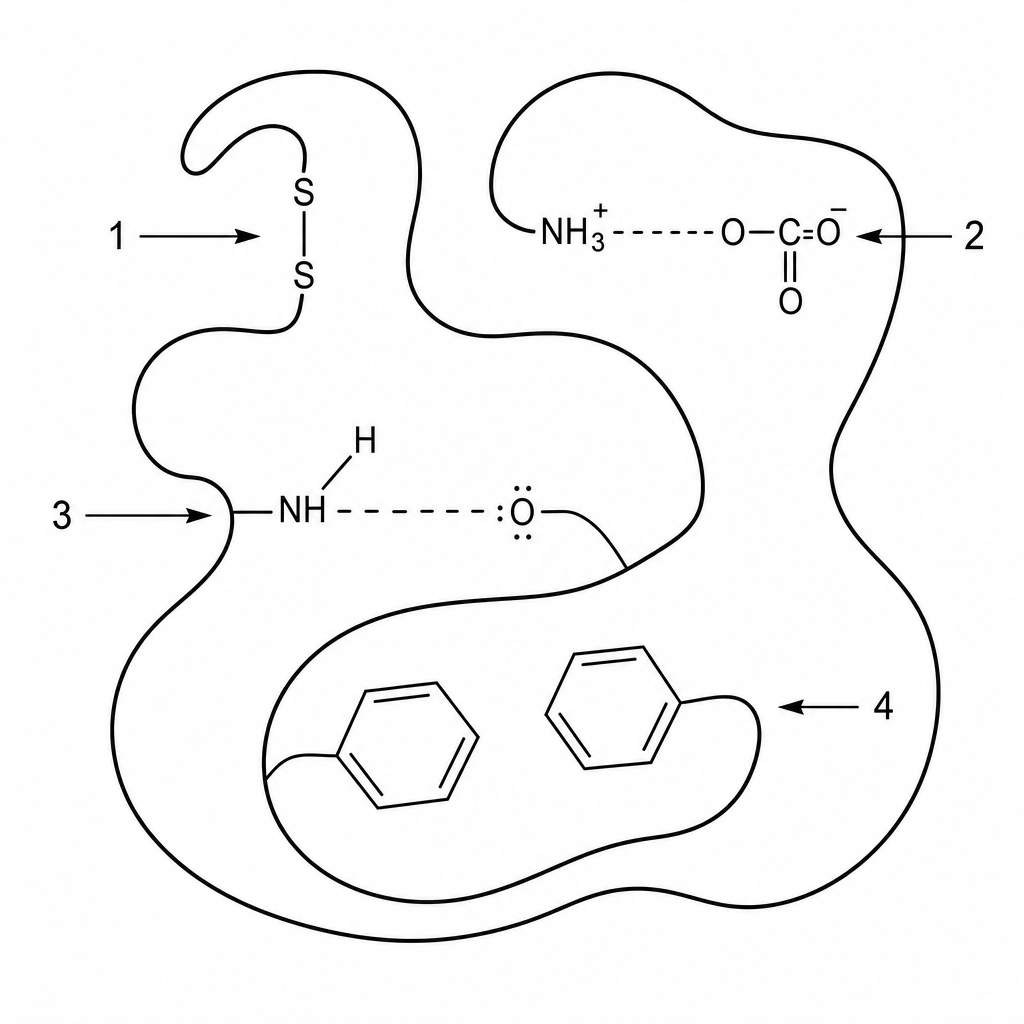
The diagram shows a single folded polypeptide chain and four types of chemical interactions (1 to 4) that stabilize its tertiary structure.
Which of the following statements correctly describes these stabilizing interactions?
Interaction 1 is a covalent disulfide bond formed via a condensation reaction between the R-groups of two methionine residues.
Interaction 2 is an ionic bond that is highly sensitive to changes in pH, which can protonate or deprotonate the interacting groups and disrupt the tertiary structure.
Interaction 3 is a hydrogen bond formed between the carbonyl oxygen and amide hydrogen of adjacent peptide bonds along the backbone.
Interaction 4 is a strong covalent hydrophobic interaction that is resistant to thermal denaturation.