What you'll learn
- How ATP transfers energy in cells and why it is useful as an immediate energy currency.
- What gross primary productivity and net primary productivity mean.
- How energy moves between trophic levels and why transfer is inefficient.
- How to calculate productivity and percentage energy transfer using units correctly.
The big idea: energy has to be transferred
Living organisms need energy for processes such as active transport, protein synthesis, movement, secretion and maintaining body temperature.
Energy enters most ecosystems as light energy from the Sun. Producers, such as plants and algae, convert some of this light energy into chemical energy in organic molecules during photosynthesis. That chemical energy can then be transferred through a food chain.
Trophic level
A trophic level is the feeding level of an organism in a food chain, such as producer, primary consumer, secondary consumer or tertiary consumer.
Energy is not recycled in ecosystems. It flows through the ecosystem and is eventually lost to the surroundings, mainly as heat from respiration.
ATP: the immediate energy currency of cells
Cells do not usually use glucose directly to power every reaction. Instead, they use a molecule called ATP.
ATP
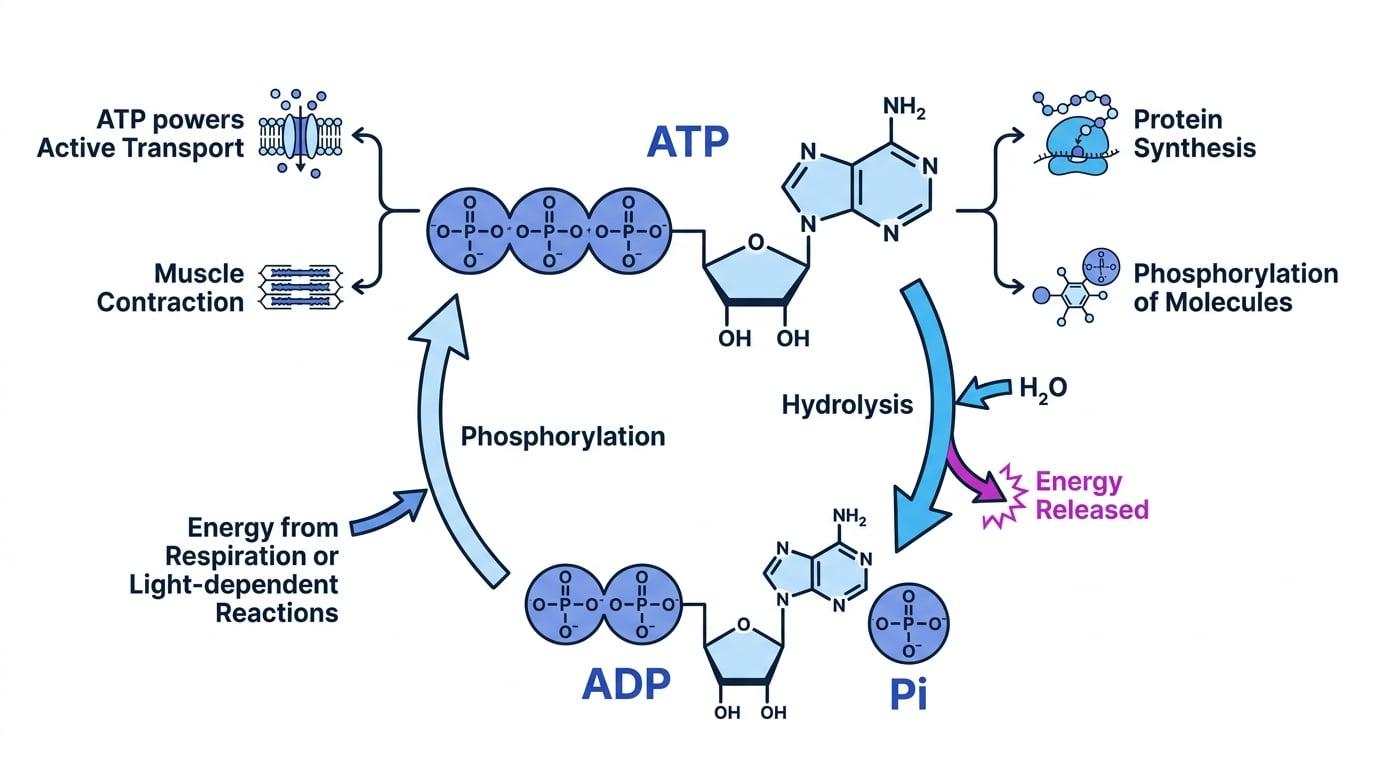
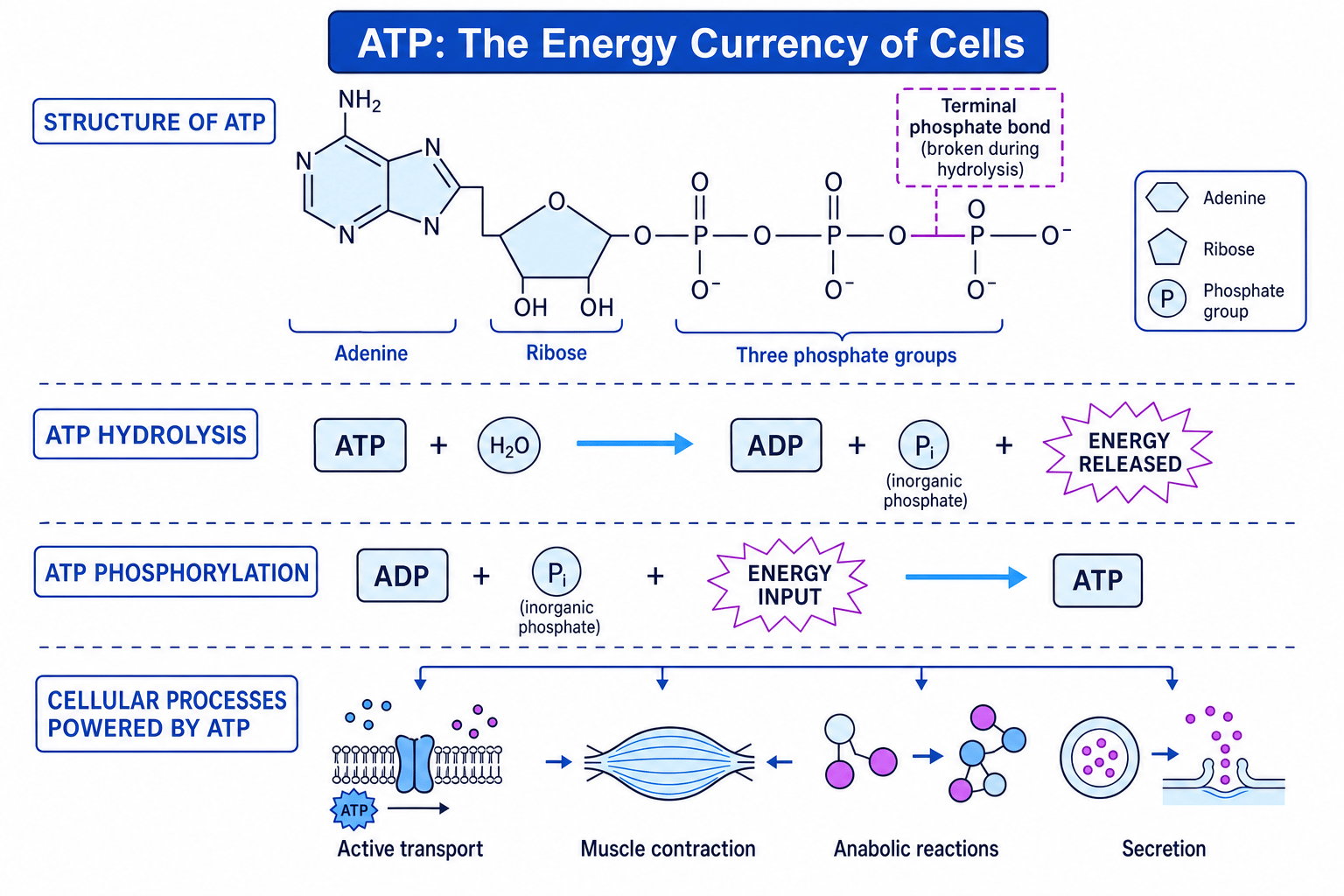
Adenosine triphosphate (ATP) is a phosphorylated nucleotide made from adenine, ribose and three phosphate groups. It transfers energy to cellular processes when it is hydrolysed to ADP and inorganic phosphate.
ATP is hydrolysed by adding water. This breaks the bond between the terminal phosphate group and the rest of the molecule:
ATP+H2O→ADP+Pi+energy\text{ATP} + \text{H}_2\text{O} \to \text{ADP} + \text{P}_{\text{i}} + \text{energy}ATP+H2O→ADP+Pi+energyHere, ADP means adenosine diphosphate, and inorganic phosphate is often written as Pi\text{P}_{\text{i}}Pi.
ATP can be regenerated when ADP is phosphorylated:
ADP+Pi+energy→ATP\text{ADP} + \text{P}_{\text{i}} + \text{energy} \to \text{ATP}ADP+Pi+energy→ATPThis usually happens during respiration, and in photosynthetic organisms it can also happen during the light-dependent reactions of photosynthesis.
Why ATP is useful
ATP is a good immediate energy source because it:
- releases energy in small, manageable amounts
- is small and soluble, so it can move around the cell
- can be regenerated quickly from ADP and inorganic phosphate
- can directly phosphorylate other molecules, making them more reactive
- links energy-releasing reactions to energy-requiring reactions
ATP links reactions
ATP acts as an energy-transfer molecule. Energy released from respiration is used to make ATP, and ATP hydrolysis then provides energy for processes such as active transport, muscle contraction and anabolic reactions.
ATP is not a long-term store
ATP is not used as a long-term energy store. Cells store larger amounts of chemical energy in molecules such as glycogen, starch and lipids, then use respiration to regenerate ATP when needed.
Productivity: measuring energy stored as biomass
In ecology, we often want to know how much energy is being stored in living material over time.
Biomass
Biomass is the total mass of living material in an organism, population or trophic level. It is often measured as dry mass because water content varies between organisms.
Productivity
Productivity is the rate at which energy is transferred into biomass. It can be measured in units such as kJ m⁻² year⁻¹ or kg m⁻² year⁻¹.
For producers, productivity depends on photosynthesis and respiration.
Gross primary productivity and net primary productivity
GPP and NPP
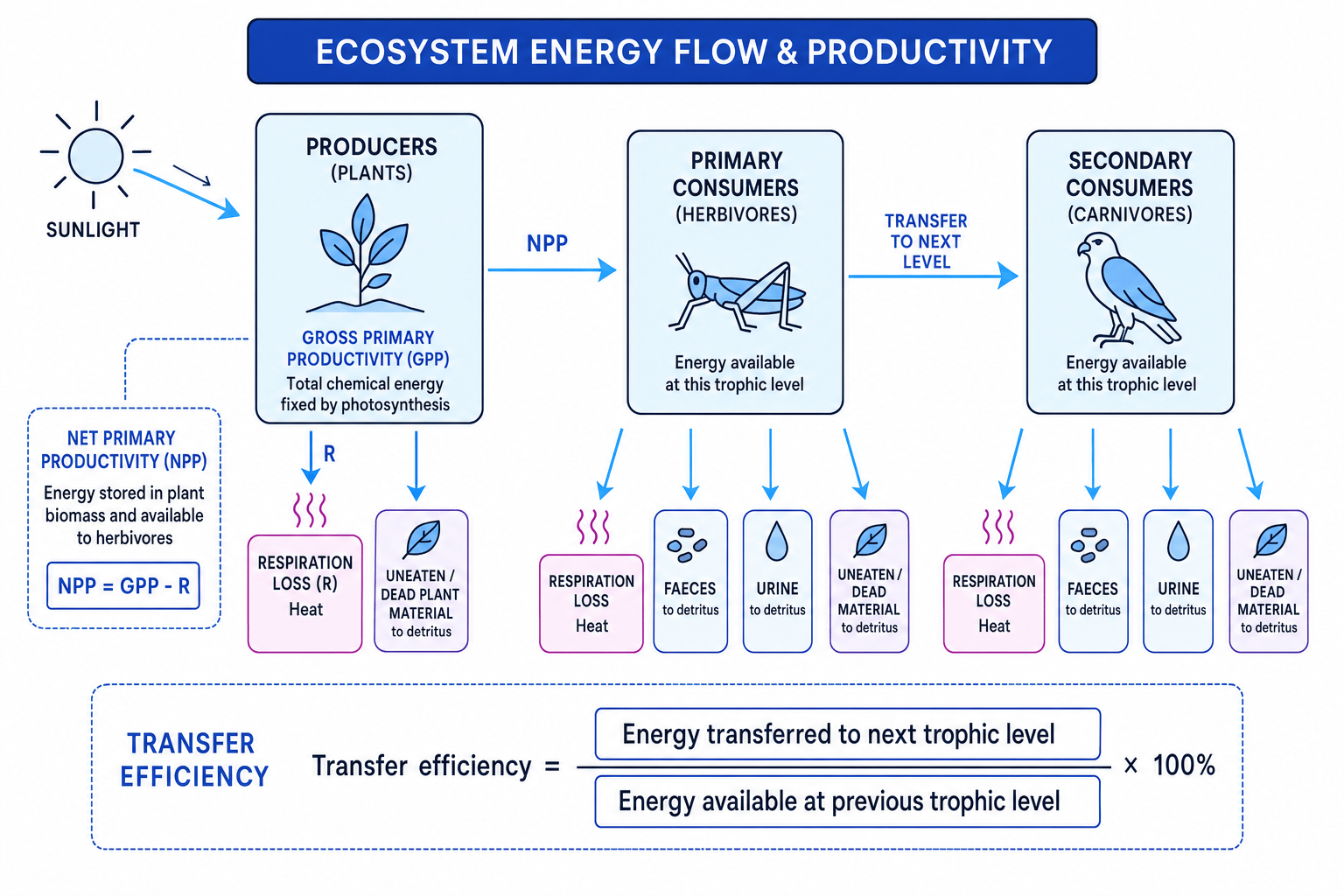
Gross primary productivity (GPP) is the total chemical energy fixed by producers during photosynthesis. Net primary productivity (NPP) is the energy remaining as plant biomass after respiratory losses.
The key equation is:
NPP=GPP−R\text{NPP} = \text{GPP} - RNPP=GPP−Rwhere RRR is energy lost by respiration.
NPP is important because it represents the energy stored in producer biomass that is potentially available to herbivores and decomposers.
Calculating net primary productivity
A grassland has a gross primary productivity of 18 500 kJ m⁻² year⁻¹. The plants lose 11 200 kJ m⁻² year⁻¹ through respiration. Calculate the net primary productivity.
-
Choose the correct relationship: NPP=GPP−R\text{NPP} = \text{GPP} - RNPP=GPP−R because you are subtracting the producer’s respiratory losses from the total energy fixed.
-
Substitute the values with units:
NPP=18 500−11 200\text{NPP} = 18\,500 - 11\,200NPP=18500−11200 -
Calculate the energy remaining in plant biomass:
NPP=7 300 kJ m−2 year−1\text{NPP} = 7\,300\ \text{kJ m}^{-2}\text{ year}^{-1}NPP=7300 kJ m−2 year−1
Sanity check for NPP
NPP must be smaller than GPP, because some of the energy fixed by photosynthesis is always used in respiration.
Energy transfer to consumers
When a herbivore eats plant material, not all of the plant’s energy becomes herbivore biomass.
Some energy is:
- not eaten, such as roots or tough stems
- egested as faeces because it was not digested
- excreted in urine as nitrogenous waste
- released as heat during respiration
- passed to decomposers in dead organisms and waste material
For consumers, net production is the energy stored as new biomass after losses.
A useful relationship is:
N=I−(F+U)−RN = I - (F + U) - RN=I−(F+U)−Rwhere:
- NNN is net production
- III is energy ingested
- FFF is energy lost in faeces
- UUU is energy lost in urine
- RRR is energy lost through respiration
Calculating net production in a consumer
A population of caterpillars ingests 6 000 kJ m⁻² year⁻¹ from leaves. They lose 2 100 kJ m⁻² year⁻¹ in faeces, 300 kJ m⁻² year⁻¹ in urine and 2 800 kJ m⁻² year⁻¹ through respiration. Calculate their net production.
-
Select the consumer net production equation because the data include ingestion, waste losses and respiration:
N=I−(F+U)−RN = I - (F + U) - RN=I−(F+U)−R -
Combine the waste losses first:
F+U=2 100+300=2 400 kJ m−2 year−1F + U = 2\,100 + 300 = 2\,400\ \text{kJ m}^{-2}\text{ year}^{-1}F+U=2100+300=2400 kJ m−2 year−1 -
Substitute into the equation:
N=6 000−2 400−2 800N = 6\,000 - 2\,400 - 2\,800N=6000−2400−2800 -
Calculate the energy stored as caterpillar biomass:
N=800 kJ m−2 year−1N = 800\ \text{kJ m}^{-2}\text{ year}^{-1}N=800 kJ m−2 year−1
Transfer efficiency between trophic levels
Energy transfer efficiency tells you what percentage of energy at one trophic level is transferred into biomass at the next trophic level.
The formula is:
transfer efficiency=energy transferred to next trophic levelenergy available at previous trophic level×100\text{transfer efficiency} = \frac{\text{energy transferred to next trophic level}}{\text{energy available at previous trophic level}} \times 100transfer efficiency=energy available at previous trophic levelenergy transferred to next trophic level×100For example, if producers have an NPP of 7 300 kJ m⁻² year⁻¹, but herbivores store only 800 kJ m⁻² year⁻¹ as biomass, the transfer efficiency is:
Calculating transfer efficiency
-
Identify the numerator as the energy transferred to the next trophic level: 800 kJ m⁻² year⁻¹.
-
Identify the denominator as the energy available at the previous trophic level: 7 300 kJ m⁻² year⁻¹.
-
Substitute into the percentage efficiency equation:
transfer efficiency=8007 300×100\text{transfer efficiency} = \frac{800}{7\,300} \times 100transfer efficiency=7300800×100 -
Calculate and round sensibly:
transfer efficiency=11.0%\text{transfer efficiency} = 11.0\%transfer efficiency=11.0%
Using GPP instead of NPP
When calculating energy available to herbivores, use NPP, not GPP. Herbivores cannot use the energy that producers have already lost through respiration.
Why food chains are usually short
Energy transfer between trophic levels is inefficient. Common values are around 10 percent, although this varies between ecosystems.
This limits the number of trophic levels in a food chain because there is less energy available at each successive level. By the time energy has passed through several trophic levels, there may not be enough to support many large predators.
Energy flows, nutrients cycle
Energy flows through ecosystems and is lost as heat. Nutrients, such as carbon and nitrogen, can be recycled by decomposers.
Measuring productivity in practice
To estimate productivity, ecologists may measure changes in biomass over time. A common practical issue is that fresh mass can be misleading because organisms contain different amounts of water.
Dry mass is more reliable. Samples can be dried in an oven at a controlled temperature until they reach a constant mass. This suggests that most water has been removed.
Energy content can be estimated using calorimetry, where a known dry mass of material is burned and the energy released is used to heat a known volume of water. The temperature change can be used to estimate energy released.
Sampling must be representative
Productivity estimates are only as good as the sampling method. Random sampling, enough repeats, consistent drying conditions and clear units are needed to make the data reliable and comparable.
In the exam
-
Write the correct formula first, then substitute values with units before calculating the final answer.
-
Check whether the question is asking for GPP, NPP, consumer net production or percentage transfer efficiency.
-
For efficiency calculations, make sure the denominator is the energy available at the previous trophic level, and remember to multiply by 100.
Check yourself
- Why is ATP described as an immediate energy currency rather than a long-term energy store?
- A plant community has a GPP of 9 200 kJ m⁻² year⁻¹ and respiratory losses of 4 700 kJ m⁻² year⁻¹. What is its NPP?
- Give three reasons why energy transfer from producers to herbivores is inefficient.