Scientists investigated the metabolic adaptations of avian muscle tissues for long-distance flight. They compared biopsy samples from the pectoralis (breast) muscle of migratory bar-tailed godwits (capable of non-stop endurance flight) with those of domestic chickens (non-migratory controls). The sections of muscle fibres were stained to show the activity of succinate dehydrogenase, an enzyme in the citric acid cycle of aerobic respiration. Darker staining indicates higher enzyme activity.
Suggest one reason for the average difference in staining intensity between the muscle fibres of the migratory godwits and the non-migratory domestic chickens.
The migratory godwits were able to sustain continuous high-intensity flight across oceans for several days, whereas the domestic chickens could only sustain short bursts of flapping. Explain why.
The scientists determined the mean diameter of the muscle fibres using an optical microscope. The circular field of view had an area of 2.85 mm22.85\text{ mm}^22.85 mm2. The diameter of this circular area was equal to the width of 32 muscle fibres lined up side-by-side.
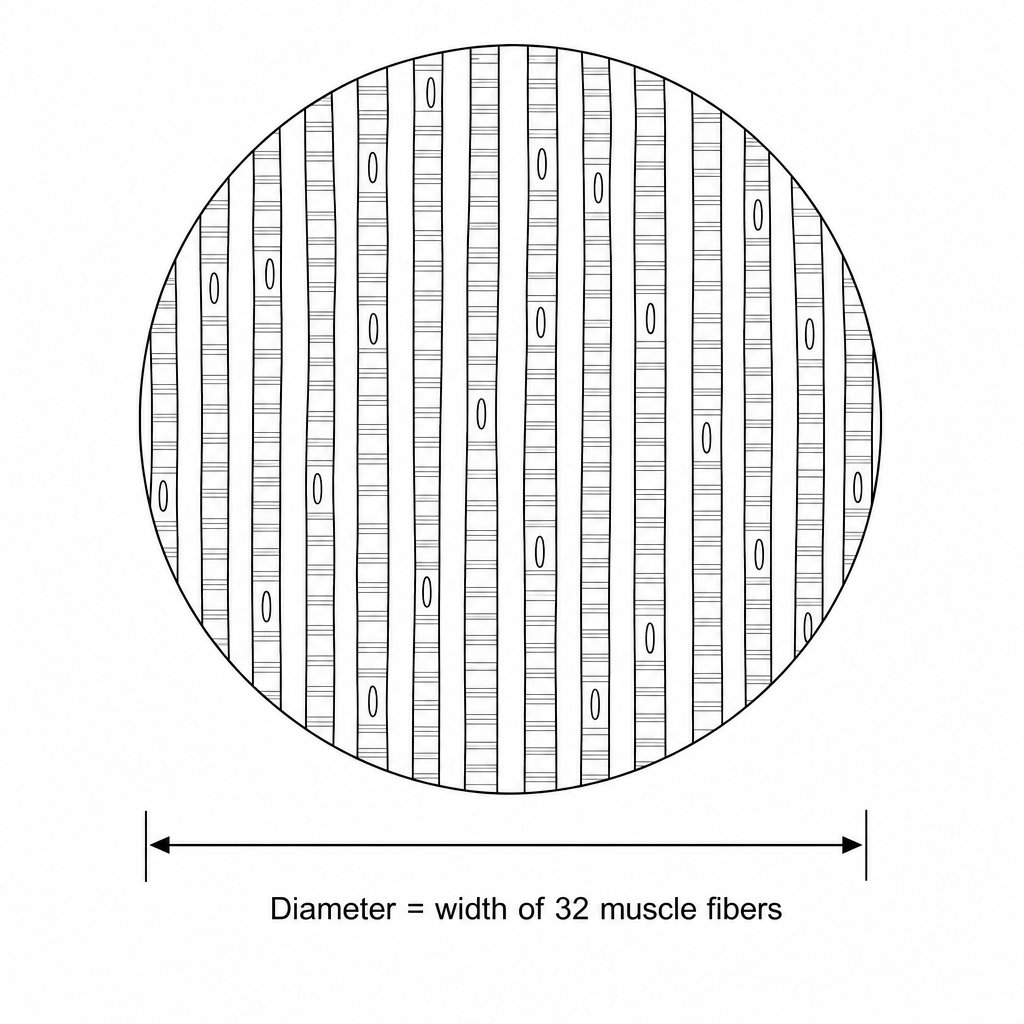
Use Area=πr2\text{Area} = \pi r^2Area=πr2 to calculate the mean diameter of a muscle fibre in micrometres (μm\mu\text{m}μm). Show your working.

