Macroeconomic policy objectives
Definition
Macroeconomic objectives: the economy-wide goals a government pursues, chiefly price stability, low unemployment and economic growth.
The three objectives
- Price stability means a low and steady rate of inflation, often around a 2% target, so that money keeps its value and firms can plan with confidence.
- Low unemployment means most people who want to work can find a job, so few labour resources sit idle and output is closer to capacity.
- Economic growth means a sustained rise in real output, measured by real GDP over time, which lifts average incomes.
Key Idea
- A government reaches for one of three toolkits to move an objective.
- Fiscal and monetary policy steer aggregate demand, while supply-side policy raises productive capacity.
Fiscal policy
Definition
Fiscal policy: the use of government spending (G) and taxation (T) to influence aggregate demand.
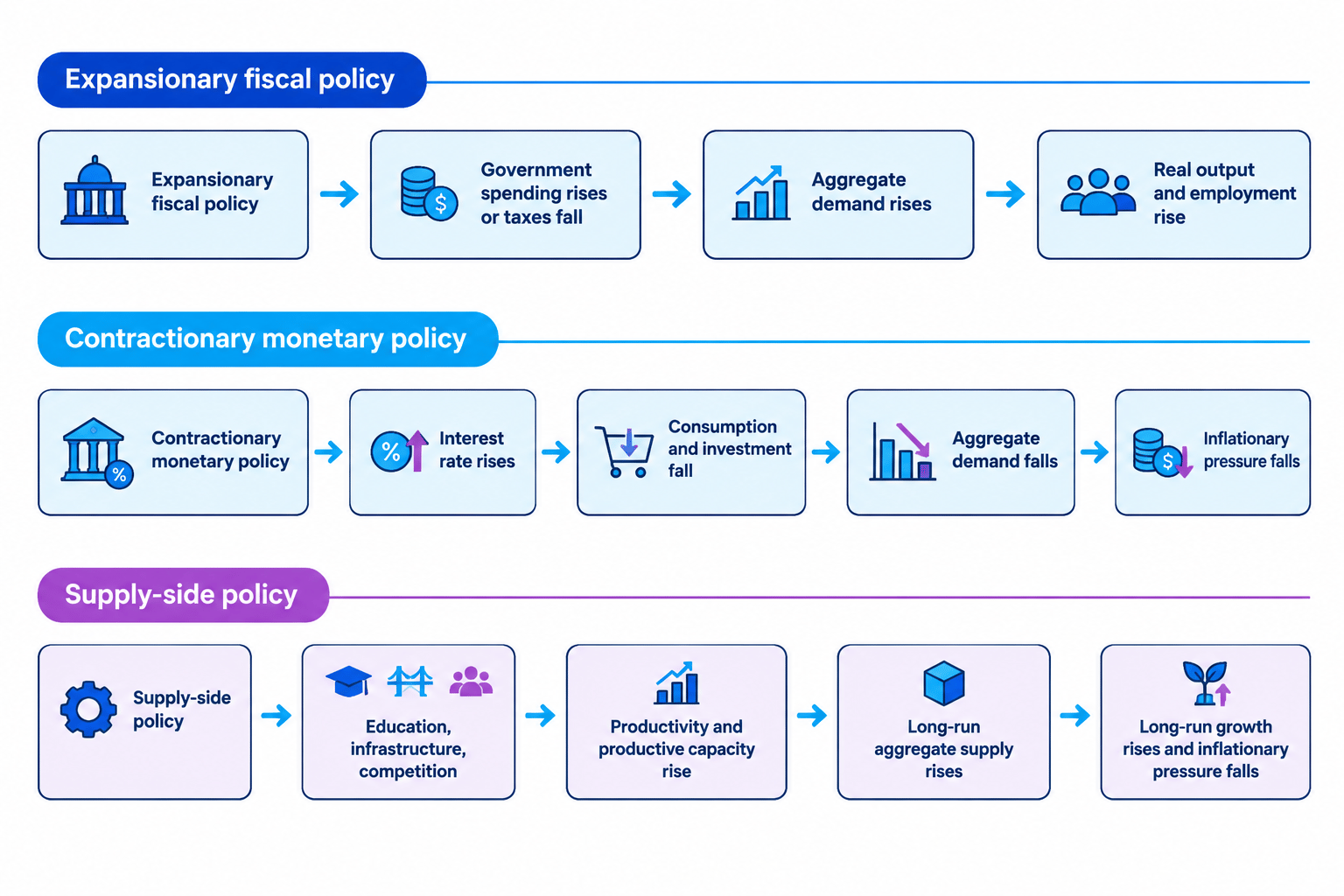
- To raise growth and cut unemployment, the government can increase spending or cut taxes, which lifts aggregate demand and so raises real output and jobs.
- To protect price stability, it can cut spending or raise taxes, which lowers aggregate demand and so eases demand-pull inflation.
Example
- In a downturn a government cuts income tax, so a typical household keeps an extra £500 a year.
- Disposable income rises, so households spend part of the £500 and consumption (C) increases.
- Higher C shifts aggregate demand right, raising real output and employment towards the growth and unemployment objectives.
Monetary policy
Definition
Monetary policy: the central bank's use of interest rates, the money supply and credit regulations to influence aggregate demand.
- Lower interest rates make borrowing cheaper, so spending and investment rise, supporting growth and employment.
- Higher interest rates make borrowing dearer, so spending falls, helping to keep inflation low and stable.
Example
- Inflation climbs to 5% against a 2% target, so the central bank acts.
- It raises the policy interest rate, so borrowing becomes dearer and saving more attractive.
- Consumption and investment fall, aggregate demand eases and the price level rises more slowly, pulling inflation back towards 2%.
Supply-side policy
Definition
Supply-side policy: measures to increase the quantity and quality of the economy's resources, raising productive capacity (LRAS).
- Examples include investment in education and training, spending on infrastructure such as roads and broadband, and measures to sharpen incentives and competition.
- By raising capacity, these measures can support growth, lower unemployment and ease inflation, because a bigger LRAS lowers the price level at any level of demand.
Note
- Demand-side policy (fiscal and monetary) works within months, so it suits short-run objectives.
- Supply-side policy works over years, so whether it helps depends on the time horizon.
Matching policy to objective
- Price stability is targeted mainly by monetary policy and by contractionary fiscal policy.
- Low unemployment is targeted by expansionary demand-side policy and by supply-side measures.
- Economic growth is supported by demand-side policy in the short run and by supply-side policy in the long run.
Which policy best achieves the objectives?
- Demand-side policy, fiscal and monetary, can move output, jobs and inflation within months, so for a short-run problem such as a sudden downturn or a demand-pull spike it is usually the effective choice.
- However, demand-side tools cannot lift long-run capacity, and each acts with a lag: monetary policy bites only after several months, while supply-side policy takes years to bear fruit, so a mismatched tool can miss its target.
- Effectiveness also depends on the cause of the problem, since a supply shock such as cost-push inflation or structural unemployment responds better to supply-side measures than to managing demand.
- On balance, no single toolkit works best in every case; the right choice depends on whether the problem is short-run or long-run and on whether it originates in demand or in supply.
Exam technique
- Name the objective, then the policy that targets it.
- Classify each policy as fiscal, monetary or supply-side, and as demand-side or supply-side.
- Trace the effect through aggregate demand or aggregate supply to the objective.
Common Mistake
- Do not confuse fiscal policy with monetary policy.
- Fiscal policy is spending and taxation, while monetary policy is interest rates and the money supply.
- Do not treat demand-side policy as a way to raise long-run capacity.
- Only supply-side policy raises the economy's productive potential.
Self review
- Name the three macroeconomic objectives covered here.
- Define fiscal policy in one sentence.
- Which policy instrument does a central bank mainly use?
- Give one supply-side policy and the objective it supports.
- Which policy mainly targets price stability?