Profit maximisation
Definition
Profit maximisation: the objective of producing the output at which marginal cost equals marginal revenue (MC = MR), which yields the greatest possible total profit.
- The traditional theory of the firm assumes firms aim to maximise profit.
- Profit = total revenue − total cost.
- Total profit is greatest at the output where MC = MR.
- The rule only gives a maximum when marginal cost is rising as it cuts marginal revenue, which is the second-order condition.
Key Idea
- While MR > MC, an extra unit adds more to revenue than to cost, so the firm expands.
- While MC > MR, the last unit costs more than it earns, so the firm cuts back.
- Profit therefore peaks exactly where MC = MR.
Finding price and output
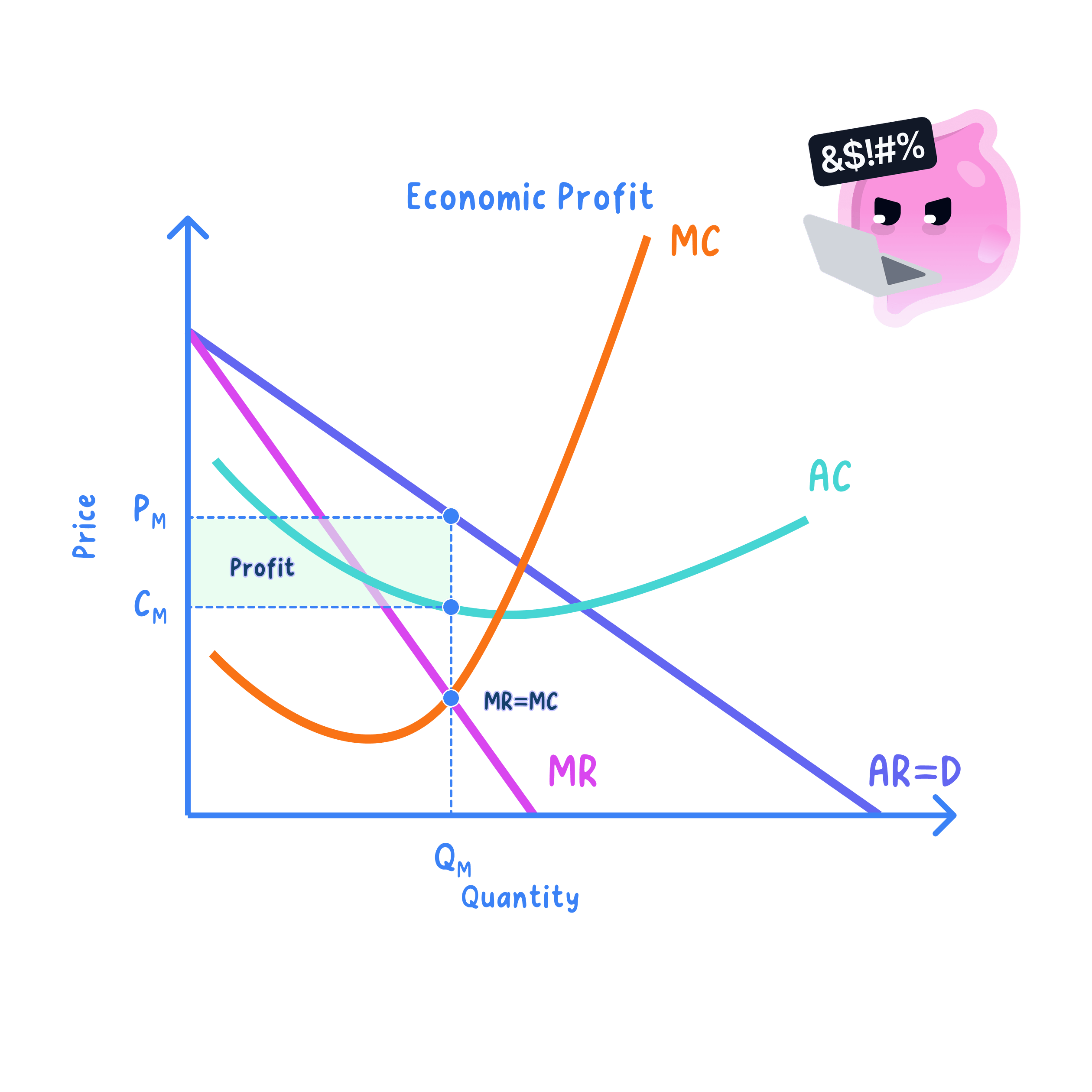
- Locate the output where the MC curve cuts the MR curve from below.
- Read the price by going up from that output to the average revenue (demand) curve.
- The firm earns supernormal profit when average revenue exceeds average cost at that output.
Example
- A firm faces marginal revenue of £10 at 3 units, £8 at 4 units and £6 at 5 units, with marginal cost of £6, £8 and £10 at those same outputs.
- At 3 units MR of £10 > MC of £6, so producing more adds to profit.
- At 5 units MC of £10 > MR of £6, so the last unit reduces profit.
- Profit is therefore maximised at 4 units, where MC = MR = £8.
- If price (average revenue) is £12 and average cost is £9 at 4 units, supernormal profit = (12 − 9) × 4 = £12.
Note
- On the standard diagram, plot the marginal cost, marginal revenue, average cost and average revenue (demand) curves.
- Mark the profit-maximising output where marginal cost cuts marginal revenue from below, then read the price up to the average revenue curve.
- Shade supernormal profit as the rectangle between average revenue and average cost at that output.
Example
- If the last unit adds the same to cost as it adds to revenue (MC = MR), that output maximises profit.
- Producing one more unit whose MC > MR would reduce total profit.
Short run and long run
- Even at the MC = MR output, a firm may still be making a loss.
- In the short run it keeps producing as long as price at least covers average variable cost.
- If price falls below average variable cost the firm shuts down, limiting its loss to fixed costs.
- In the long run the firm must cover all costs, including normal profit, or it leaves the industry.
Note
- Normal profit is the minimum reward needed to keep the entrepreneur in the industry.
- Because it is a necessary payment, normal profit is treated as a cost and is included in average cost.
Why firms value profit
- Profit rewards the entrepreneur for bearing risk and organising the other factors of production.
- Retained profit is a cheap internal source of finance for investment.
- Strong profit reassures shareholders and helps the firm borrow on better terms.
Key Idea
- Profit is at once a reward for risk, a source of finance and a signal of success.
- This is why the traditional model treats maximum profit as the firm's central goal.
How realistic is the MC = MR assumption?
- The rule is a sound benchmark because any firm genuinely chasing the largest profit has an incentive to expand while MR > MC and cut back while MC > MR, so even managers who never draw the curves are pushed towards the MC = MR output, and in competitive markets firms that stray far from it are punished by losses.
- But firms rarely know their marginal cost and marginal revenue schedules precisely, so in practice many set prices by adding a mark-up to average cost (cost-plus pricing); with imperfect information the MC = MR point is an approximation the firm estimates rather than a figure it can read off.
- The model also assumes a single profit-seeking decision-maker, yet where ownership is divorced from control the principal-agent problem lets salaried managers pursue sales, growth or an easier life, so the firm may settle away from strict profit maximisation.
- On balance, MC = MR remains the soundest analytical starting point and a fair long-run approximation, but how closely a real firm reaches it depends on the quality of its cost and revenue information, how contestable its market is, and how well owners can align managers with the profit goal.
Exam technique
- Always state both parts of the rule: MC = MR and marginal cost is rising through it.
- On a diagram, find the output at MC = MR, then read the price up to the average revenue curve.
Common Mistake
- Do not confuse the profit-maximising rule with break-even, where average revenue = average cost.
- MC = MR maximises profit, not revenue, so do not read the price off the marginal revenue curve.
Self review
- State the profit-maximising rule in full.
- Why must marginal cost be rising as it cuts marginal revenue?
- How do you find the profit-maximising price on a diagram?
- When does a loss-making firm shut down in the short run?
- Give two reasons firms value profit.
