Tools of monetary policy
Definition
Interest rate: the price of borrowing money or the reward for saving; the central bank's policy interest rate anchors interest rates across the whole economy.
Money supply: the total stock of money in circulation in the economy.
Quantitative easing (QE): a central bank creating new money to buy financial assets, mainly government bonds, so as to raise the money supply and lower longer-term interest rates.
Credit regulations: rules set by the authorities that control how much, and how easily, banks can lend.
Interest rates
- The policy interest rate is the central bank's main lever.
- Raising it makes borrowing dearer and saving more attractive.
- This dampens consumption and investment, so aggregate demand falls.
- Cutting it does the reverse, cheapening credit and raising aggregate demand.
Money supply
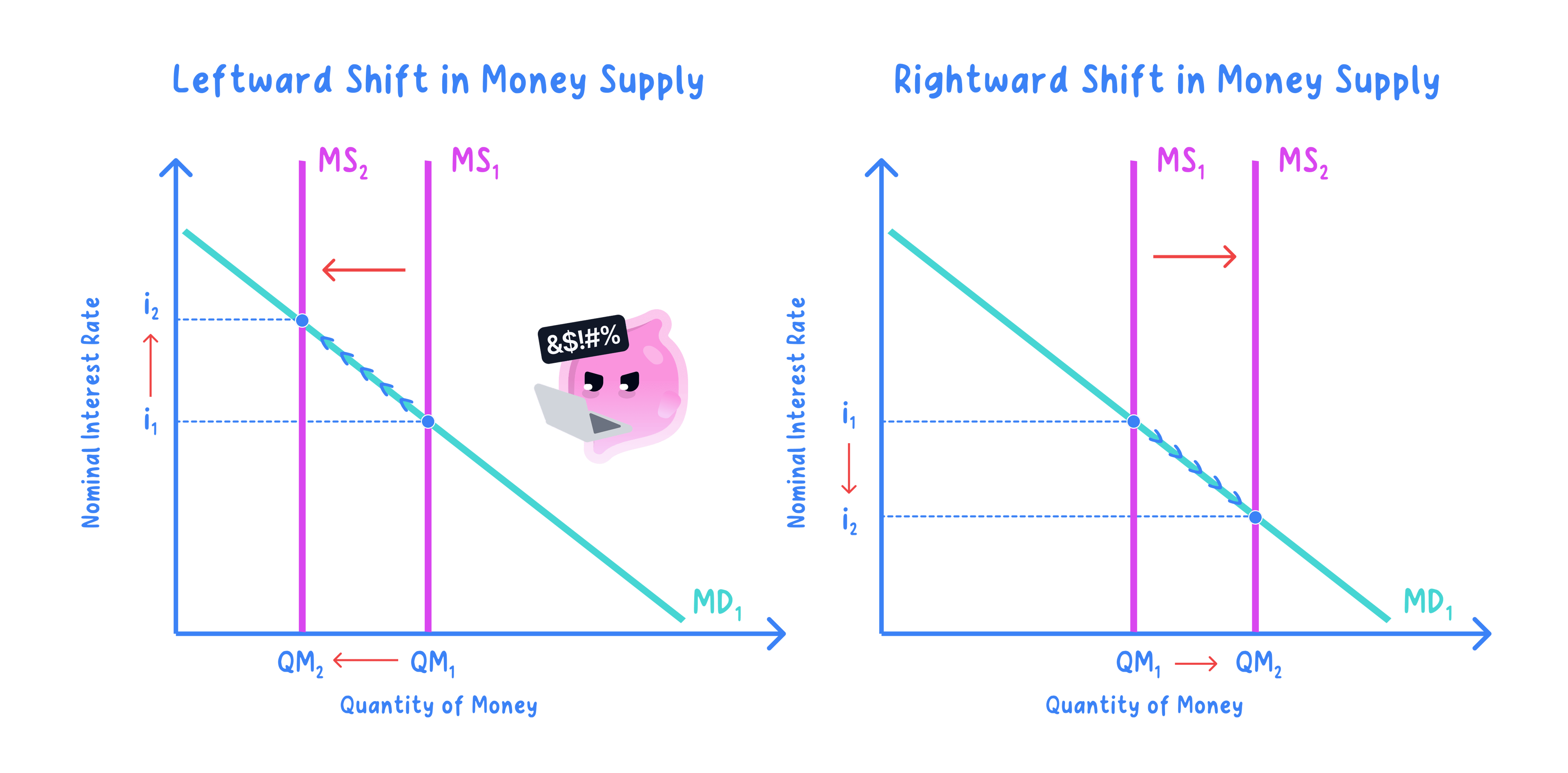
- Through quantitative easing the central bank buys government bonds from banks and pension funds.
- More money and lower bond yields push down longer-term interest rates, encouraging lending and spending.
- It can shrink the money supply by selling bonds through open market operations.
- A smaller money supply raises interest rates and squeezes spending.
Key Idea
- All three tools work by changing the cost and availability of credit.
- Each ultimately shifts aggregate demand, so the choice is about strength and speed, not direction.
Credit regulations
- Reserve requirements set the fraction of deposits a bank must hold rather than lend.
- Raising them shrinks the money banks can create through lending, tightening credit.
- Loan-to-value limits cap how much can be borrowed against an asset, restraining riskier lending.
- Such rules can cool credit growth even when the interest rate is left unchanged.
Example
- Suppose UK inflation reaches 6%, well above the 2% target, so the Bank of England tightens policy.
- It raises the policy rate from 2% to 3.5% and supervisors lift banks' reserve requirements.
- A £250,000 variable mortgage then costs roughly £3,750 more a year in interest, and banks ration new lending.
- Facing dearer, scarcer credit, households and firms cut consumption and investment, so aggregate demand falls.
- On an AD/AS diagram (average price level against real output), AD shifts left from AD1 to AD2.
- The price level rises more slowly towards target, though the full effect depends on time lags.
How reliably do these tools control aggregate demand?
- The tools work because they all change the cost and availability of credit, so when borrowing is interest-elastic even a modest rate change swings consumption and investment, moving aggregate demand in the intended direction.
- However, the effect depends on confidence and the state of the economy: if firms and households are pessimistic, cheaper credit may not revive spending, banks may not pass on the full rate change, and lending can migrate to lenders that credit rules do not reach.
- On balance, the tools do push aggregate demand the right way, but how far and how fast depends on interest-elasticity, the level of confidence and the time lag before borrowing decisions respond, which is why a central bank usually combines all three rather than relying on one.
Exam technique
- Learn all three tools, since questions may ask for more than just interest rates.
- Link each tool to its effect on the cost or availability of credit.
- Finish every chain at aggregate demand, output and the price level.
Common Mistake
- Do not treat the money supply and the interest rate as unrelated tools.
- Changing the money supply also affects interest rates, and vice versa.
- Do not describe quantitative easing as printing cash to hand out; it is bond buying.
Self review
- Name the three tools of monetary policy.
- How does raising the policy interest rate affect spending?
- What is quantitative easing?
- How does a higher reserve requirement reduce lending?
- Give one example of a credit regulation.
