The financial firefighter
Definition
International Monetary Fund (IMF): an organisation of member countries that promotes exchange rate stability and lends short-term to members facing balance of payments difficulties.
Conditionality: the set of policy reforms a borrowing government must implement to receive and keep IMF finance.
Moral hazard: the danger that the expectation of a rescue encourages governments or lenders to take on more risk than they otherwise would.
- The International Monetary Fund (IMF) promotes global monetary cooperation and financial stability among its member countries.
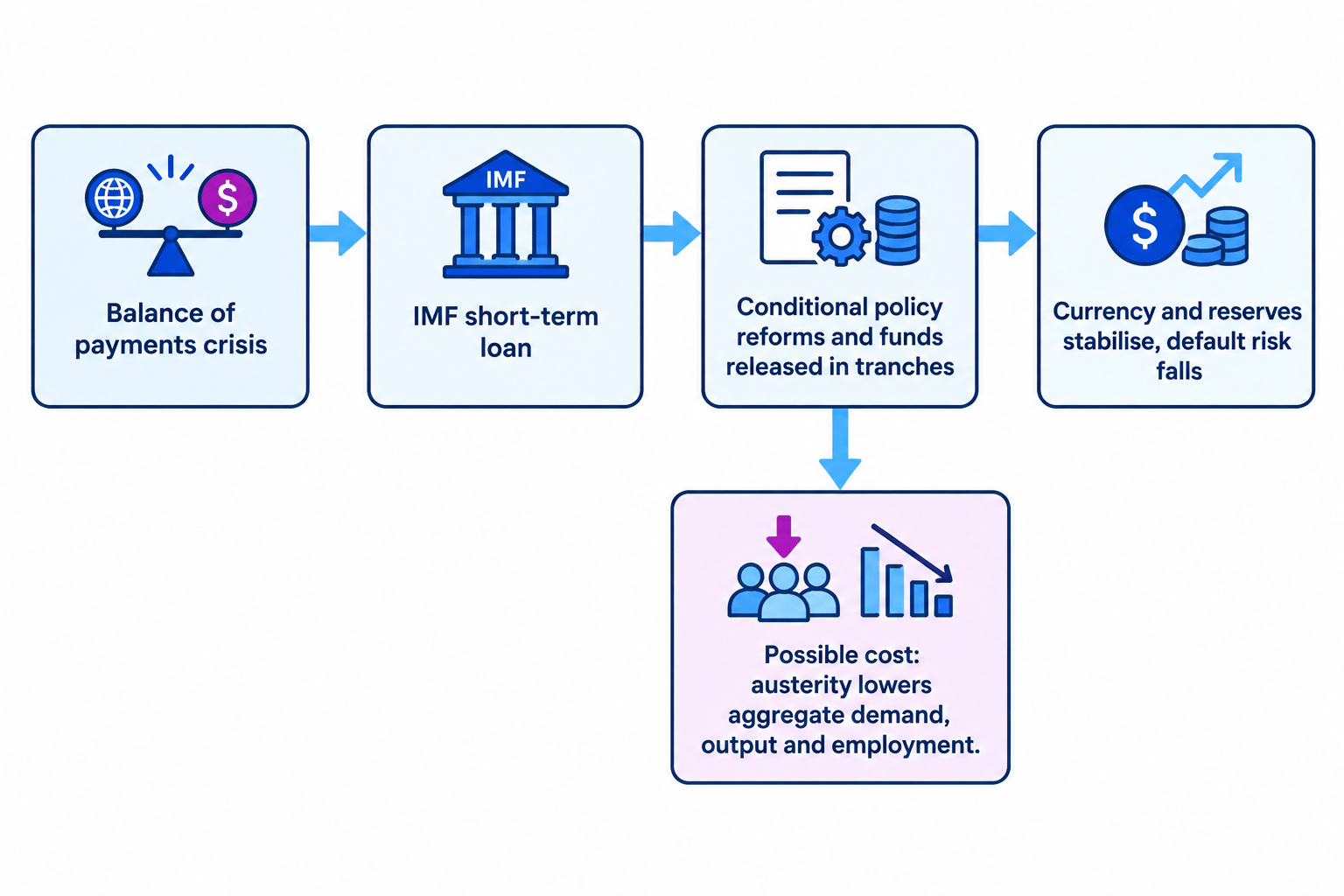
- It lends short-term to a country in a balance of payments crisis, so the country can keep paying for essential imports and servicing foreign debt.
- This lending is tied to conditionality: the government must carry out agreed reforms before further funds are released.
Key Idea
- The IMF is the world's short-term financial firefighter.
- It lends to countries in crisis in return for policy reform, not for long-term development.
What the IMF does
- Crisis lending
- It provides emergency foreign currency to a country whose reserves are too low to cover imports or debt repayments, which prevents a disorderly default.
- Conditionality
- Funds are released in tranches only if the government hits targets such as cutting the budget deficit or freeing up markets, which is meant to restore solvency but can squeeze demand.
- Surveillance
- It monitors member economies and the global system, so risks such as an overvalued currency can be flagged before they trigger a crisis.
- Technical assistance
- It trains officials in tax collection, budgeting and exchange rate management, raising the quality of policy over time.
Note
- The IMF handles short-term stability and balance of payments crises, while the World Bank funds long-term development projects.
- Keeping the two institutions apart is an easy way to signal precise knowledge.
Evaluation: help or harm?
- Strengths
- Emergency finance can stop a crisis in one country spreading to its trading partners and lenders, containing contagion.
- The funds buy time for a government to stabilise its currency and rebuild reserves rather than default abruptly.
- Criticisms
- Deficit-cutting conditions reduce government spending, which lowers aggregate demand and can deepen the very recession the loan was meant to ease.
- A standardised reform package may ignore a country's particular circumstances, so the medicine can do more harm than good.
- Repeated bailouts can create moral hazard, as governments delay hard reforms expecting the IMF to step in again.
- Judgement
- On balance, IMF support is effective at the narrow job it is built for, restoring short-run liquidity and confidence and heading off a disorderly default that would spread to trading partners; it does little directly for long-run development, and its net effect is positive only where conditions are realistic, well paced and matched to the country's circumstances, and can be negative where blanket austerity deepens the downturn it was meant to cure.
Example
- In 2018 Argentina agreed a record $57bn IMF programme to defend the peso and cover its financing gap.
- Conditions required deep spending cuts, so aggregate demand fell, the recession deepened, and by 2020 the country was again renegotiating its debts.
- The case shows conditionality can steady a currency in the short run yet worsen output, so the net effect depends on how reforms are designed and paced.
Exam technique
- Be clear the IMF deals with short-term stability, not long-run development.
- Link its lending explicitly to a balance of payments crisis.
- Evaluate conditionality using aggregate demand, austerity and moral hazard.
- Use a named case such as Argentina or Greece to earn application marks.
Common Mistake
- Do not confuse the IMF with the World Bank.
- The IMF handles short-term crises, while the World Bank funds long-term development.
- Do not treat IMF loans as costless.
- Conditions and austerity can carry real output and welfare costs.
Self review
- What is the main role of the IMF?
- What kind of assistance does the IMF provide, and over what time horizon?
- What is conditionality, and why is it attached to loans?
- How does the IMF differ from the World Bank?
- Give one criticism of IMF lending and explain its mechanism.