Price discrimination
Definition
Price discrimination: charging different consumers different prices for the same good or service, where the price difference does not reflect a difference in the cost of supply.
- It allows the firm to convert some consumer surplus into extra profit.
- Economists distinguish first, second and third degree price discrimination.
Key Idea
- The firm charges more to consumers whose demand is less price-sensitive.
- The aim is to capture surplus that a single price would leave with consumers.
Conditions for discrimination
- The firm must be a price maker with some market power to set price above marginal cost.
- Consumers must be separable into groups with different price elasticities of demand.
- There must be no resale between the groups, or the cheaper buyers would undercut the dearer ones.
First-degree price discrimination
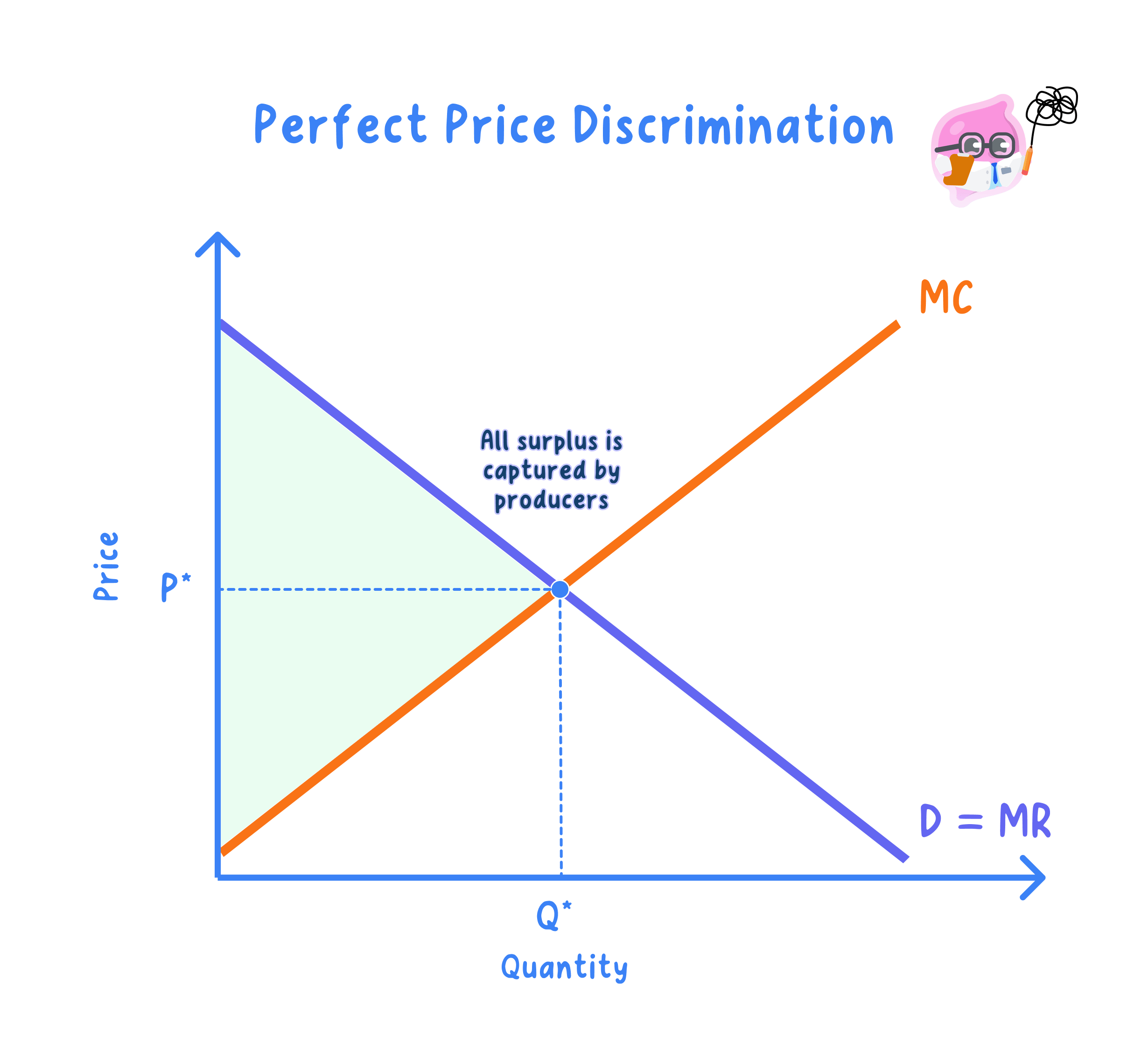
- The firm charges each consumer the maximum they are willing to pay for each unit.
- This captures the entire consumer surplus as profit.
- It is rare because the seller needs to know each buyer's willingness to pay, as in individual bargaining or auctions.
Second-degree price discrimination
- The price varies with the quantity bought or the version chosen.
- Consumers effectively sort themselves by how much they buy.
- Examples include bulk discounts and block tariffs for electricity or water.
Third-degree price discrimination
- The firm splits the market into identifiable groups by age, time of use or location, each with its own demand.
- It sets a higher price in the inelastic sub-market and a lower price in the elastic sub-market.
- In each sub-market the firm produces where MC = MR, sharing a common marginal cost.
Example
- A rail operator charges peak commuters, whose demand is inelastic, more than off-peak leisure travellers.
- Cheaper student or senior cinema tickets separate a more price-sensitive group from full-fare buyers.
Note
- The third-degree diagram shows the two sub-markets side by side, each with its own demand and marginal revenue but sharing a common marginal cost.
- Each sub-market sets marginal revenue equal to that common marginal cost, giving a higher price in the more inelastic market and a lower price in the more elastic market.
Two sub-market example
- A firm supplies one good to two separable markets at a constant marginal cost of £2 per unit.
- Market A has the less elastic demand P = 20 − Q, while market B has the more elastic demand P = 12 − Q.
- With a single price the firm maximises profit at £9, selling 11 units in A and 3 units in B, for total revenue of £126.
- By discriminating it instead sets MR = MC in each market separately.
- This gives a higher price of £11 in the less elastic market A and a lower price of £7 in the more elastic market B.
- Total output is unchanged at 14 units, yet total revenue rises from £126 to £134.
Example
- At a single price of £9 the firm sells 14 units in total and earns total revenue of £126.
- Discriminating, it charges £11 in the more inelastic market A for 9 units and £7 in the more elastic market B for 5 units, earning £99 and £35.
- Total revenue rises to £134, so charging the higher price where demand is less elastic raises revenue by £8.
Consequences of price discrimination
- The firm earns higher profit by converting consumer surplus into producer surplus.
- Consumers in the inelastic group lose surplus by paying more, while those in the elastic group may pay less.
- Cross-subsidy can keep a service running that a single price would make unprofitable, widening access.
- The extra profit may fund investment and innovation, but it also reduces consumer surplus and can be seen as unfair.
Key Idea
- Price discrimination has clear winners and losers, so its overall effect on welfare is ambiguous.
- Judge it case by case, weighing higher profit and wider access against lost consumer surplus.
Is price discrimination against the consumer interest?
- It can clearly work against consumers because it transfers surplus from buyers to the firm: first-degree discrimination extracts the whole consumer surplus, and even third-degree discrimination forces the inelastic group, often those with the least choice such as peak commuters, to pay more, which many regard as inequitable.
- But it can also serve consumers, because price-sensitive groups such as students, off-peak travellers or lower-income buyers gain access at lower prices they would not otherwise be offered, and cross-subsidy can keep running a service that a single price would make unprofitable, so total output and access can be greater than under uniform pricing.
- The extra producer surplus is not necessarily wasted either, since in industries with high fixed costs it may fund investment and innovation (dynamic efficiency), though this benefits consumers only where competition or regulation stops the profit being retained as pure excess.
- On balance, price discrimination is not automatically against the consumer interest; whether consumers gain depends on the degree of discrimination, which group a consumer is in, whether the good is essential or one they can do without, whether cross-subsidy genuinely widens access and raises output, and whether the higher profit is reinvested rather than simply pocketed.
Exam technique
- For third-degree discrimination, draw two sub-markets sharing a common marginal cost and set MC = MR in each.
- Always name the three conditions and evaluate consequences for both the firm and each consumer group.
Common Mistake
- Do not forget the no-resale condition, since arbitrage would collapse the scheme.
- Do not confuse price discrimination with genuine cost differences or with product differentiation.
Self review
- Define price discrimination.
- State the three conditions for effective price discrimination.
- How do first, second and third degree discrimination differ?
- In third-degree discrimination, which group pays the higher price and why?
- Give one gain and one loss from price discrimination.
