Redistribution Policies
- Redistribution aims to reduce poverty and inequality and to achieve a fairer distribution of income and wealth.
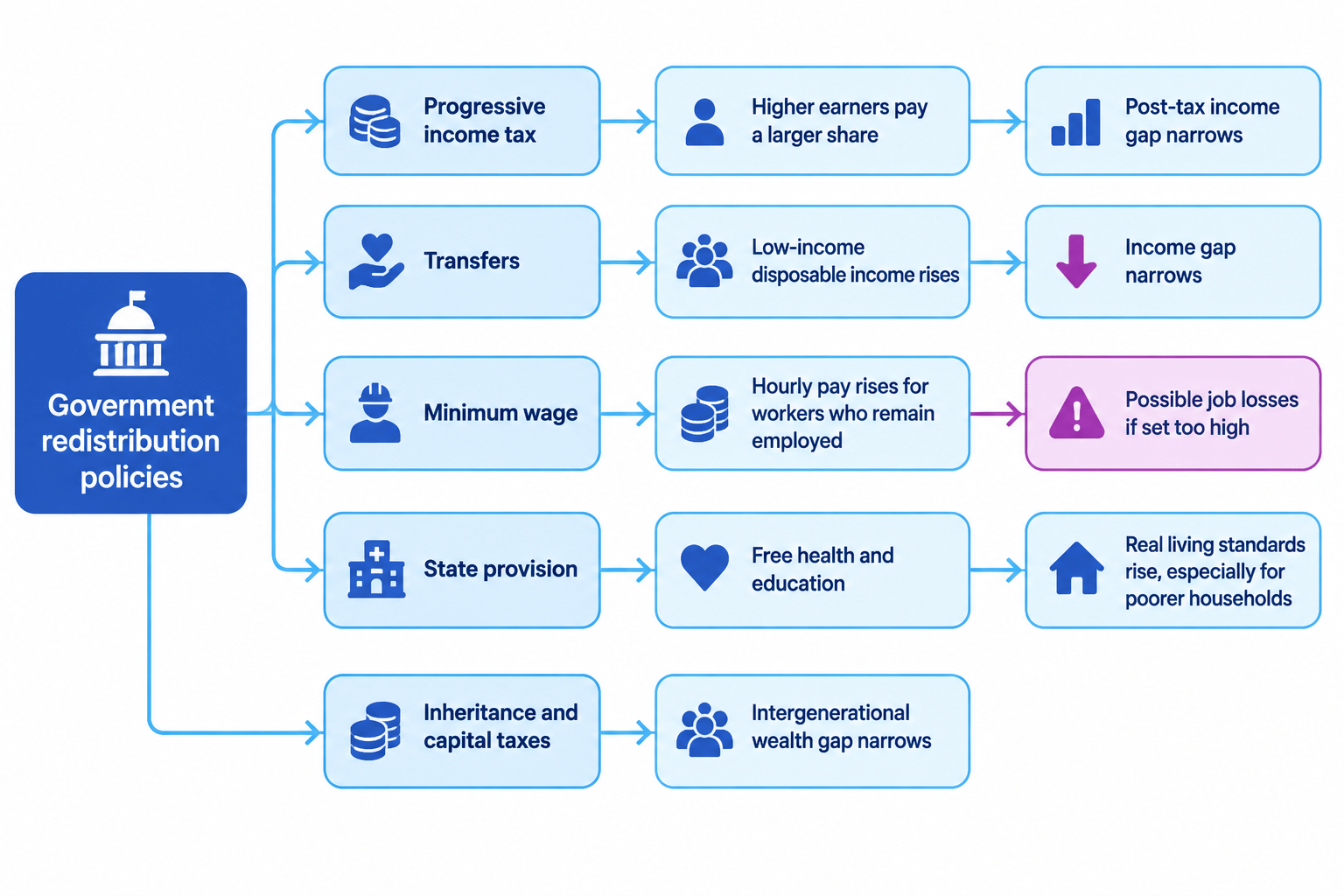
- Governments use taxes, transfers, a wage floor and state provision to do this.
- Each tool changes the distribution of income or wealth through a different mechanism.
Key Idea
- Redistribution moves resources from higher-income to lower-income households.
- A policy only redistributes if it narrows the gap between rich and poor, not merely if it raises spending.
Progressive And Wealth Taxes
Definition
Progressive income tax: a tax that takes a rising proportion of income as income rises, so higher earners pay a larger % of their income in tax.
Inheritance and capital taxes: taxes on transfers of wealth and on gains made on assets, which reach the stock of wealth rather than the flow of income.
Average tax rate
Average tax rate=tax paidincome×100 \text{Average tax rate}=\dfrac{\text{tax paid}}{\text{income}}\times 100 Average tax rate=incometax paid×100- The average tax rate is the proportion of total income paid in tax, and under a progressive tax it rises as income rises.
- So higher earners give up a larger share of income than lower earners.
- This narrows the gap between post-tax incomes, directly reducing income inequality.
- Inheritance and capital taxes reach wealth that income tax never touches, taxing it as it passes on.
- These reduce the build-up of unequal wealth as it passes between generations.
Example
- Income up to £10,000 is untaxed, income from £10,000 to £40,000 is taxed at 20% and income above £40,000 at 40%.
- A £50,000 earner pays £0 on the first £10,000, £6,000 on the next £30,000 and £4,000 on the top £10,000, a total of £10,000.
- A £15,000 earner pays only £1,000, an average rate of about 7%, so the higher earner gives up a larger share — the mark of a progressive tax.
Transfers And Wage Floors
Definition
Transfer payment: a payment from government to individuals, such as a pension, unemployment benefit or child support, made without any good or service in return.
Minimum wage: a legal floor on the pay an employer may offer, set above the market equilibrium wage for the lowest-paid workers.
- Transfer payments move money to those on low incomes, raising their disposable income.
- They lift the poorest without requiring output in return, narrowing the income gap.
- A minimum wage raises the hourly pay of the lowest-paid workers who keep their jobs.
- This lifts incomes at the bottom, so the pay distribution becomes less unequal.
Example
- A minimum wage of £11 per hour set above the £9 market wage raises the pay of low-skilled workers who stay employed.
- But at £11 firms may demand less labour, so some workers could lose their jobs — an equity gain for some at an efficiency cost.
State Provision
- State provision of essential goods and services gives health and education free at the point of use.
- These services are funded from taxation but consumed regardless of ability to pay.
- Because they are worth a larger share of a poor household's living standards, they reduce inequality in real terms.
Example
- Free state schooling worth about £7,000 per child a year is worth relatively more to a low-income household than a rich one.
- This raises their real living standards even though their money income is unchanged.
How effective are these policies?
- Used together these tools do reduce measured inequality, because taxes and transfers noticeably lower the Gini coefficient in most developed economies, and transfers and state provision are the most direct and reliable since they raise the real living standards of the poorest regardless of the labour market.
- Against this, progressive taxes and transfers can weaken incentives to work if marginal tax rates become very high.
- High capital and inheritance taxes may encourage avoidance or the movement of wealth abroad, so they raise less than expected.
- A minimum wage set too high risks creating unemployment among low-skilled workers, which can worsen the position of those it aims to help.
- State provision requires tax funding and can strain the government budget.
- So how much to redistribute involves an equity–efficiency trade-off, and the right mix depends on how responsive workers and savers are to higher tax rates.
- On balance a mix of policies redistributes more effectively than any single tool, because transfers and state provision reliably lift the poorest while progressive taxes fund them, but how much inequality actually falls, and at what efficiency cost, depends on how responsive workers and savers are to higher tax rates, how well targeted the transfers are, the level at which the minimum wage is set relative to productivity, and the strength of tax enforcement.
Exam technique
- For each policy, explain the mechanism by which it changes the distribution before evaluating it.
- Match income tools such as progressive tax to income inequality and wealth taxes to wealth inequality.
Common Mistake
- Do not simply list policies without explaining how each one redistributes.
- Do not assume redistribution is costless, because most policies affect incentives or the budget.
Self review
- State the aim of redistribution.
- Name four types of redistribution policy.
- How do inheritance and capital taxes reduce inequality?
- Give one drawback of a minimum wage as a redistribution tool.