Opportunity cost
Definition
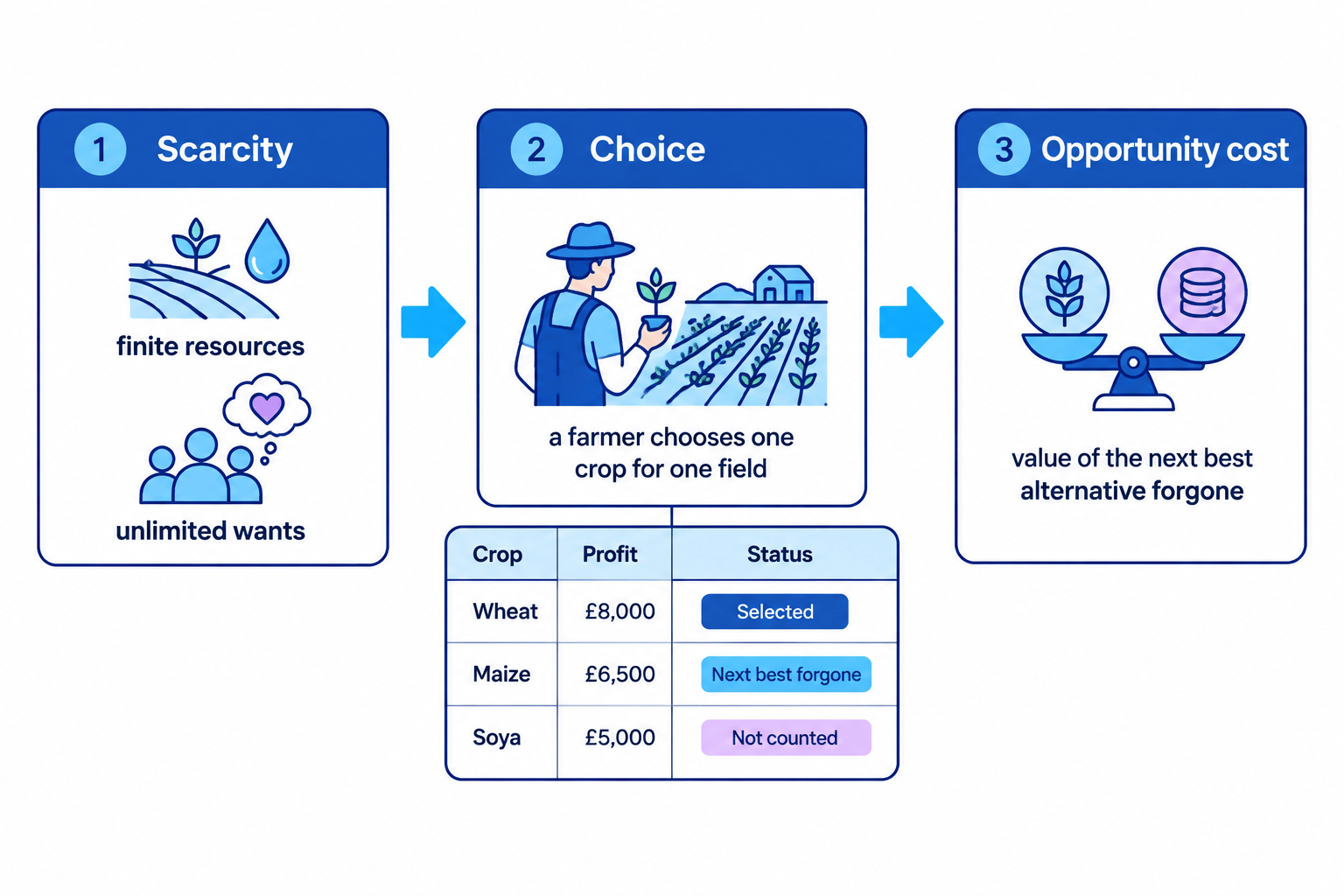
Opportunity cost: the value of the next best alternative that is given up when a choice is made.
Free good: a good so abundant that using it uses up no scarce resource, so it has a zero opportunity cost.
- The fundamental economic problem is scarcity: resources are finite while human wants are effectively unlimited.
- Because resources are limited, using them for one purpose makes them unavailable for another.
- This means every use of a resource forces a choice between competing alternatives.
- Choosing one alternative means the others must be given up.
- The value of the single next best alternative that is given up is the opportunity cost.
- It is the next best option only, not the total value of every option that was rejected.
Key Idea
- Scarcity is permanent and affects every economy, however rich or poor.
- Opportunity cost is the value of the next best alternative given up, not the value of every alternative added together.
Scarcity, choice, cost
- Scarcity
- Limited resources cannot meet unlimited wants, so something always has to give.
- Choice
- Scarcity forces every agent to select some options and reject others.
- Opportunity cost
- A choice is only worthwhile if its benefit is greater than the next best thing given up.
Example
- A farmer owns one field and can plant it with only one crop this season.
- Wheat would earn a profit of £8,000, maize £6,500 and soya £5,000.
- The farmer plants wheat because it earns the most.
- The opportunity cost is the maize, the next best alternative, whose £6,500 profit is forgone.
- It is not the £5,000 from soya and not the £11,500 from maize and soya added together, because only the single next best option counts.
Cost for each agent
- Consumers
- Spending on one good means forgoing another, such as a holiday instead of a new phone.
- For example, spending £40 on a concert ticket means that same £40 can no longer be saved or spent on a meal out.
- Firms
- Using capacity to make one product sacrifices the profit from the next best product.
- For example, a firm using a machine to make Product A gives up the £5,000 profit it could have earned making Product B.
- Government
- Every spending decision trades off against the next best public project or a tax cut.
- For example, using a fixed budget on defence gives up the schools that same money could have funded.
How useful is it?
- It forces decision-makers to treat resources as costly rather than free, which improves the quality of choices.
- In practice the next best alternative is not always known, so the cost can be hard to pin down.
- Some sacrifices, such as time, health or the environment, are real but difficult to value in money.
- Even so, thinking in opportunity-cost terms is one of the most widely applied ideas in the whole subject.
Exam technique
- Define opportunity cost precisely as the next best alternative forgone, not simply what you lose.
- Name the specific sacrifice in the context given rather than talking in general terms.
- Use it to justify a decision by comparing the benefit gained with the best alternative given up.
Common Mistake
- Do not confuse scarcity with a shortage.
- Scarcity is the permanent gap between wants and resources, while a shortage is a temporary excess of demand over supply at the current price.
- Do not treat opportunity cost as the sum of all the alternatives.
- It is only the single next best option that is given up.
Self review
- Define the fundamental economic problem.
- What is the difference between scarcity and a shortage?
- Define opportunity cost precisely.
- Give an opportunity cost example for a consumer, a firm and a government.
- Why can opportunity cost be hard to measure in practice?