The Natural Rate
Definition
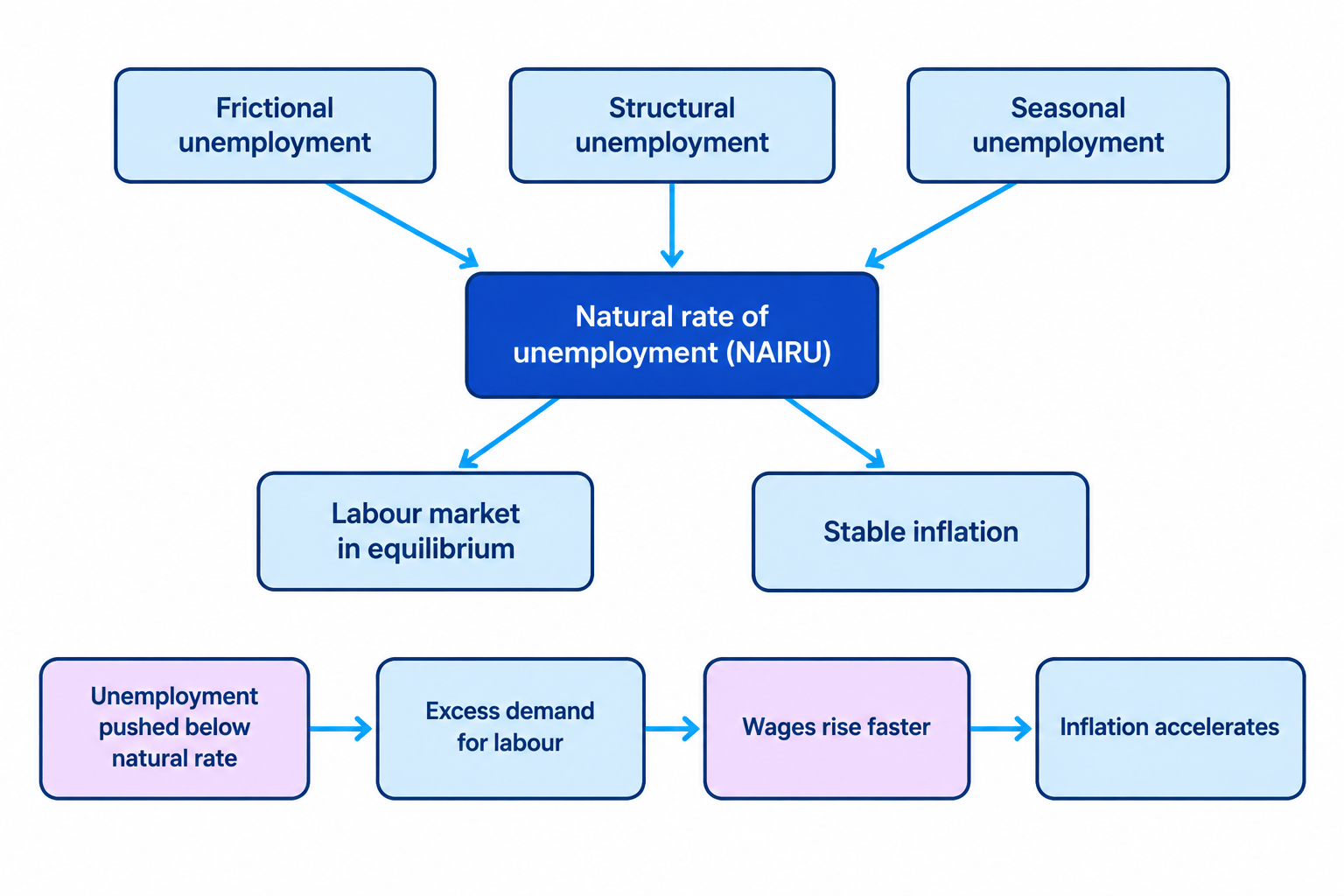
Natural rate of unemployment: the rate that remains when the labour market is in equilibrium, made up of frictional, structural and seasonal unemployment, so there is no excess demand or supply of labour.
NAIRU: the non-accelerating inflation rate of unemployment, the same equilibrium rate viewed as the level at which inflation is stable.
- At the natural rate the only unemployment left is people between jobs or mismatched, not people short of vacancies.
- Because there is no excess demand for labour, wages and therefore prices are not being bid up → inflation is stable.
- So the natural rate matches the unemployment that remains at the full-employment level of output.
Key Idea
- At the natural rate inflation is stable, which is why it is also called the NAIRU.
- It equals the equilibrium unemployment left at full-employment output.
What Makes It Up
- Frictional unemployment comes from workers moving between jobs and searching for the right match.
- Structural unemployment comes from skills and location mismatches as industries decline and others grow.
- Seasonal unemployment follows the time of year, such as fewer tourism jobs in winter.
Example
- Of a labour force of 30 million, 0.9 million are frictionally, structurally or seasonally unemployed while the market is in equilibrium.
- The natural rate here is 3%; demand-side stimulus cannot cut below this without accelerating inflation.
Determinants of the Natural Rate
- The flexibility of the labour market affects how fast the unemployed are matched to vacancies → more flexibility lowers the rate.
- The generosity and duration of unemployment benefits affect the incentive to search → more generous benefits tend to raise the rate.
- The quality of education and training affects occupational mobility → better training lowers structural unemployment.
- Hysteresis can raise the rate after a long spell of high unemployment erodes skills and work habits.
Policy Implications
- The natural rate sets a floor that demand-side policy cannot easily cross, since it reflects supply-side frictions not weak demand.
- Pushing unemployment below the natural rate creates excess demand for labour → wages and prices are bid up → inflation accelerates.
- It depends on the tools used: lowering the natural rate itself needs supply-side policies such as training and benefit reform, not demand-side stimulus.
Exam technique
- State that the natural rate is frictional plus structural plus seasonal unemployment.
- Link it to stable inflation at full-employment output.
Common Mistake
- Do not treat the natural rate as 0%.
- It is the equilibrium unemployment that remains when the market clears.
Self review
- Define the natural rate of unemployment.
- What three types make it up?
- Name two determinants of the natural rate.
- Why can demand-side policy not easily push below it?