Equilibrium and Disequilibrium
Definition
Equilibrium unemployment: the unemployment that remains when the labour market clears, so the number searching for work equals the number of vacancies; it is made up of frictional and structural unemployment.
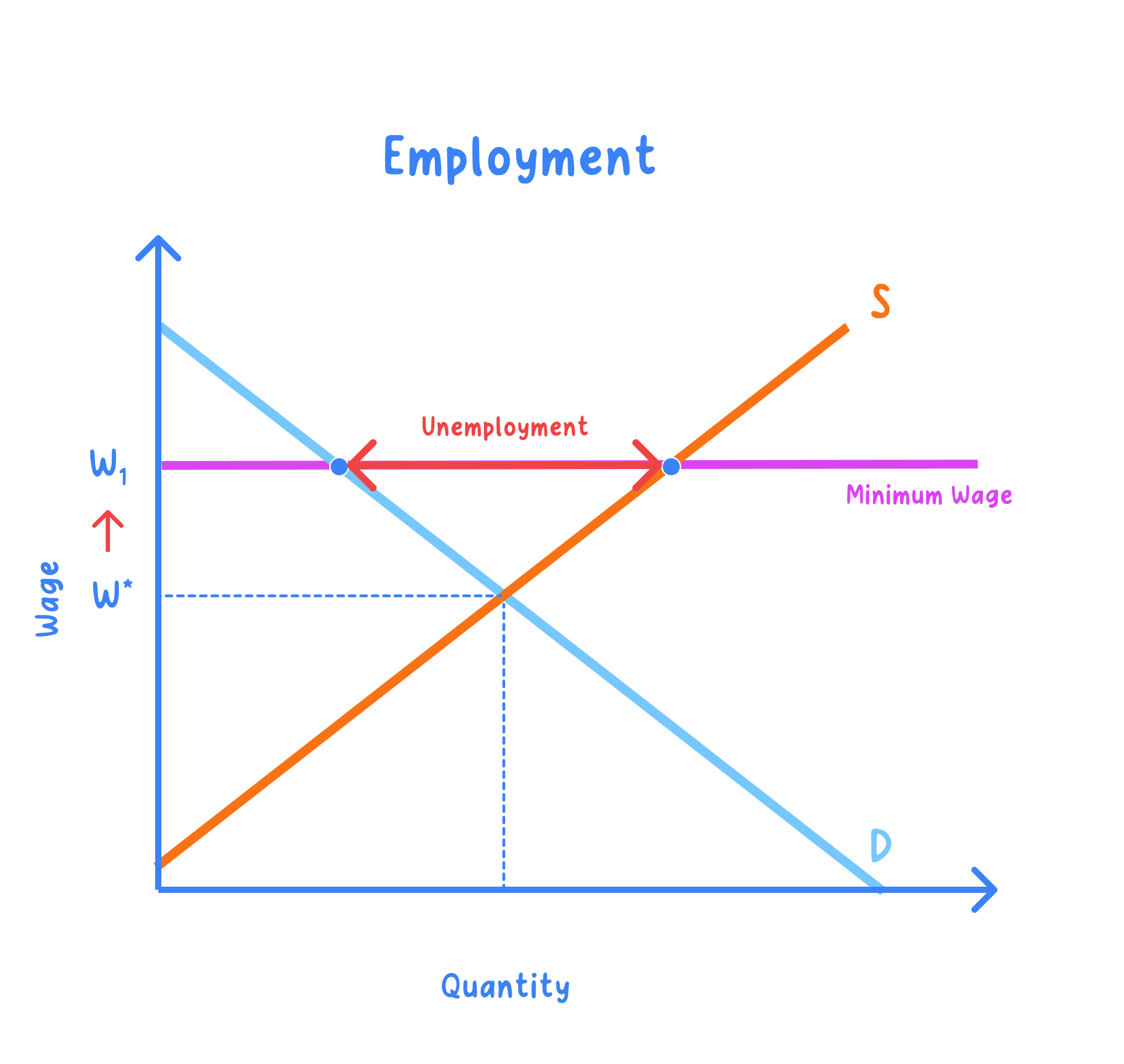
Disequilibrium unemployment: unemployment that exists because the labour market does not clear at the current wage, so the supply of labour exceeds the demand for labour.
- When the real wage is stuck above the clearing level, some willing workers are priced out → an excess supply of labour appears as disequilibrium unemployment.
- When the market does clear, only equilibrium unemployment is left because those workers are between jobs or mismatched, not short of vacancies.
- So the key test is whether the wage has adjusted to bring labour supply and demand into balance.
Key Idea
- Equilibrium unemployment is frictional plus structural, left even when the market clears.
- Disequilibrium unemployment arises when wages are held above clearing or aggregate demand falls.
Two Sources of Disequilibrium
- Real-wage (classical) unemployment arises when the wage is held above the clearing level, for example by a minimum wage or union power → firms demand less labour.
- Demand-deficient (cyclical) unemployment arises when a fall in aggregate demand cuts the derived demand for labour while wages are slow to fall.
- Both are disequilibrium because the wage does not fall fast enough to clear the market.
Showing It in the Market
- On a labour market diagram the vertical axis is the wage rate and the horizontal axis is the quantity of labour.
- A wage set above the clearing level makes labour supplied exceed labour demanded → an excess supply gap.
- That horizontal gap between supply and demand is the disequilibrium unemployment.
Example
- At a clearing wage of £9 per hour 20 million work; a minimum wage of £11 raises labour supplied to 22 million but cuts labour demanded to 18 million.
- Excess supply = 22 − 18 = 4 million workers, which is the disequilibrium unemployment created.
- The £2 gap above the clearing wage prices out about 18% of those who want to work at that wage → real-wage unemployment.
What Hysteresis Adds
Definition
Hysteresis: the tendency for high unemployment to persist long after its original cause has passed, because long spells out of work erode workers' skills and attachment to the labour force.
- A deep recession pushes many into long-term unemployment → their skills decay and employers view them as less hireable.
- When demand recovers these workers are not re-absorbed → a temporary rise in unemployment becomes long-lasting.
- So hysteresis can raise the natural rate itself, meaning demand-side recovery alone will not restore full employment.
Will the labour market always self-correct back to equilibrium unemployment?
- In the classical view disequilibrium unemployment should be temporary: an excess supply of labour pushes the real wage down until labour demand and supply rebalance, leaving only equilibrium (frictional plus structural) unemployment.
- However, wages are often sticky downwards, held up by minimum wage laws, union contracts and firms' reluctance to cut pay, so disequilibrium unemployment can persist; hysteresis can even raise the natural rate, so a demand recovery alone does not restore full employment.
- On balance, whether the market self-corrects depends on labour market flexibility and the depth of the downturn: flexible economies such as the US, where pay and hiring adjust quickly, return towards equilibrium faster, whereas rigid markets such as Spain and parts of the eurozone after 2008, where unemployment stayed above 20% for years, show hysteresis trapping unemployment well above the natural rate.
Exam technique
- Distinguish equilibrium from disequilibrium unemployment by whether the market clears.
- Use hysteresis to explain why unemployment can persist after a recession ends.
Common Mistake
- Do not confuse equilibrium with disequilibrium unemployment.
- One remains when the market clears, while the other arises when it does not.
Self review
- What is disequilibrium unemployment?
- Name the two sources of disequilibrium unemployment.
- What is equilibrium unemployment made up of?
- What is hysteresis?
- What are the axes on a labour market diagram?
