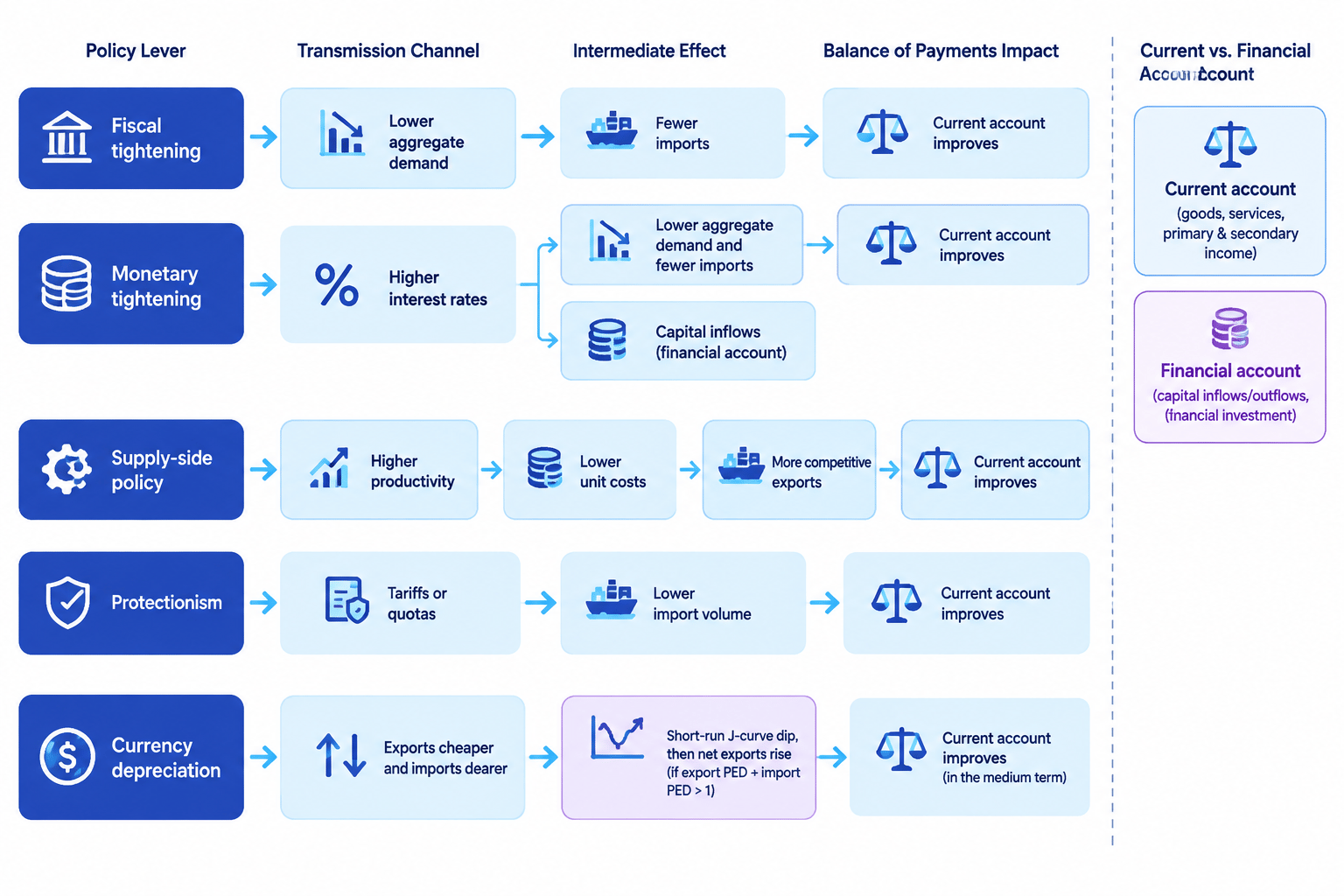
Five policy levers
- Governments can use several policies to influence the balance of payments, especially the current account.
- The main levers are fiscal policy, monetary policy, supply-side policy, protectionism and exchange rate policy.
- Each works through a different channel and carries different side effects.
Key Idea
- Demand-side policies change how much a country spends on imports.
- Supply-side and exchange rate policies change how competitive its exports are.
- Protectionism restricts imports directly.
How each lever works
Definition
Marshall-Lerner condition: a depreciation improves the current account only if the combined price elasticity of demand for exports and imports is greater than 1.
J-curve effect: after a depreciation the current account first worsens, then improves, because trade volumes adjust more slowly than prices.
- Fiscal policy: higher taxes or lower government spending cut aggregate demand, which reduces spending on imports and narrows a current account deficit.
- Monetary policy: higher interest rates cut demand for imports and attract capital inflows onto the financial account, supporting the balance of payments.
- Supply-side policy: raising productivity lowers unit costs, which improves export competitiveness and lifts net exports over time.
- Protectionism: tariffs and quotas raise import prices or cap import volumes, switching demand towards domestic goods.
- Exchange rate policy: a lower currency makes exports cheaper abroad and imports dearer at home, which tends to raise net exports.
Note
- Demand-side and protectionist measures act quickly but carry costs.
- Supply-side policy is slow but improves the current account without harming growth.
How effective is each lever?
- Fiscal and monetary tightening act quickly, usually within a few months, and the fall in imports is roughly the drop in demand multiplied by the marginal propensity to import, but the correction costs output and jobs, so it best suits a deficit driven by excess demand rather than a structural one.
- A lower currency can be powerful, but it improves the current account only if the Marshall-Lerner condition holds, and even then the J-curve means the balance worsens for several months before it improves; the gain also erodes where the economy relies on imported inputs or where trading partners retaliate or devalue in turn.
- Protectionism acts fastest and most directly on import volumes, but its effect is capped by the threat of retaliation and by trade rules, and it raises prices and misallocates resources, so a current account gain can be outweighed by the welfare loss.
- Supply-side policy is the most durable route because it raises competitiveness without deflating demand or raising prices, but it works only over several years, can strain the government budget and has an uncertain payoff, so it fits a structural deficit and the long run.
Which lever should a government use?
- In favour, tightening demand improves the current account quickly and reliably, and protectionism cuts imports directly, so both can stabilise a deficit at speed.
- Against, tightening demand slows growth and raises unemployment, protectionism can provoke retaliation and raise prices, and a devaluation may worsen the balance at first through the J-curve, so each quick fix carries a real cost.
- Supply-side policy is the least damaging route because it lifts competitiveness without deflation, inflation or retaliation, but its payoff is slow and uncertain.
- On balance, the best choice depends on the cause of the imbalance and the time available: expenditure-reducing or protectionist measures for an urgent, demand-driven deficit, and supply-side or exchange rate policy for a structural one, ideally combined so that a short-run stabiliser buys time for a long-run cure.
Example
- A currency falls 10%. Demand for exports has a price elasticity of 0.5 and demand for imports a price elasticity of 0.7.
PED(exports) + PED(imports) = 0.5 + 0.7 = 1.2 > 1
- The sum exceeds 1, so the Marshall-Lerner condition holds and the depreciation should improve the current account once volumes adjust.
Exam technique
- Identify whether the deficit comes from weak competitiveness or excess demand.
- Choose the policy that fits the cause, such as supply-side for a structural problem.
- Trace the effect through exports, imports and the current account.
- Evaluate the side effects, such as slower growth or retaliation.
Common Mistake
- Do not assume a devaluation always improves the current account; it depends on elasticities and the J-curve.
- Do not ignore the side effects of demand-side policy, since cutting demand to fix the current account also cuts growth.
Self review
- Name five policies that can influence the balance of payments.
- How does tightening demand improve the current account, and what determines the size of the fall in imports?
- Why is supply-side policy described as slow but low-cost?
- State the Marshall-Lerner condition and explain the J-curve.
- What is one risk of using protectionism?