Division Of Labour
Definition
Division of labour: the splitting of a production process into separate tasks, each carried out by a different worker who specialises in it.
Specialisation: when a worker, firm or country concentrates on a narrow range of tasks it does relatively well.
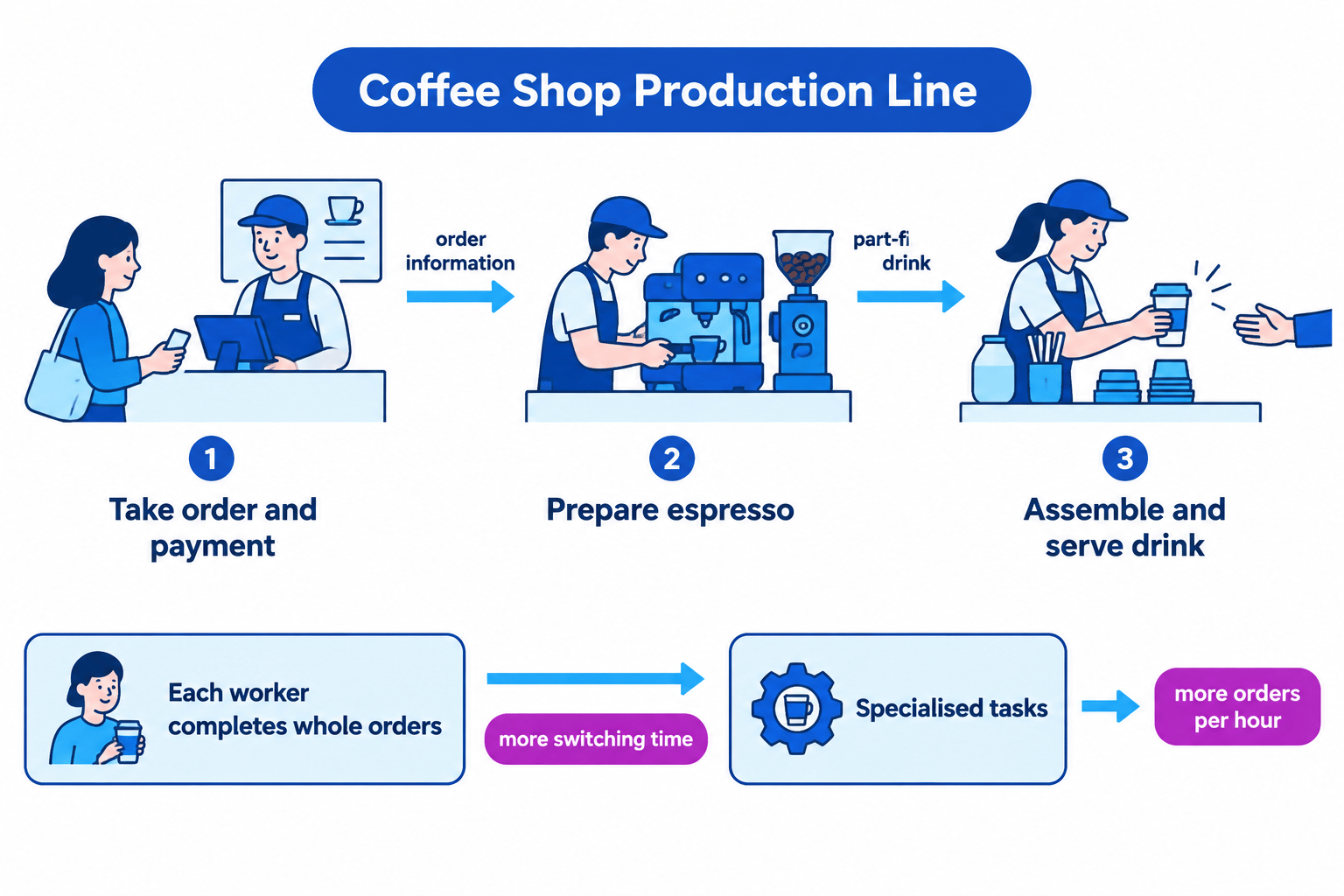
- Picture a busy coffee shop: instead of each person making a whole order, one takes orders, one pulls the espresso and one works the till, so the queue clears far faster.
- Adam Smith argued that dividing the work in this way can sharply raise productivity, the output produced per worker.
- Higher productivity lowers the labour cost of each unit, so firms can produce more at lower cost and cut prices or raise profit.
Key Idea
- Dividing labour raises productivity, which lowers unit costs and raises total output.
- But narrow, repeated tasks also risk boredom, structural unemployment and over-dependence.
Why Productivity Rises
Definition
Productivity: output produced per unit of input, usually measured per worker per hour.
- Skill and practice
- A worker who repeats one task becomes faster and more accurate at it, so more is produced in the same hour.
- Less time switching
- No time is lost moving between different jobs and picking up different tools.
- Use of machinery
- Narrow, repeated tasks are easier to mechanise, which raises output per worker further.
Example
- Adam Smith's pin factory showed that dividing the work let a small team make far more pins than each working alone.
- Working alone one person might make 20 pins a day, but a team of 10 splitting the tasks made about 48,000 a day.
- So productivity rises from 20 pins to 4,800 pins per worker per day, a huge increase.
- Higher output per worker cuts the labour cost of each pin, so unit costs fall and total output rises.
- The same idea underlies the modern assembly line.
The Costs
- Repetitive tasks can cause boredom and lower motivation, which may reduce quality and raise labour turnover.
- Highly specialised workers face structural unemployment if demand for their single skill disappears, because their skill does not transfer to other jobs.
- Over-dependence on narrow tasks makes firms and economies vulnerable when one stage of production is disrupted.
Weighing It Up
- For firms the productivity and cost gains are usually large, which is why the division of labour is so widespread.
- But the gains depend on motivation, since a bored workforce can offset them with lower quality, so it depends on how the work is managed.
- The risks rise the more narrowly workers specialise, so on balance specialisation works best alongside training and some job variety.
Exam technique
- Define productivity precisely and link specialisation to lower unit costs, not just to more output.
- Balance the productivity gains against demotivation and structural unemployment to earn evaluation marks.
- Consider the effect on workers, firms and the whole economy separately.
Common Mistake
- Do not treat specialisation as having only benefits, since it also brings boredom, structural unemployment and over-dependence.
- Do not confuse productivity with production, since productivity is output per worker while production is total output.
Self review
- Define specialisation and the division of labour.
- What is productivity, and how does it differ from production?
- Give two reasons the division of labour raises productivity.
- Give two drawbacks of specialisation.