Definition
Diminishing marginal utility: the tendency for the extra satisfaction from each additional unit of a good to fall as more is consumed within a period.
Law of diminishing marginal utility: the generalisation that this fall in marginal utility applies to almost every good.
This single tendency is what pulls the demand curve downwards, so it sits at the heart of consumer theory.
What it says
- The first unit gives the most satisfaction because the most urgent want is met first.
- Each further unit meets a less urgent want, so it adds a smaller amount of utility.
- So marginal utility declines as quantity rises.
- This holds within a given period, ceteris paribus, with tastes and other goods unchanged.
Example
- A diner buys £3 pizza slices; total utility for the first three slices is 20, 34 and 42 utils.
- The 3rd slice adds 8 utils against 14 from the 2nd, so as hunger eases each slice is worth less.
- Because the next slice is now worth less, the diner will buy more only if the £3 price falls, which is why demand slopes down.
Seeing it in a schedule
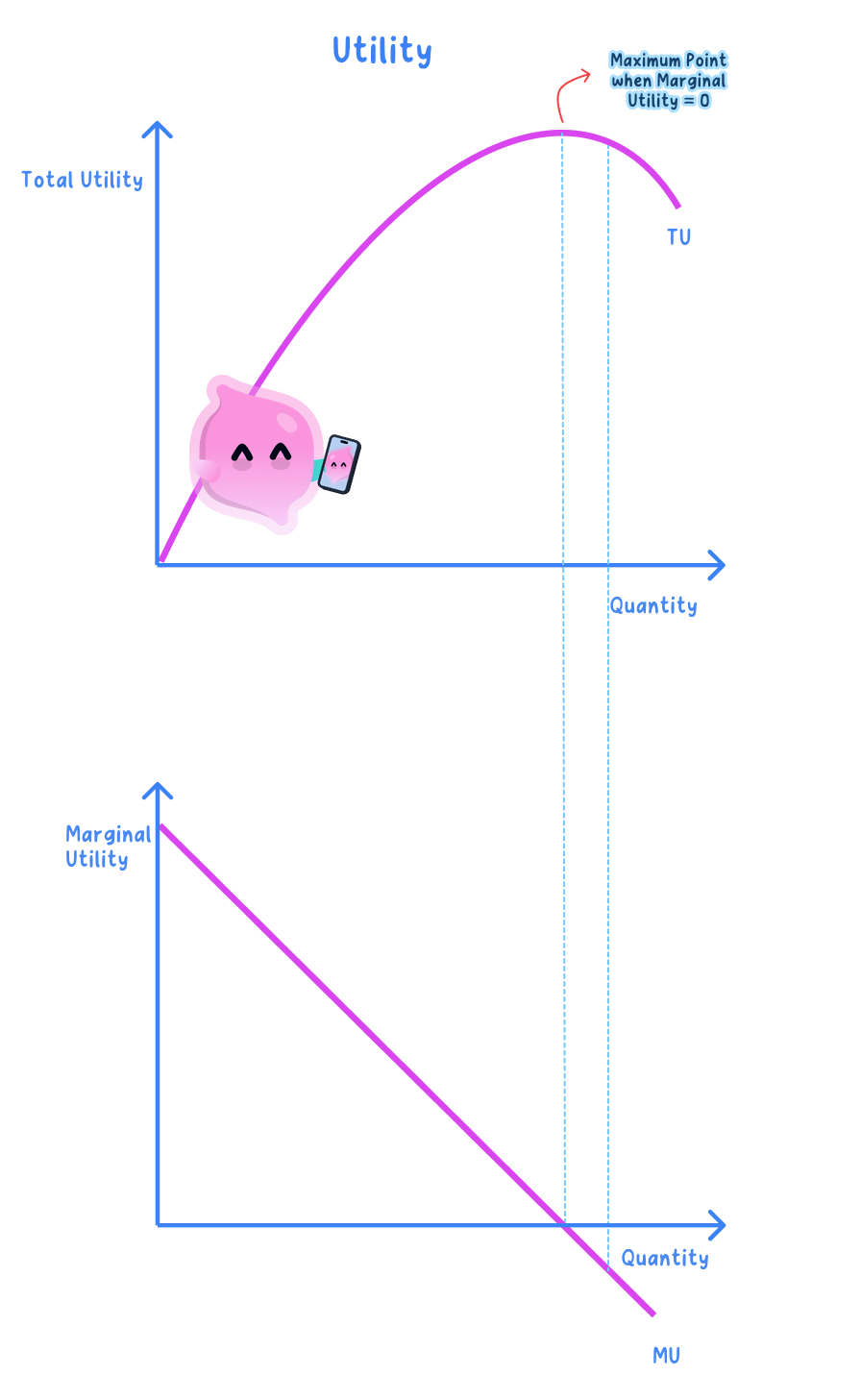
- In a utility schedule the marginal utility figures get smaller down the column.
- Plotted on a diagram, the marginal utility curve slopes downward.
- Total utility still rises while marginal utility is positive (+), but by smaller steps.
- Total utility flattens as marginal utility approaches 0.
Note
- On a hot day the first glass of water gives about 12 utils.
- The second adds only 8 utils and the third only 5 utils.
- So the same good brings less at the margin as more is drunk.
Why total utility keeps rising
- A falling marginal utility is still a positive (+) addition to total utility.
- Total utility therefore keeps rising as long as marginal utility is above 0.
- Total utility falls only once marginal utility turns negative (−).
- So diminishing marginal utility does not mean falling total utility; it means total utility rises more slowly.
Exam technique
- State that marginal utility falls as consumption rises.
- Illustrate with a schedule or a downward-sloping marginal utility curve.
- Stress that total utility still rises while marginal utility is positive.
Common Mistake
- Do not claim total utility falls as soon as marginal utility falls.
- Total utility falls only when marginal utility becomes negative (−).
Self review
- What is diminishing marginal utility?
- Which unit gives the most satisfaction, and why?
- What happens to marginal utility as consumption rises?
- Why does total utility keep rising at first?
- When does total utility fall?
