Tools of protection
Definition
Tariff: a tax imposed on imported goods that raises their price in the domestic market.
Import quota: a legal limit on the physical quantity of a good that may be imported over a given period.
Export subsidy: a government payment to domestic producers that lowers the price of the goods they sell abroad.
Embargo: a complete ban on trade in a particular good or with a particular country.
Excessive administrative burdens ('red tape'): rules, paperwork and standards deliberately used to raise the cost and difficulty of importing.
Key Idea
- A tariff raises the price of imports, cuts the quantity imported and earns the government revenue.
- A quota limits quantity directly and hands the scarcity gain to licence holders, not the state.
- Every tool distorts prices and tends to create a deadweight welfare loss.
The main instruments
- A tariff adds a fixed sum or a percentage to each imported unit, so buyers face a higher price and switch towards home goods.
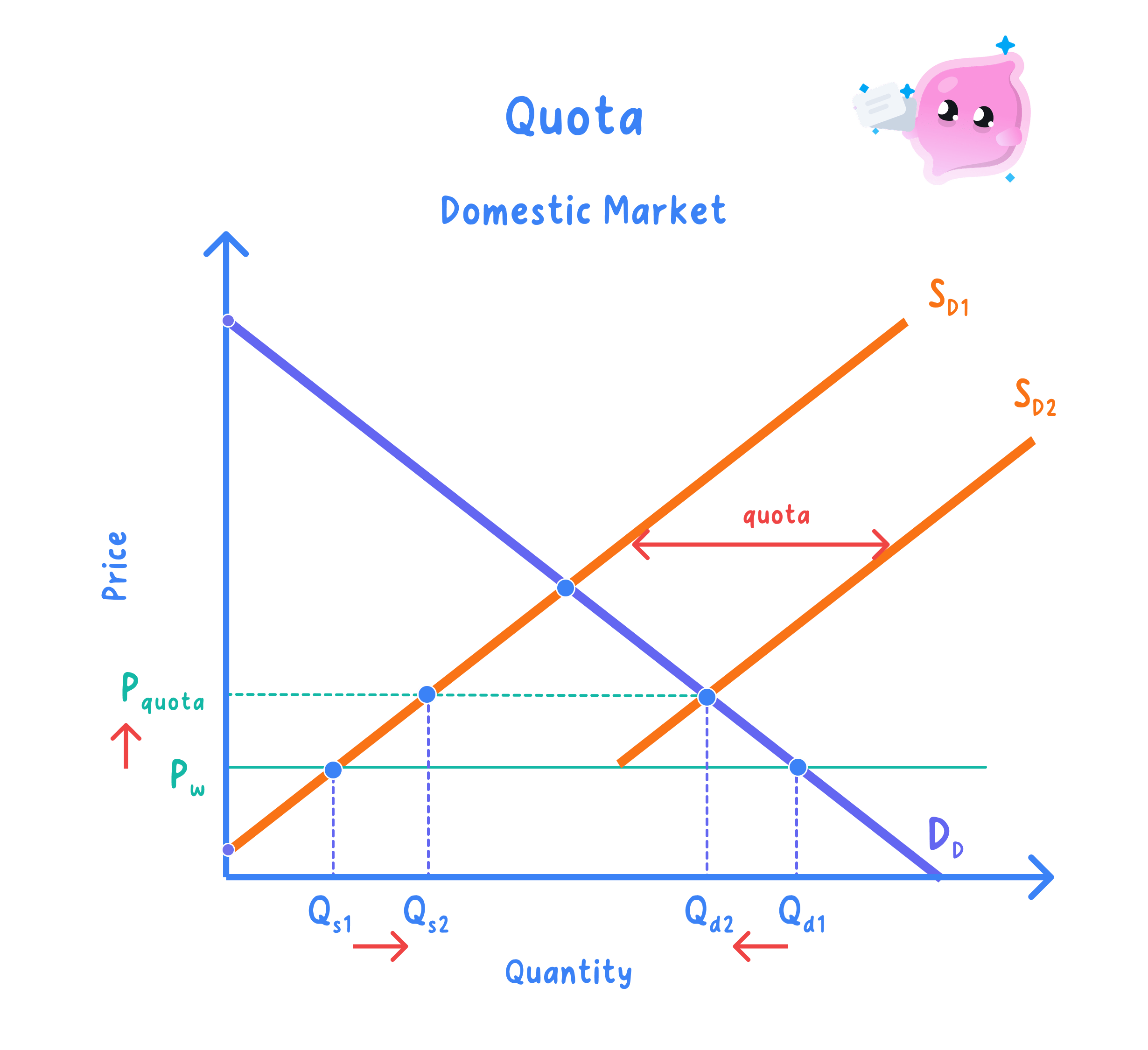
- A quota caps the volume allowed in, so scarcity pushes the price up until demand matches the permitted supply.
- An export subsidy cuts exporters' costs, letting them undercut rivals abroad and win market share.
- An embargo bans trade outright, usually for political or security reasons.
- Red tape uses safety, labelling or licensing rules to make importing slow and costly.
A tariff in numbers
- At the world price of £10 the country can import freely.
- At £10 home firms supply 40 units and consumers demand 100 units, so imports are 60 units.
- A tariff of £2 per unit raises the domestic price to £12.
- At £12 home supply rises to 50 units as production becomes more profitable.
- At £12 consumer demand falls to 90 units as the good is now dearer.
- Imports are the gap between demand and home supply, so they fall from 60 to 40 units.
Example
- A good imported at a world price of £10 faces a specific tariff of £2 per unit, a 20% tax on the import price, and 40 units are still imported.
- The £2 tariff lifts price to £12, raises home supply 40 → 50, cuts demand 100 → 90 and imports 60 → 40, so the government collects £80 while consumers pay more.
Reading the tariff diagram
- Put price on the vertical axis and quantity on the horizontal axis.
- Add the downward-sloping domestic demand curve and the upward-sloping domestic supply curve.
- Draw a horizontal world price line at £10, the price under free trade.
- The tariff lifts the effective price line up to £12, a higher horizontal line.
- Domestic quantity supplied rises along the supply curve from 40 to 50 units.
- Domestic quantity demanded falls along the demand curve from 100 to 90 units.
- Imports shrink to the narrower gap between demand and supply at the higher price.
- Government revenue is the rectangle equal to the £2 tariff × the 40 units still imported.
- Two welfare loss triangles remain, one from less efficient extra home production and one from lost consumption.
Note
- Under a tariff the revenue rectangle is captured by the government.
- Under a quota the same price rise occurs, but the scarcity gain goes to importers rather than the state.
- Both measures leave the two deadweight welfare loss triangles.
Impact and effectiveness of each tool
- A tariff raises price, cuts imports and gives the government revenue, but raises costs for consumers and import-using firms.
- A quota raises price and cuts imports but hands the extra revenue to whoever holds the import licences.
- An export subsidy expands domestic exports but costs taxpayers and can distort world prices.
- An embargo stops trade entirely, achieving its aim but often raising domestic prices sharply.
- Red tape restricts imports quietly and can be hard for trading partners to challenge.
- How much a tariff or quota actually cuts imports depends on the price elasticity of demand for imports: if import demand is inelastic (few close home substitutes), a tariff mainly raises prices and revenue while imports barely fall, so it protects domestic producers only weakly.
- Effectiveness also varies over the time horizon: protection can shelter output and jobs in the short run, but over time sheltered firms may lose the incentive to cut costs and innovate, and trading partners can retaliate, which cancels export gains and can leave the economy worse off.
Example
- Many economies place tariffs on imported steel so home mills keep sales as the import price is forced up.
- Some cap textile imports with quotas, so scarcity lifts the price and shelters local clothing producers.
- Others subsidise farm exports so domestic growers can undercut rivals on world markets.
Tariff versus quota
- Both raise the domestic price and reduce the quantity imported.
- A tariff earns the government revenue, whereas a quota does not.
- Under a quota the extra revenue from higher prices accrues to importers holding licences.
- So the tools differ mainly in who captures the gain from the higher price — though it depends on how the quota licences are allocated.
Is any single tool of protection clearly the best?
- In favour of the tariff, it raises the domestic price, cuts imports and hands the government revenue that can fund retraining or offset the consumer loss, which a quota or red tape cannot do.
- Against every tool, each still leaves the two deadweight welfare loss triangles, invites retaliation and raises costs for consumers and import-using firms, so protection is rarely costless whichever instrument is chosen.
- The best tool depends on the aim: an embargo suits a security goal, an export subsidy targets foreign markets, and red tape is hard for partners to challenge, so effectiveness is judged against the objective, not in the abstract.
- On balance a tariff is often the least distorting choice because the revenue stays at home rather than accruing to licence holders, but which tool is best depends on the policy objective, the elasticity of demand and the risk of retaliation.
Exam technique
- Draw the tariff diagram and label the world price, the tariff, imports, the revenue rectangle and the welfare loss.
- Show that a quota raises price like a tariff but yields no government revenue.
- Always link each number back to its economic meaning.
Common Mistake
- Do not omit the two deadweight welfare loss triangles from the tariff diagram.
- Do not claim a quota raises government revenue, as the gain goes to licence holders.
Self review
- Define a tariff and an import quota.
- In the worked example, what happens to imports when the £2 tariff is added?
- How is tariff revenue calculated?
- Define an export subsidy and an embargo.
- Why does a quota yield no government revenue?
