Fixed and managed rates
Definition
Fixed exchange rate: a system in which the currency is pegged at an official value and the central bank acts to hold it there.
Managed float (dirty float): a system in which the currency floats on the market but the central bank intervenes to steer it towards a target or band.
- Under a managed float, sometimes called a dirty float, the rate floats but the central bank intervenes to influence it.
- In both systems the rate is set partly by policy, not by market forces alone.
Key Idea
- A fixed rate is pegged at an official level and defended by the central bank.
- A managed float moves with the market but is nudged towards a target or band.
- Both rely on foreign-exchange reserves and interest rate changes.
How a fixed rate is maintained
- The rate is driven by the demand for and supply of the currency in the foreign-exchange market.
- To stop the currency falling, the central bank buys its own currency using foreign-exchange reserves.
- To stop the currency rising, it sells its own currency and builds up reserves.
- It can also raise interest rates to attract capital inflows, which adds to demand for the currency.
Example
- To hold the peg the central bank must buy an excess supply of $10bn of its currency each month.
- Reserves used over 6 months = $10bn × 6 = $60bn
- Reserves are finite, so persistent one-way pressure of $60bn over six months can make the peg impossible to defend.
Intervention on a diagram
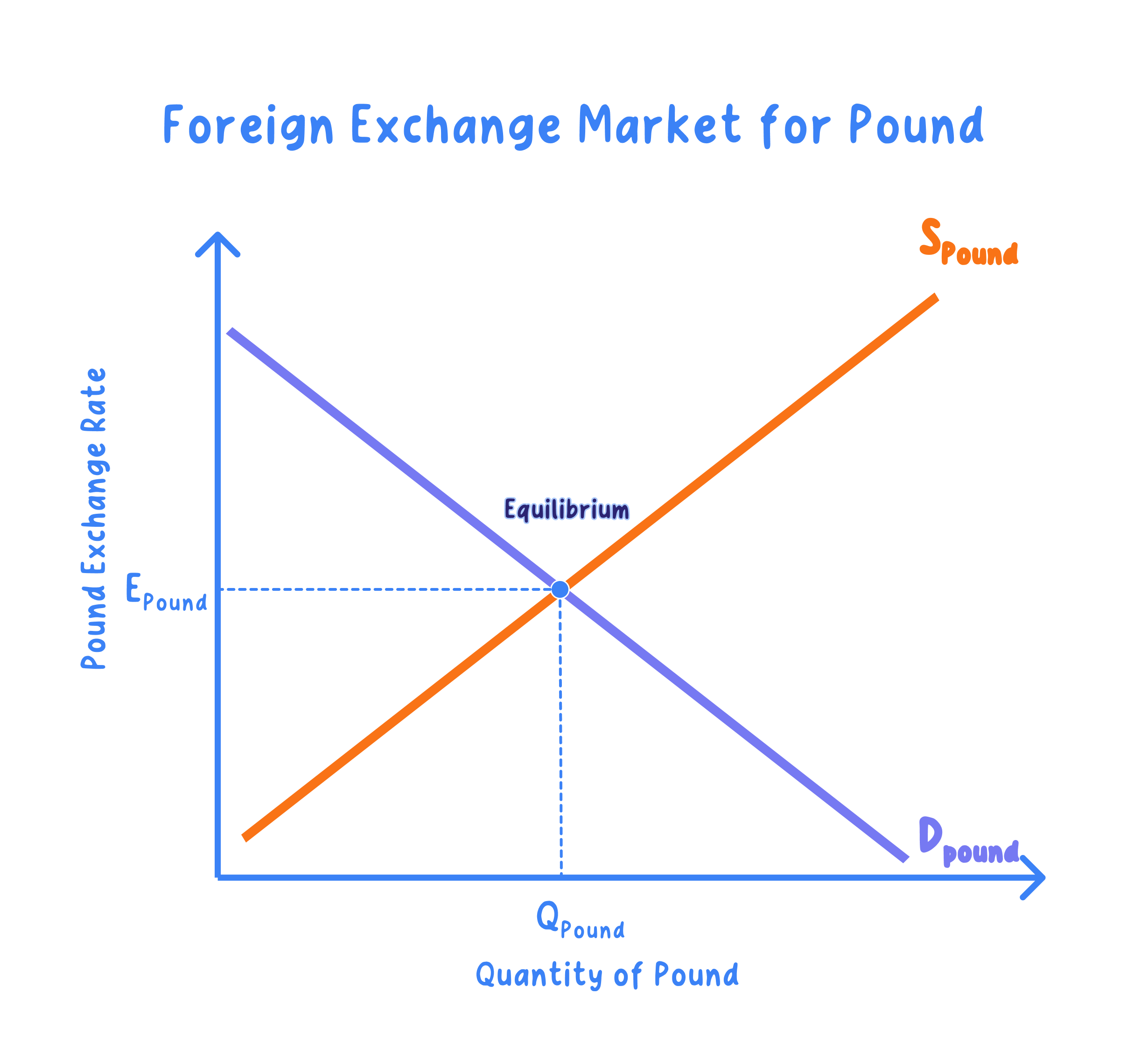
- On the diagram the exchange rate is on the vertical axis and the quantity of the currency on the horizontal axis.
- The free-market rate is where the demand for and supply of the currency cross.
- If the free-market rate would sit below the peg, there is an excess supply of the currency.
- The central bank buys that excess supply itself, adding to demand to hold the rate at the peg.
How a managed float works
- The rate is largely set by market forces, but the central bank intervenes when it chooses.
- It may keep the rate within a target band rather than at a single value.
- Intervention smooths short-term volatility and leans against large swings.
Note
- A managed float sits between a pure float and a hard peg.
- It keeps some exchange-rate stability while allowing gradual adjustment.
Over- and under-valued currencies
Definition
Over-valued currency: a currency held above the rate that demand and supply would set, making exports uncompetitive.
Under-valued currency: a currency held below the rate that demand and supply would set, making exports artificially cheap.
- An over-valued rate makes exports dear and can worsen the current account.
- Holding a rate below its market level leaves the currency under-valued.
- An under-valued rate supports exports and a trade surplus but can add to inflation.
Example
- China, for much of the 2000s, deliberately held the yuan below its market rate to support its exporters.
- This built up very large foreign-exchange reserves over time, which passed $3 trillion.
- It also brought accusations of currency manipulation from trade partners such as the United States.
Limits of intervention
- A fixed rate gives certainty for trade and investment but ties up reserves and limits monetary policy.
- Reserves are finite, so a rate held far from its market level can become impossible to defend.
- Defending a rate with high interest rates can conflict with domestic goals such as growth and jobs.
- A managed float is more flexible but needs ongoing intervention and can still be volatile, so the right choice depends on the economy's priorities.
Exam technique
- State whether the system is fixed or managed before explaining how the rate is set.
- Explain the central bank's tools: buying or selling reserves and changing interest rates.
- Stress that defending a rate can drain reserves and become unsustainable.
- Note the conflict between defending the rate and domestic policy.
Common Mistake
- Do not assume a fixed rate is unchanging; it is held by active intervention and can still be revalued or devalued.
- Do not assume a central bank can hold a rate away from its market level indefinitely, since reserves are finite and intervention has real costs.
Self review
- How does a central bank maintain a fixed exchange rate?
- What is a managed (dirty) float?
- How can interest rates be used to defend a currency?
- What is the difference between an over-valued and an under-valued currency?
- Why can defending a fixed rate become unsustainable?
